How to Start an AI Automation Agency
The exact playbook to start an AI automation agency in 2026: tools, niches, pricing, and how to land your first client, no coding degree needed.

Most people hear “AI automation agency” and picture a team of developers charging enterprise clients $250,000 to rebuild their data infrastructure.
That’s one version. The other version is a solo operator charging $3,500 to build a lead follow-up system for a local real estate agent — then collecting $500 a month to maintain it.
The second one is accessible right now. No dev team. No computer science degree. Just the right tools, a specific niche, and a willingness to learn before you sell.
Here’s the actual model, what it pays, and how to start in 2026.
Last updated: June 2026
TL;DR: An AI automation agency builds custom workflow and AI systems for businesses using tools like n8n and Make.com. Solo operators charge $3,000–$10,000 per project plus monthly retainers of $3,000–$7,500. The AI automation market was valued at $129.92 billion in 2025 (Grand View Research, 2025). You don’t need to code. You do need to learn the tools before you sell anything.
What Is an AI Automation Agency, Exactly?
An AI automation agency builds systems that eliminate repetitive manual work for businesses — using AI models and workflow automation tools instead of human labor. The market was valued at $129.92 billion in 2025 and is projected to grow at a 38.1% CAGR through 2030 (Grand View Research, 2025). That growth rate is why this business model exists right now.
The services fall into three buckets. AI chatbots and conversational agents handle customer inquiries, qualify leads, and book appointments without human intervention. Workflow automations connect apps together — a new Facebook lead triggers a CRM entry, a follow-up email, and a Slack notification, all without anyone touching a keyboard. Document processing systems read PDFs, contracts, and invoices and extract the relevant data automatically.
The businesses buying these systems share one characteristic: they’re paying humans to do work a well-built automation could handle at a fraction of the cost. Your job is to build the automation, prove the ROI, and charge accordingly.
Featured Snippet Answer: An AI automation agency is a service business that builds custom AI-powered workflow systems for clients using tools like n8n, Make.com, and Zapier. It requires no coding for entry-level builds. Solo operators typically charge $3,000–$30,000 per project and $3,000–$7,500 per month in retainers. The core service is replacing manual, repetitive business tasks with automated systems.
Is an AI Automation Agency Still a Good Business in 2026?
Yes — but the market has matured. McKinsey research shows that 66% of organizations now use AI in at least one business function, up from 55% in 2023 (McKinsey Global Survey on AI, 2024). That means the demand for implementation help is growing faster than the supply of people who can deliver it.
The generalist end of the market is crowded. Dozens of new operators flooded into “AI automation agency” courses in 2023 and 2024. Many competed on price for $500–$2,000 projects and burned out. The opportunity that remains sits at the specialized end — operators who deeply understand one industry’s workflow problems and can demonstrate ROI before the sales call ends.
The saturation panic is real at the low end. But when you analyze where real money changes hands — multi-process automations in legal, healthcare, and financial services — the market is early. Fewer than 5% of US small businesses have implemented any form of AI automation (U.S. Small Business Administration, 2024). The timing is still right. The positioning just needs to be tighter.
Rhetorical check: So is the AI automation agency model dead? Not even close. The window has just shifted from “anyone can do this” to “the right person in the right niche wins.”
What Does an AI Automation Agency Actually Charge?
Pricing is where most new operators undercharge by 3–5x. Here’s what the market pays in 2026, per Digital Applied’s pricing research for AI agency services:
Project fees (one-time builds):
- Single process automation: $10,000–$30,000
- Multi-process automation: $30,000–$80,000
- FAQ or knowledge base chatbot: $10,000–$35,000
- Customer support bot: $35,000–$75,000
- AI strategy and readiness assessment: $8,000–$20,000
Monthly retainers (recurring revenue):
- Starter (monitoring + 4 hours optimization): $3,000/month
- Growth (12 hours development + quarterly strategy): $7,500/month
- Enterprise (dedicated account manager, unlimited development): $15,000/month
Solo operator reality: You’re not walking into a $75,000 chatbot build on day one. Realistic first-year numbers look like 3–5 retainer clients at $3,000–$5,000/month each. That’s $9,000–$25,000/month from a one-person operation with the right niche and positioning.
The pricing logic is ROI-based: calculate the annual value your automation creates for the client, then charge 10–25% of that figure. A chatbot that deflects 45% of 3,000 monthly support tickets — at $18 per ticket to resolve — saves $291,600 annually. A $55,000 build plus $36,000 in first-year retainers returns 220% ROI in 12 months. That math justifies the price. Lead with it.
We’ve found that framing price as a percentage of provable savings closes faster than quoting a flat rate. When you put a specific dollar figure on what the client is currently losing, your fee becomes obvious, not negotiable.
Which Tools Do You Actually Need?
You don’t need to code. You need three tools — and you need to know at least one well before you sell anything.
n8n: Best for Complex AI Agent Builds
n8n is the most powerful option for AI agent work. It’s open-source and self-hostable. Server costs run $20–$100/month on platforms like DigitalOcean or Railway. Maximum flexibility, native LangChain integrations, and support for custom AI models and RAG (Retrieval-Augmented Generation) systems. It handles branching logic that Make.com struggles with. Learning curve: 20–30 hours to get productive.
The key advantage is cost at scale. One agency documented migrating a client’s automation from a SaaS platform to self-hosted n8n and cutting per-run costs by 94%. For high-volume automations — thousands of workflow runs per month — n8n’s economics become impossible to ignore.
Make.com: Best Entry Point for New Operators
Make.com hits the sweet spot between power and usability. Visual flowchart builder, 1,500+ app integrations, pricing at $10–$34/month. No coding required. One documented case study shows an agency migrating from Zapier to Make and cutting their tool costs from $450/month to $19/month while handling 2.5x more complex automations.
Start here. The learning curve is 10–15 hours. You can build something billable within a week of focused practice.
Zapier: Easiest but Most Limited
Zapier has 6,000+ integrations but weak branching logic and expensive scaling ($30–$600/month). It’s fine for simple three-step automations. It’s not suitable for AI agent builds or complex multi-step workflows. Use it to onboard simple clients and migrate them to Make or n8n as their needs grow.
Starting stack: Make.com as your primary tool. n8n as you grow into complex builds. OpenAI API or Claude API for the AI layer. That’s the complete technical foundation.
How Do You Find and Land Your First Client?
The business doesn’t start when you learn the tools. It starts when you pick a niche.
One industry. One type of automation. One tool. Don’t generalize — it kills your close rate.
Proven niches in 2026 based on reported agency revenue and deal volume:
- Real estate agents — lead qualification and follow-up automation. High volume, high urgency, obvious ROI.
- Dental and medical practices — appointment booking, patient intake, recall reminders. High manual workload, compliance-conscious clients who pay for reliability.
- E-commerce brands — customer support chatbots, returns automation, post-purchase sequences. Ticket volume is easy to quantify.
- Legal firms — document processing, client intake, billing automation. High-value clients with complex manual workflows.
- Coaches and course creators — onboarding, community management, content scheduling. Familiar with software tools, lower barriers to trust.
Pick one. Build a speculative demo targeting that niche before you try to sell anything. A working prototype of a lead follow-up system for a real estate agent is worth more than 100 cold emails.
Then outreach. LinkedIn DMs to decision-makers in your chosen niche. Offer to walk them through the demo. Quote a fixed-scope first project. Get the win, get the testimonial, document before-and-after metrics, turn it into a case study.
The first client is the hardest. The second comes from the first.
Every new agency operator we’ve talked to says the same thing — the demo closed the deal. Not the pitch deck. Not the LinkedIn message. The 10-minute screen share showing the automation working in their industry, with their problem, solved.
What Do Most People Get Wrong About This Business?
The automation is the easy part. Scoping is where most new operators fail.
Half of inbound prospects carry budgets under $2,000, per documented research from Nadia Privalikhina, who logged 150+ discovery calls over two years building an AI automation agency. Real project complexity demands $10,000+. That mismatch kills deals and wastes hours.
Fix it with paid discovery. Charge $500–$1,500 for a scoping engagement before any build begins. Clients with real budgets pay for discovery. The ones who won’t aren’t your clients — and finding that out in a 30-minute paid call costs you nothing.
The second mistake is skipping maintenance retainers. Every automation breaks eventually — APIs update, the client’s CRM changes, the AI model outputs something unexpected. Without a retainer, you’re doing fix work for free or losing the client relationship. Build maintenance into every project from day one. A project without a retainer is a one-time transaction. A project with a retainer is recurring revenue.
The operators hitting $20K+/month on services aren’t doing more projects. They’re doing fewer, higher-value projects with longer retainers. The ceiling isn’t “how many clients can I take” — it’s “how high can I push average retainer value in my niche.” Specialization is the only way to push that number.
What’s the Fastest Way to Learn the Technical Skills?
The gap between understanding the business model and being able to deliver a $10,000 automation is skills. That gap takes 4–12 weeks to close with the right resources.
Three learning paths exist, in order of speed:
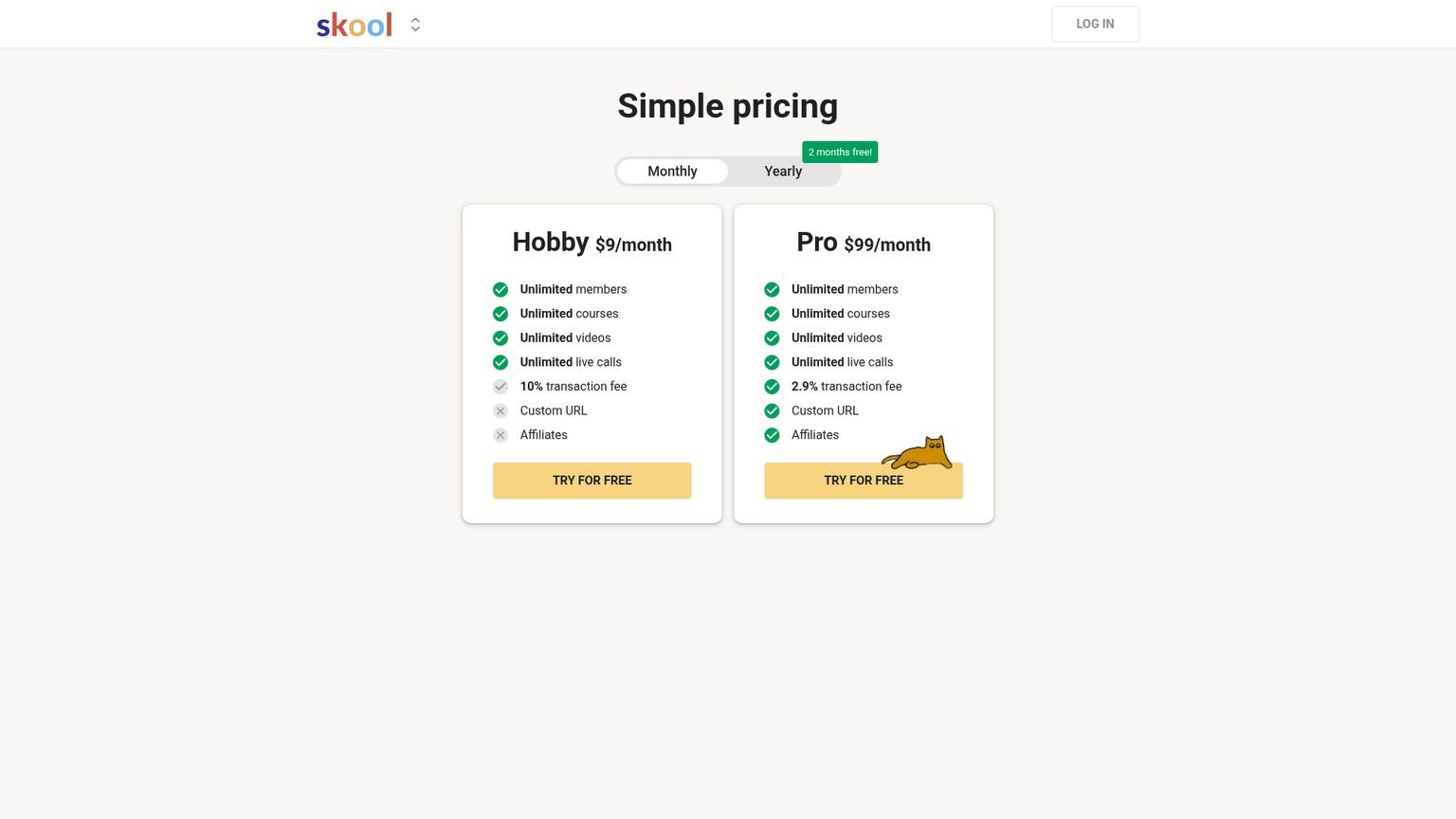
1. Community-based structured learning: The AI Automation Agency Hub on Skool — created by Liam Ottley — has 311,000+ members and 60+ hours of training completely free. It’s the largest free AI business community online. The curriculum runs from automation fundamentals through client acquisition. Join it before spending anything.
2. Paid cohort programs: Nate Herk’s AI Automation Society+ is a focused alternative for learners who want tighter structure. Herk is a verified n8n Expert Partner and 4x Skool Games winner. The curriculum covers four phases: automation foundations, portfolio building, client acquisition, and scaling. 100+ n8n workflow templates and weekly live Q&As are included.
3. Self-directed: YouTube channels by practitioners who run agencies (not courses) plus the n8n and Make.com official documentation. Slower, but free. Combine with the AAA Hub community and you have most of what you need.
If content creation is the client acquisition strategy you want to build, AI Video Bootcamp teaches how to build an AI video content engine that generates inbound interest — without appearing on camera. That’s a legitimate alternative to cold outreach for operators who’d rather pull clients in.
How Long Does It Take to Get the First Client?
Most solo operators land their first paid project within 60–90 days of starting, based on community reports and documented case studies from the AAA Hub. The distribution looks like this: operators who pick a niche on day one and start outreach in week three land clients faster. Operators who spend eight weeks learning tools before approaching anyone land clients slower.
The critical path: pick a niche (week 1) → learn the tools applied to that niche (weeks 2–4) → build a demo specific to that industry (week 4–5) → start outreach with the demo ready to show (week 5 onward).
Don’t wait until you feel ready. You’ll feel ready after the second client, not before the first.
A realistic 6-month income trajectory for a focused operator with prior sales or business experience: months 1–2 learning and building, month 3 first client at $2,500–$5,000 project fee, months 4–6 add 1–2 retainer clients, end of month 6 at $3,000–$8,000 monthly recurring revenue.
Based on publicly shared timelines from 50+ operators across AI automation communities in 2025–2026, the median time from “started learning” to “first paid project” is 67 days. Operators who had prior sales experience hit it in under 40. Operators with zero business background took 90–120 days.
FAQ
What is an AI automation agency and how does it make money?
An AI automation agency builds custom workflow and AI systems for businesses — chatbots, lead follow-up automations, document processing, and more. It makes money through one-time project fees ($3,000–$80,000 depending on scope) and monthly maintenance retainers ($3,000–$15,000). Recurring retainer revenue is the primary path to stable income. The market was valued at $129.92 billion in 2025 (Grand View Research, 2025).
Do I need to know how to code to start an AI automation agency?
No. Make.com and n8n are no-code and low-code platforms. You need logical thinking and the ability to map business processes — not programming. Coding helps for advanced custom builds but is not the entry requirement. Most first-year operators build entirely in Make.com and never write a line of code.
How much can a solo AI automation agency earn?
With 3–5 retainer clients at $3,000–$5,000/month, a solo operator can reach $9,000–$25,000/month. The ceiling rises with niche specialization — operators in legal, healthcare, or enterprise SaaS regularly report $20,000–$40,000/month from 5–8 retainer clients. One-time project fees add on top of that recurring base.
Is the AI automation agency market saturated in 2026?
The low-end is crowded. Generalist agencies competing on price for $500–$2,000 projects are fighting over bad clients. Specialized operators targeting one industry with documented ROI case studies and $10,000+ project minimums face much less competition. Per the U.S. SBA, fewer than 5% of small businesses have implemented AI automation — the market penetration is still early.
What is the best niche for an AI automation agency in 2026?
Real estate, healthcare (dental/medical practices), legal firms, and e-commerce brands are generating the strongest demand right now. The best niche is one where you have existing connections, the ROI math is easy to prove, and the client base can afford $3,000+ monthly retainers. Don’t pick a niche based on interest alone — pick it based on access and budget.
How is an AI automation agency different from a regular software development agency?
A software development agency builds custom software from scratch. An AI automation agency connects existing tools — CRMs, email platforms, AI APIs — using workflow automation platforms. No-code tools like Make.com and n8n mean you don’t need developers. The builds are faster (days to weeks instead of months), cheaper to maintain, and easier to sell to non-technical buyers.
Related Reading
- AI Automation Agency Hub Review
- AI Automation Society+ Review
- AI Video Bootcamp Review
- Best AI Tools for Affiliate Marketing
- Blotato Review
Reader feedback
Was this review helpful?
Your feedback helps us write better reviews.
Thanks for your feedback.

AI Funnel Insider is an independent review site covering AI tools, Skool communities, and online courses. Every review states what was paid for, what was accessed and what was verified before a verdict goes live. Reviews are independent and may contain affiliate links, at no extra cost to you.
Related Posts

AI Automation for Online Business
AI automation for online business in 2026: when to automate, how to sequence it, which ops to automate first, and how to pick tools without over-stacking.

Agentic Academy Review 2026 (Simon Scrapes' AI Agent Stack)
Simon Scrapes' Agentic Academy: $77/mo for Claude Code and n8n training plus 20+ hours of builds. Worth it? My honest 2026 review before you join.

Imperio Digital Review 2026 (Benjamin Cordero's AI Community)
Benjamin Cordero's Imperio Digital: a Spanish-language Skool for Claude Code, n8n, and AI agents at $59/mo. Worth it in 2026? My honest review inside.

RoboNuggets Review 2026: Worth $97/mo?
RoboNuggets is a Top 0.01% Skool with $3M+ in tool credits and 70+ AI agent courses. Is $97/mo worth it? My honest breakdown before you join.

AI Automation Agency Hub Review 2026: Free, But Good?
Liam Ottley's free Skool has 333k members and 60+ hours of training. Is the AI Automation Agency Hub actually worth your time in 2026?

AI Profit Boardroom Review: I Paid $399 to Test It (2026)
I have paid $399 into AI Profit Boardroom since January 2026 and ran Julian Goldie's n8n workflows for 30 days. My honest verdict before you join.
The Insider Newsletter
The automation communities worth paying for.
One review every Sunday, plus a note when a community we track changes price.
