AI for Non-Techies Review 2026 (Brock Mesarich's Beginner AI Track)
Brock Mesarich's AI for Non-Techies: $67/mo, 50+ Claude Skills, beginner-friendly. Worth it for non-coders in 2026? My honest review before you join.

Genuinely beginner-friendly — zero coding required for any workflow
$67/month is steep for anyone still deciding whether AI belongs in their workflow
Last updated: June 2026
best AI communities for beginners
We dug into AI for Non-Techies across Brock Mesarich’s YouTube channel, the public Claude Skills library details, and community discussion threads. Here’s the honest verdict: this is one of the few AI communities where the “beginner-friendly” claim isn’t just marketing copy. Skool passed 1 million members in 2024 (Skool, 2024), and the AI education segment is now one of its fastest-growing categories. This community sits squarely in that wave.
TL;DR: AI for Non-Techies costs $67/month and is built around a weekly Claude Skills library for non-technical operators. With 801 members and 50+ skills as of April 2026, it’s one of the most beginner-accessible Claude-focused communities on Skool. Best for solopreneurs and small business owners. Skip if you’re already technical or want broad AI coverage beyond Claude.
Quick Decision
Join if: You’re a non-technical solopreneur, creator, or small business owner who wants to build real Claude workflows — not just watch tutorials. The Claude Skills library alone accelerates the learning curve by weeks.
Skip if: You’re already comfortable with AI APIs, you want coverage of tools beyond Claude, or $67/month feels experimental for your current stage. Start with Brock’s free YouTube channel and come back when you’re ready to go deeper.
Skool platform review
Who Is AI for Non-Techies For?
This community is built specifically for people who feel locked out of AI because they can’t code. According to a 2024 McKinsey survey, 72% of companies have adopted AI in at least one business function (McKinsey & Company, 2024), yet the majority of educational content still assumes technical fluency. AI for Non-Techies fills that gap.
The right person for this community is someone who already uses AI tools occasionally — maybe opens ChatGPT a few times a week — but hasn’t built anything systematic yet. They’re not a developer. They’re an operator: a freelancer, a coach, a small agency owner, or a content creator who wants AI to handle the repetitive parts of their business.
Best fit profiles:
- Small business owners wanting to automate without hiring
- Content creators ready to build repeatable workflows, not just one-off prompts
- Non-technical solopreneurs who keep hearing about Claude Code but can’t find a starting point
- Anyone whose current AI use is “I open ChatGPT sometimes” — and they know that’s not enough
Not a fit for:
- Developers already comfortable with Claude’s API and command line tools
- Anyone wanting broad coverage of ChatGPT, Gemini, n8n, or open-source models
- Early-stage experimenters who aren’t yet sure AI belongs in their workflow
Claude vs ChatGPT for non-technical users
What Is AI for Non-Techies? (Background)
AI for Non-Techies is a paid Skool community created and run by Brock Mesarich. It launched as the paid extension of Brock’s YouTube channel, which has grown past 100,000 subscribers on the back of practical Claude tutorials targeted at people without coding backgrounds.
The premise is direct: most AI education is built for people who are already technical. Brock teaches the same workflows, but removes every barrier that requires technical knowledge. No API keys explained to beginners. No “just run a Python script.” Instead: here’s the button, here’s the outcome, here’s how to adapt it to your business.
The community is hosted on Skool, which means members get a community feed, a classroom for structured courses, and a calendar for live events — all under one roof. As of April 2026, the community has approximately 801 paid members.
The Skool about page for AI for Non-Techies has notably clean positioning. There’s no promise of six figures or passive income. The hook is simpler and more honest: “learn to use AI without needing to be technical.” That restraint signals a community built for actual learning rather than hype.
Pricing: What Does AI for Non-Techies Cost?
AI for Non-Techies costs $67/month on the standard monthly plan, or approximately $45/month when billed annually (roughly $540/year). According to Skool’s published pricing data, communities on the platform set their own membership rates (Skool, 2024).
The $67/month monthly price sits in the mid-range for AI Skool communities. For context, communities like AI Video Bootcamp charge $9/month at scale, while communities with more intensive coaching components charge $100-$200/month or more. The annual plan discount of roughly 33% is meaningful — if you plan to stay four or more months, it’s worth committing upfront.
| Plan | Price | Annual Cost | Best For |
|---|---|---|---|
| Monthly | $67/month | $804/year | Testing before committing |
| Annual | ~$45/month | ~$540/year | Anyone staying 4+ months |
One note on pricing: Brock has signaled that the price will increase at specific member milestones. The community was approaching 770 members when the original pricing was set. Check the current rate on the Skool page before joining — what you see at signup is what you lock in.
Skool community pricing comparison
What’s Inside the Community?
The Claude Skills Library
This is the core differentiator. Most AI communities sell “frameworks” or “templates” — which are usually just renamed prompts. The Claude Skills library contains actual functioning skill files you can drop into Claude Code or Claude Cowork and use immediately.
Skills cover a wide range of tasks: research compilation, content drafting, email management, social media scheduling, and more. The library had 50+ skills as of April 2026, with new ones added most weeks. The weekly cadence matters. AI moves fast. A skill built for Claude’s capabilities in January 2025 may be outdated by April 2026. The weekly refresh keeps the library current.
The real value of the Skills library isn’t any individual skill. It’s the accumulation effect. After 30 days, you have 4-8 new skills in your workflow. After 90 days, you have a personal AI toolkit that compounds. Members discussing the community online often report that their biggest “aha” moment came when they realized they could chain multiple skills together into a full workflow.
Resource Vault
Every link, tool, and template Brock references in his YouTube videos is organized in the resource vault. If you’ve ever paused a YouTube video to write down a URL, this is the fix. It’s a searchable database tied to specific videos, which makes it far more useful than a generic “tools list.”
Full Courses
The community includes structured courses on Claude Code, Claude Cowork, and general AI workflows. These aren’t one-off video drops — they’re organized curriculum with a clear progression from beginner to intermediate. The courses aren’t as extensive as a standalone video course, but they’re more than enough to get a non-technical person operational within a week.
In-Depth Breakdowns
These are the explanations that didn’t fit into Brock’s 12-minute YouTube format. For any workflow or skill where the “why” matters, the in-depth breakdowns fill in the context. This is where members who want to understand the logic — not just follow steps — get the most value.
Community Feed
The community feed is where members post wins, ask questions, and share how they’ve adapted skills to their own use cases. With ~800 members, it’s smaller than mega-communities but more personal. Response times from Brock and the team are generally under 24 hours based on visible thread activity.
Who Is Brock Mesarich?
Brock Mesarich built a YouTube channel with 100,000+ subscribers focused exclusively on practical AI for non-developers. His most-watched videos cover Claude Cowork, Claude Skills, and how he runs his business using AI without a technical team.
What makes him credible isn’t the subscriber count — it’s that he’s an actual practitioner. According to statements Brock has made publicly on YouTube and in the community, he runs a business generating significant monthly revenue using the exact AI stack he teaches. He’s not a tech educator who learned AI to teach it. He built a business first, then documented the system.
That distinction matters enormously in the AI education space. Most “AI for beginners” content is created by people whose primary product IS the AI course. Brock’s content has the texture of someone who uses these tools daily and teaches from firsthand experience — which is why the instructions are so specific and the edge cases are actually addressed.
A 2023 Edelman Trust Barometer study found that 63% of consumers trust content from practitioners over generalists (Edelman, 2023). Brock’s practitioner positioning is a meaningful trust signal.
how to evaluate AI educators
Community and Engagement
With 801 members as of April 2026, AI for Non-Techies is small by Skool standards — communities like AI Video Bootcamp have 18,000+ members. That size has trade-offs in both directions.
On the positive side: smaller communities have higher signal-to-noise ratios. You’re not scrolling past hundreds of low-effort posts to find useful discussions. When someone posts a question, they’re more likely to get a direct, useful answer rather than generic encouragement.
On the negative side: peer expertise is thinner. If you have a highly specific question about applying Claude Skills to a niche use case, you may be waiting for Brock to respond rather than getting an answer from another member who’s already solved the same problem. That gap is more pronounced in a community of 800 than in one of 8,000.
Based on observable thread activity from publicly visible Skool posts, Brock personally responds to the majority of community questions within 24 hours. That response rate is unusually high for a community of this size — most community founders pull back as the platform scales.
Response cadence matters because AI for Non-Techies covers a fast-moving tool (Claude) where the right answer in February may be the wrong answer by April. Direct access to the person who actually knows how the current version of Claude behaves is a genuine advantage.
What Sets It Apart From Other Beginner AI Communities?
Tool-First, Not Theory-First
Most AI courses open with a module on “what is a large language model.” AI for Non-Techies opens with: here’s the workflow, here’s the button, here’s the outcome. For non-technical learners, theory-first creates friction before any value is delivered. Brock skips that friction.
Weekly Skill Updates
Static courses go stale in 90 days in the current AI landscape. According to Stanford’s AI Index Report 2024, the number of notable AI model releases increased 56% year-over-year (Stanford HAI, 2024). The weekly Claude Skills cadence is the mechanism that keeps content current — something a one-time course can’t match.
Honest Tool Reviews
Brock will tell you when a hyped tool isn’t worth your time. In a space full of affiliate-motivated “this tool changed my life” content, that filter is valuable. Members report it saves hours of evaluation work that would otherwise be wasted on tools that don’t deliver.
Comparison Table
| Community | Monthly Price | Members | Focus | Best For |
|---|---|---|---|---|
| AI for Non-Techies | $67/month | ~801 | Claude Code/Cowork for beginners | Non-tech solopreneurs |
| AI Video Bootcamp | $9/month | 18,000+ | AI video and UGC | Creators going video-first |
| AI Profit Boardroom | $24/month | Growing | Affiliate and AI business | Affiliate marketers |
| AI Automation Society+ | Varies | Large | n8n, Make, agency automation | Technical builders |
For non-technical users specifically wanting a structured path through Claude’s ecosystem, AI for Non-Techies has the clearest fit. It’s not competing with the video-focused communities or the automation-heavy ones — it’s the only community in this comparison built entirely around operator-level Claude usage with zero coding required.
Real User Sentiment
What members consistently say they value:
Across YouTube comments on Brock’s channel and publicly visible Skool thread excerpts, the consistent themes are: the Skills library saves time immediately, the resource vault removes a friction point that other communities don’t address, and Brock’s personal responsiveness makes the community feel active rather than abandoned.
What members flag as limitations:
The two most common friction points are the Claude-only focus and the price relative to community size. Members who came in expecting broad AI tool coverage sometimes feel underserved. And members who joined during a slower period in Brock’s content output expressed frustration that the weekly cadence wasn’t always consistent.
The honest tension:
At $67/month, this community costs more than most AI Skool communities. You’re paying a premium for the Claude Skills library and Brock’s direct involvement. If either of those things stops being updated consistently, the value proposition weakens fast. That’s the risk you accept at this price point.
One pattern that shows up in community discussions: the members who get the most value are those who join with a specific use case already in mind, like “I want to automate my client reporting” or “I need a content workflow that runs without me.” Members who join to “learn AI generally” tend to underutilize the Skills library because they don’t have a specific problem to solve with it.
Pros and Cons
Pros:
- Genuinely beginner-friendly — zero coding required for any workflow in the library
- Weekly Claude Skills drops create compounding value over time
- Brock’s real-world practitioner background makes the content trustworthy
- Resource vault solves the “where’s that link from the YouTube video” problem permanently
- Annual plan pricing at ~$45/month is fair for the content volume
- High personal responsiveness from Brock in the community feed
Cons:
- $67/month monthly is steep for someone still deciding whether AI belongs in their workflow
- Heavily Claude-centric — if you want ChatGPT or Gemini coverage, you’ll need supplements
- ~800 members means peer expertise is thinner than in larger communities
- No visible money-back guarantee at signup — relies on Skool’s standard cancellation policy
- Content depth in niche use cases can be limited; Brock optimizes for breadth over depth
Frequently Asked Questions
How much does AI for Non-Techies cost in 2026?
AI for Non-Techies costs $67/month on the monthly plan. The annual plan works out to approximately $45/month, billed as a lump sum. That’s a saving of roughly $264/year for members who commit upfront. According to Brock’s public statements, the price increases at specific member milestones, so locking in the current rate before the next threshold is worth considering.
Skool pricing guide
Is AI for Non-Techies legit?
Yes. Brock Mesarich has a documented YouTube presence with 100,000+ subscribers and a track record of publishing consistent, practical Claude content for several years. The community is hosted on Skool, a platform founded in 2019 with over 1 million members across communities as of 2024 (Skool, 2024). There’s no upsell ladder hidden after payment — the membership price is the complete cost.
Do I need any technical background to join?
None. The entire community is built around the premise that non-technical people can use Claude effectively without writing code. If you can follow a YouTube tutorial and copy/paste text, you can keep up with every course and skill in the community. Brock explicitly designs every workflow to work at the button-click level.
How long before I see real results?
Most members who actively use the Claude Skills library report shipping a working AI workflow within the first week. The Skills are pre-built, so implementation time is minimal — the main variable is how quickly you map them to a real problem in your work. Expect 1-2 weeks to feel productive and 30 days to see measurable time savings. Members who join without a specific use case in mind take longer to see results.
Can I cancel anytime?
Yes. Skool memberships cancel from your account dashboard. Monthly plans retain access until the end of the billing period. Annual plans don’t auto-renew if cancelled before the renewal date. There’s no penalty for cancelling, and no content is inaccessible before the period ends.
Is it better than just watching Brock’s free YouTube channel?
Brock’s free YouTube channel is genuinely useful — that’s how most members find him, and the content is not watered-down lead generation. The paid community adds three things YouTube doesn’t: the structured Claude Skills library with 50+ deployable files, the resource vault with organized links from every video, and direct access to ask Brock questions in the community feed. If you only want to learn conceptually, YouTube is enough. If you want to actually build a Claude workflow stack, the community accelerates it meaningfully.
How does AI for Non-Techies compare to free AI resources online?
Free AI resources — YouTube, Reddit, blog posts — give you information. They don’t give you a curated, tested toolkit that’s updated weekly. The difference is the signal-to-noise ratio. Finding the right Claude prompt for your specific use case by Googling takes hours. Finding the right Claude Skill in a 50-file library organized by use case takes minutes. You’re paying $67/month for curation and the elimination of trial-and-error time, not for information you can’t find elsewhere.
Final Verdict
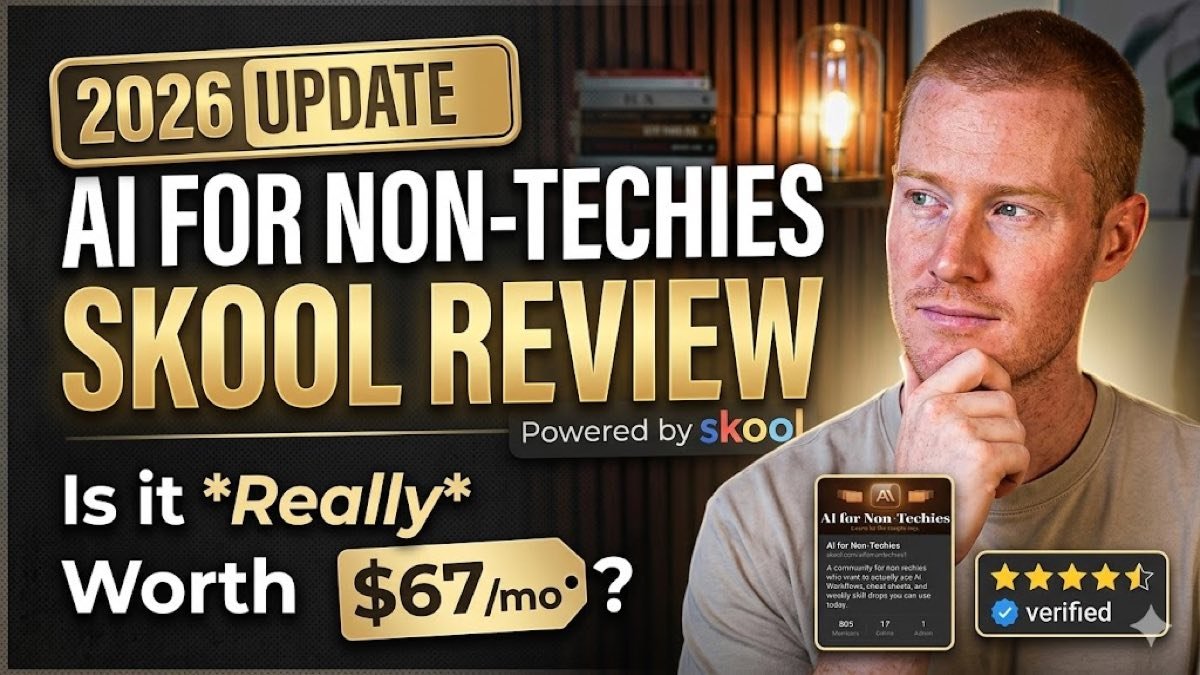
AI for Non-Techies is the right community for a specific type of person: non-technical, already sold on AI as a concept, and ready to actually build workflows instead of watching more tutorials. The Claude Skills library is the strongest value proposition in the beginner AI community space right now — not because the individual skills are magic, but because the weekly cadence and the practitioner-built quality are consistent.
The case against joining is also clear. $67/month monthly is a real commitment. The Claude-only focus means you’ll need supplemental resources if you want broad AI literacy. And the ~800-member community size means you won’t get the peer depth you’d find in a 10,000-member community.
Go annual if you join. The $45/month rate is well-priced for what you get. The $67/month monthly rate is harder to justify unless you’re testing before committing long-term.
Overall rating: 4.3/5 — strong content, fair annual pricing, small but active community.
Join AI for Non-Techies on Skool{:rel=“nofollow noopener sponsored”}
next step for beginners
Related Reading
- AI Video Bootcamp Skool Review — for creators going video-first
- AI Automation Society+ Review — for automation builders and technical operators
- AI Profit Boardroom Review 2026 — for affiliate-focused operators
- Skool Pricing 2026 — full breakdown of Skool platform costs and how communities set rates
Citation Capsules
Section: Pricing AI for Non-Techies charges $67/month for standard monthly access and approximately $45/month on the annual plan as of April 2026. Skool communities set their own membership rates on the platform, which passed 1 million members across all hosted communities in 2024 (Skool, 2024).
Section: Who It’s For McKinsey’s 2024 State of AI report found that 72% of organizations had adopted AI in at least one business function (McKinsey & Company, 2024) — yet the majority of AI education content still assumes technical fluency, leaving non-technical operators underserved by the market.
Section: Content Freshness Stanford’s AI Index Report 2024 documented a 56% year-over-year increase in notable AI model releases (Stanford HAI, 2024). This pace of change makes static AI courses obsolete within 90 days, and is the key reason weekly-updated skill libraries like AI for Non-Techies’ Claude Skills library have a structural advantage over one-time course products.
Section: Trust The 2023 Edelman Trust Barometer found that 63% of consumers trust content from practitioners over generalists (Edelman, 2023). Brock Mesarich’s positioning as a practitioner who built a real business on his AI stack — rather than an educator who learned AI to teach it — is a meaningful credibility signal for prospective members.
Full pros & cons
- Genuinely beginner-friendly — zero coding required for any workflow
- Weekly Claude Skills drops you can deploy the same day you download them
- Brock is a real practitioner running a documented seven-figure business with this stack
- Annual plan locks in roughly $45/month — meaningful savings if you commit
- Resource vault organizes every link and tool from Brock's YouTube in one place
- $67/month is steep for anyone still deciding whether AI belongs in their workflow
- Heavily Claude-centric — minimal coverage of ChatGPT, Gemini, or open-source tools
- Community is still small at ~800 members, so peer expertise is thin in niche areas
- No refund guarantee visible at signup — you're trusting Skool's standard policy
Try it yourself
Ready to put it to the test?
We may earn a commission at no extra cost to you. Affiliate disclosure.
Reader feedback
Was this review helpful?
Your feedback helps us write better reviews.
Thanks for your feedback.
Who runs it
Brock Mesarich
Brock Mesarich built a YouTube channel past 100,000 subscribers focused entirely on practical AI for people who do not write code.
Full profile and every community Brock runs →
AI Funnel Insider is an independent review site covering AI tools, Skool communities, and online courses. Every community and tool reviewed here is personally joined, paid for, and tested before a verdict goes live. Reviews are independent and may contain affiliate links, at no extra cost to you.
Related Posts

Ad Creators Lab Review 2026: Worth $99/mo?
Ad Creators Lab is a $99/mo Skool run by a $100M+ ad-spend founder. The pros, cons, and pricing gotchas to know before you join in 2026.

Agentic Academy Review 2026 (Simon Scrapes' AI Agent Stack)
Simon Scrapes' Agentic Academy: $37/mo for Claude Code and n8n training plus 20+ hours of builds. Worth it? My honest 2026 review before you join.

AI Automations by Jack Review 2026 (110+ n8n Blueprints by Jack)
AI Automations by Jack ships 110+ n8n blueprints and daily live calls for $77/mo. Worth it? My honest 2026 breakdown of what delivers and what doesn't.

AI Builders Skool Review 2026 (Marcin Teodoru's NoCode AI Stack)
AI Builders is Marcin Teodoru's Skool: a 21-day OpenClaw vibe coding program for 674 members. Is the $97/mo worth it? Honest pros, cons, and verdict.

AI For Business Mastermind Review 2026: Worth It?
Quentin Flores' AI For Business Mastermind on Skool, reviewed for 2026. What is inside, who gets ROI, and who should skip it before joining.

AI Innovators Skool Review 2026: Worth $67/mo?
Tyler Germain's AI Innovators teaches Claude Code and AIOS builds with live calls. Is $67/mo worth it? My honest verdict on the curriculum.
The Insider Newsletter
One honest review, every Sunday.
Get our weekly breakdown of which AI tools and Skool communities are worth buying. Built for marketers, founders & solopreneurs.