Clief Notes Review 2026: 40+ Free AI Lessons, Real?
Clief Notes gives 40+ free AI lessons on Skool, taught by a Marine vet with an Edinburgh MSc. Is it worth your time in 2026? Honest verdict.

40+ free lessons with more depth than most $497 paid courses
Scale works against you. Personal attention from Jake sits behind VIP at $97/mo
Last updated: September 2026
Clief Notes is worth joining, and the free tier is the whole reason. Jake Van Clief gives away 40+ structured lessons on folder architecture, prompt frameworks and Claude Code, with no paywall on the part that matters. The community sits at 47,500 members as of August 2026 and it is still free. (Skool.com/cliefnotes, 2026)
The AI Skool space is full of rooms that hit 20,000 members on paid ads and then charge $2,000 for recycled prompts. This one grew without ads, and the founder’s résumé survives a background check.
TL;DR: Clief Notes is a free Skool community built on Jake Van Clief’s Interpretable Context Methodology (ICM). It covers folder architecture, prompt frameworks and Claude Code. 47,500 members, 40+ free lessons, optional paid vaults, and a VIP tier around $97/mo. (Skool.com/cliefnotes, 2026)
What Is Clief Notes (CliefNotes AI)?
Clief Notes, also written CliefNotes and sometimes misspelled Cleif Notes, is a free Skool community founded by Jake Van Clief. It teaches a practical AI method built on folder architecture, plain-text files, and reusable prompt frameworks, so your work with tools like Claude Code holds together across long sessions and model updates. Searchers who type “Clief Notes AI” mean this same community.
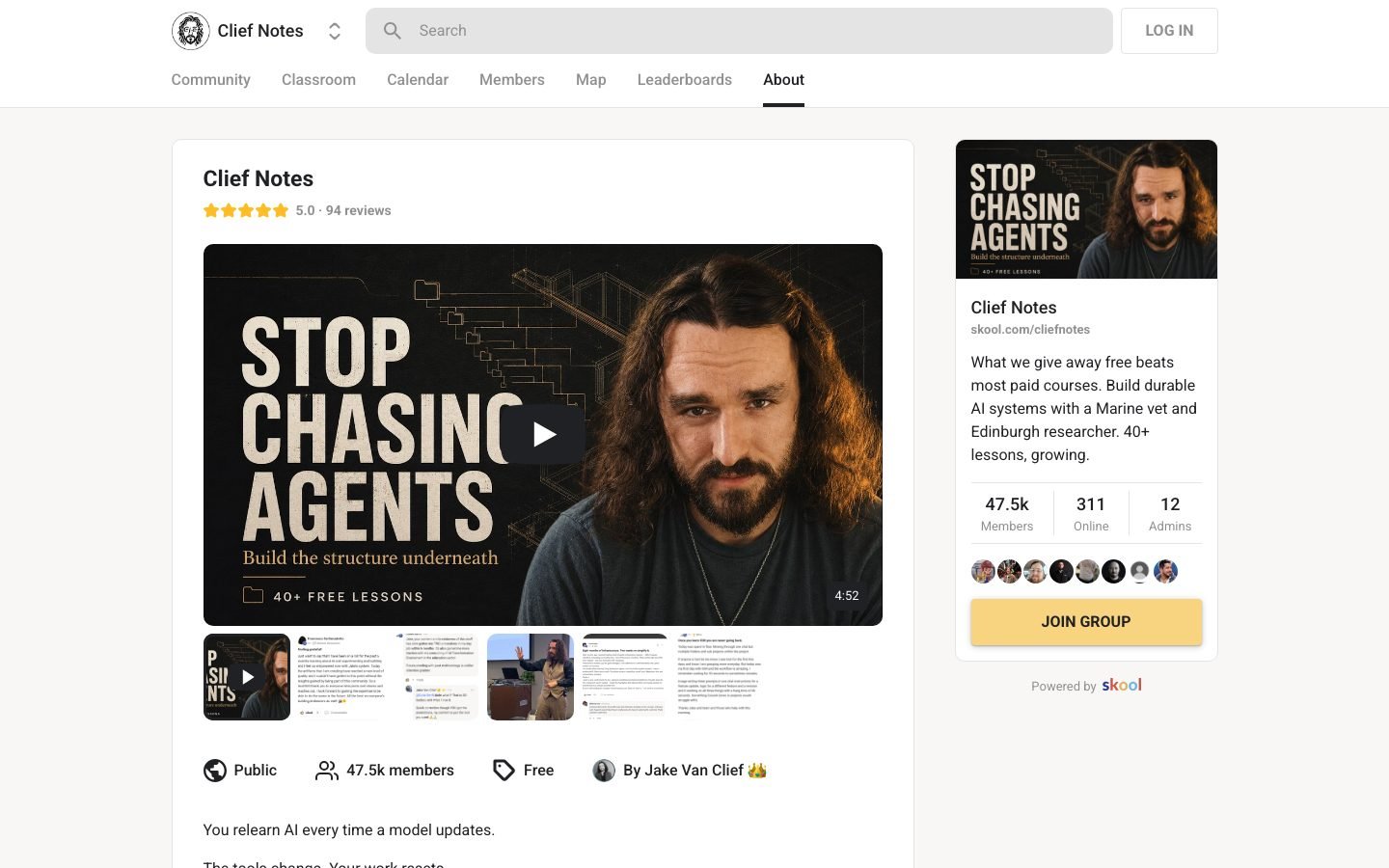
- Founder: Jake Van Clief, a U.S. Marine Corps veteran with an MSc in AI Governance from the University of Edinburgh (Skool, September 2026).
- Price and size: free to join, 40+ lessons that grow every month, and 47,500 members as of the last check.
- The method: everything sits on the Interpretable Context Methodology (ICM), which uses folders and text files instead of complex agent software. It suits builders who want a repeatable system rather than a tips list.
Quick Decision: Should You Join Clief Notes?
It earns its 4.6/5 for one reason. A Skool community with 40+ structured lessons behind no paywall is rare, and Jake has said publicly that the core content stays free. His words in the community announcement: access stays free, forever.
Join the free tier if you:
- Build with AI and feel the gap between knowing tools and knowing systems
- Want folder architecture and prompt frameworks that age well no matter which model you use
- Are learning Claude Code and need a production method rather than a tips list
Skip it if you:
- Want a small mastermind with daily founder access. That is VIP, around $97/mo
- Need done-for-you templates with zero theory. Clief is deliberately systems-heavy
- Are not ready to restructure your projects around the folder architecture
For most people the answer is simple. Join the free tier, work through The Foundation, then decide whether a paid vault fits.
Who Is Clief Notes Actually For?
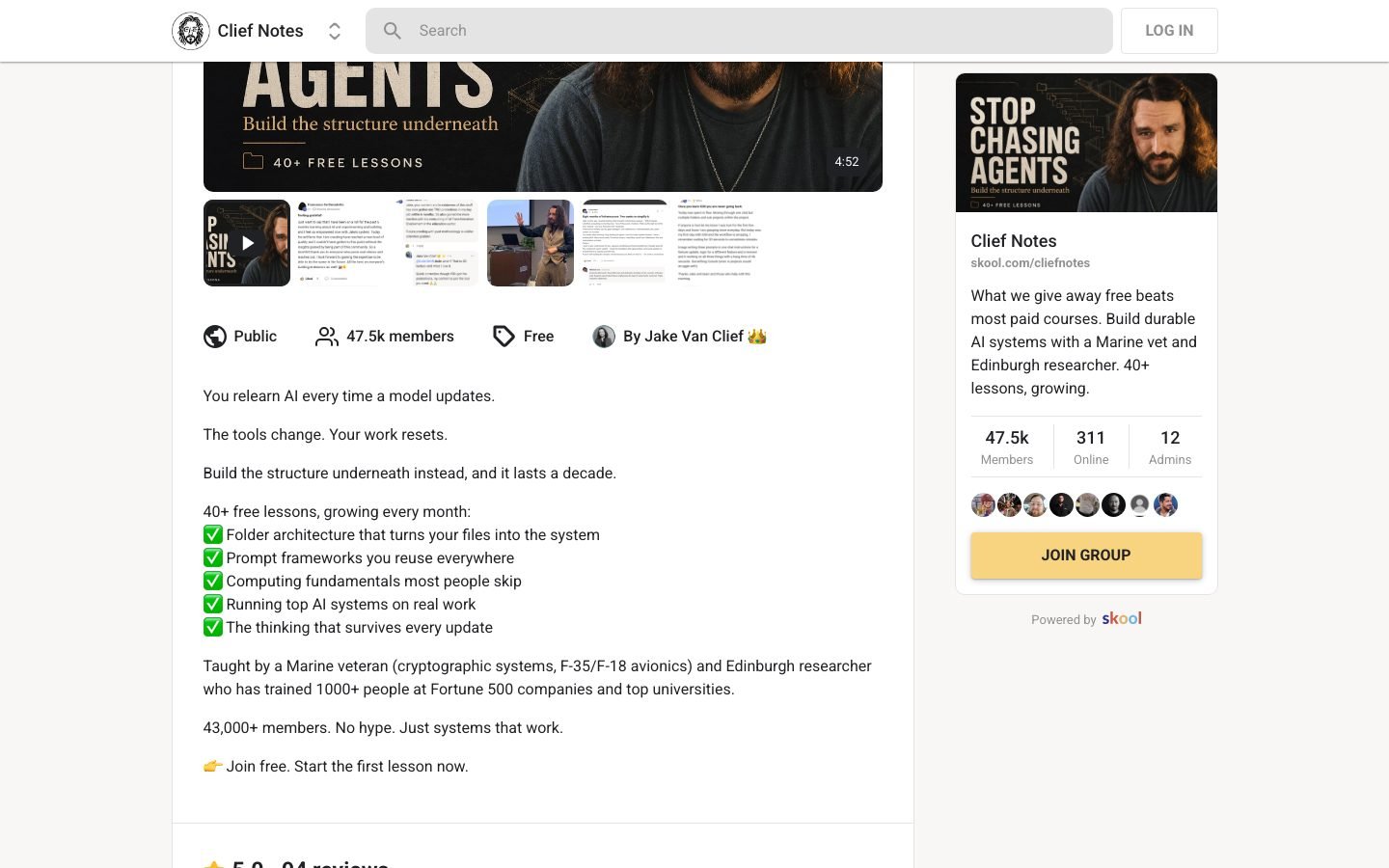
It serves a specific builder: the one who is tired of tools changing while results stay inconsistent. Jake teaches the thinking layer under the tools. Judging by the public Show Your Work and Discussion threads, the room skews technical founders, engineers and senior ops people rather than beginners chasing a first win.
Best fit:
- Engineers and technical founders who want a production-grade AI workflow
- Operators learning Claude Code, Codex or similar agentic tools
- Anyone hitting context loss, folder chaos or prompt drift at work
- People who bought several AI courses and still have no system
Probably not for you:
- Complete beginners who want 10-minute videos with instant results
- Creators focused on AI video or social content. AI Video Bootcamp fits that better
- Agency builders chasing lead gen and offers. AI Profit Boardroom is the closer match
The typical post in the feed comes from someone with a real project problem. Context collisions in Claude, folder structure that broke at scale, prompt frameworks that decayed over a long session. That reads very differently from the “my first side hustle” posts in most AI rooms.
What Does Clief Notes Cost in 2026?
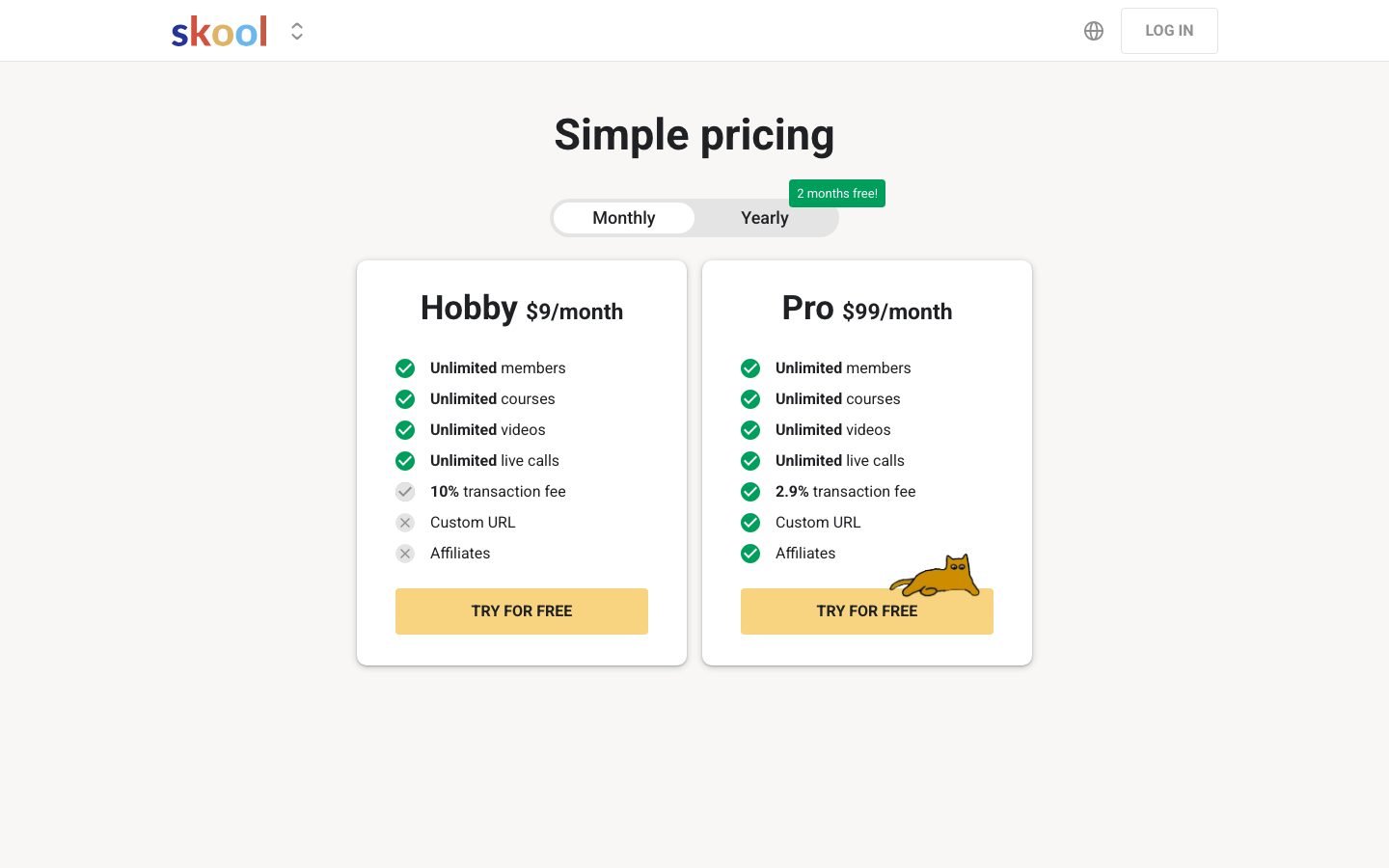
The free tier is the product. Paid tiers exist on top of it, and Jake has been direct that nobody needs them.
| Tier | Price | Core Access |
|---|---|---|
| Free | $0/mo | The Foundation (40+ lessons), community feed, David’s Corner |
| Premium vault | from $7/mo | Asset vaults, Skills Field Manual, deeper applied resources |
| VIP | around $97/mo | Direct access to Jake, enterprise case studies, live calls |
| Lifetime VIP | $5,000 | One-time, includes The Lyceum |
Things worth knowing before you pay:
The community page lists Clief Notes as free and does not publish the paid tier prices. That is the honest state of it as of mid-2026. Jake announced the Premium vault at $7/mo, and third-party listings put VIP near $97/mo. Treat those figures as directional and check the current number inside the community before you upgrade.
VIP has climbed since launch, and the team has said it will keep climbing as the room grows. A rising price is not by itself a reason to buy. Upgrade when you have exhausted the free curriculum, not before.
The $5,000 Lifetime VIP exists because members asked for a one-time option. Jake’s own framing was that he does not expect anyone to actually pay it. Take that however you want.
Skool pays affiliates 20% on paid tiers, which is why more Clief Notes reviews keep appearing in search. Worth knowing when you read them, this one included.
What’s Inside the Clief Notes Classroom?
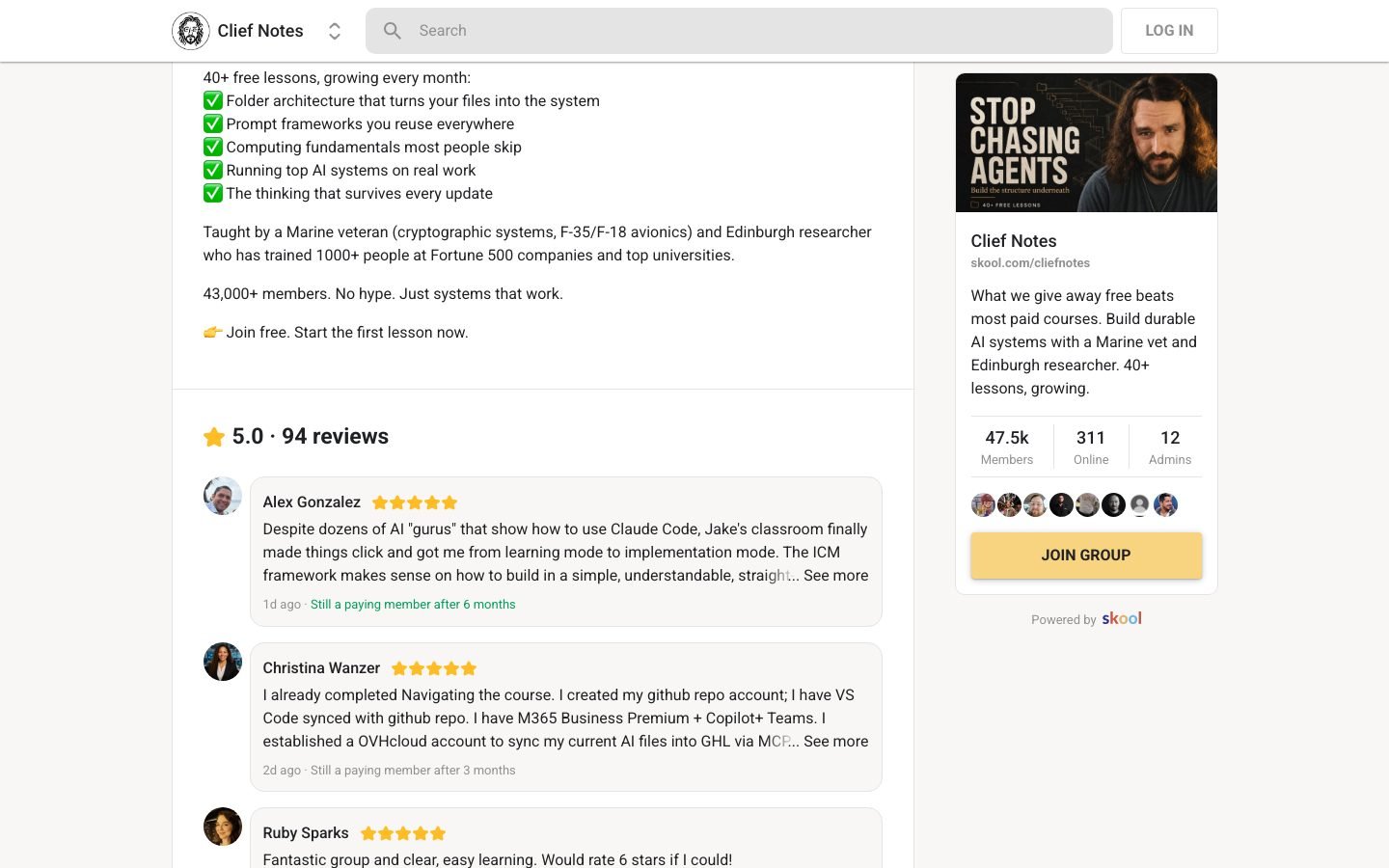
The free classroom runs three levels plus a supplementary section from admin David Vogel. The structure mirrors the method itself. You do not skip levels.
The Foundation (Level 1)
This is where the reputation comes from. It covers:
- Computing fundamentals relevant to AI, neither condescending nor over-academic
- Folder architecture, the load-bearing structure everything else sits on
- The Interpretable Context Methodology, Jake’s framework for holding coherent AI context across long sessions
- Prompt frameworks that compound instead of decaying
The depth beats most courses selling at $497.
Implementation Playbooks (Level 2)
Level 2 moves from concept to production. Applying the architecture to real projects, handling context at scale, building repeatable workflows. This is where the method stops being theory and starts being testable.
Building Your Stack (Level 3)
Level 3 is for people actively building tools and Claude Code agents. Composing skills, writing CLAUDE.md files that do not drift, building systems that survive model updates.
David’s Corner
A separate section curated by admin David Vogel. Resource lists, AI acronym cheat sheets, design inspiration vaults, workflow posts. It is the resource layer rather than curriculum.
The free tier is not a sales brochure
Most Skool classrooms give away deliberately incomplete content so the paid tier looks necessary. Clief Notes inverts that. The Foundation is complete on its own. Levels 2 and 3 extend it, but you can run a real production method having paid nothing. That inversion is why 47,500 people joined without an ad budget.
Jake Van Clief’s Credentials Are the Real Differentiator
Most Skool founders cannot survive a basic Google search. Jake’s record is publicly checkable across several sources. (LinkedIn/Jake Van Clief, 2025)
- 8 years, U.S. Marine Corps: cryptographic systems, F-35 and F-18 avionics. Not ornamental. That work demands systems thinking under hard constraints, which is exactly the mental model behind his folder architecture.
- MSc in AI Governance, University of Edinburgh: Edinburgh ranks in the global top 20 for AI research. (QS World University Rankings, 2025) A governance MSc is about understanding AI systems at institutional and production scale, not prompt tricks.
- Published researcher: peer-reviewed work, not a ghostwritten white paper.
- Fortune 500 trainer: 1,000+ employees at Pacific Life, Colgate-Palmolive and KPMG UK. Enterprise training forces a method that holds up under scrutiny.
- Production AI implementations: shipped work with measurable ROI, not demos.
Communities take the shape of whoever runs them. This one attracts engineers with real problems because that is who is leading it.
How Active Is the Clief Notes Community?
Most Skool reviews screenshot the member count and stop. The real signal here is the Show Your Work threads, where members post work in progress and get feedback. They run daily, with visible engagement from David Vogel and, on higher-tier posts, from Jake.
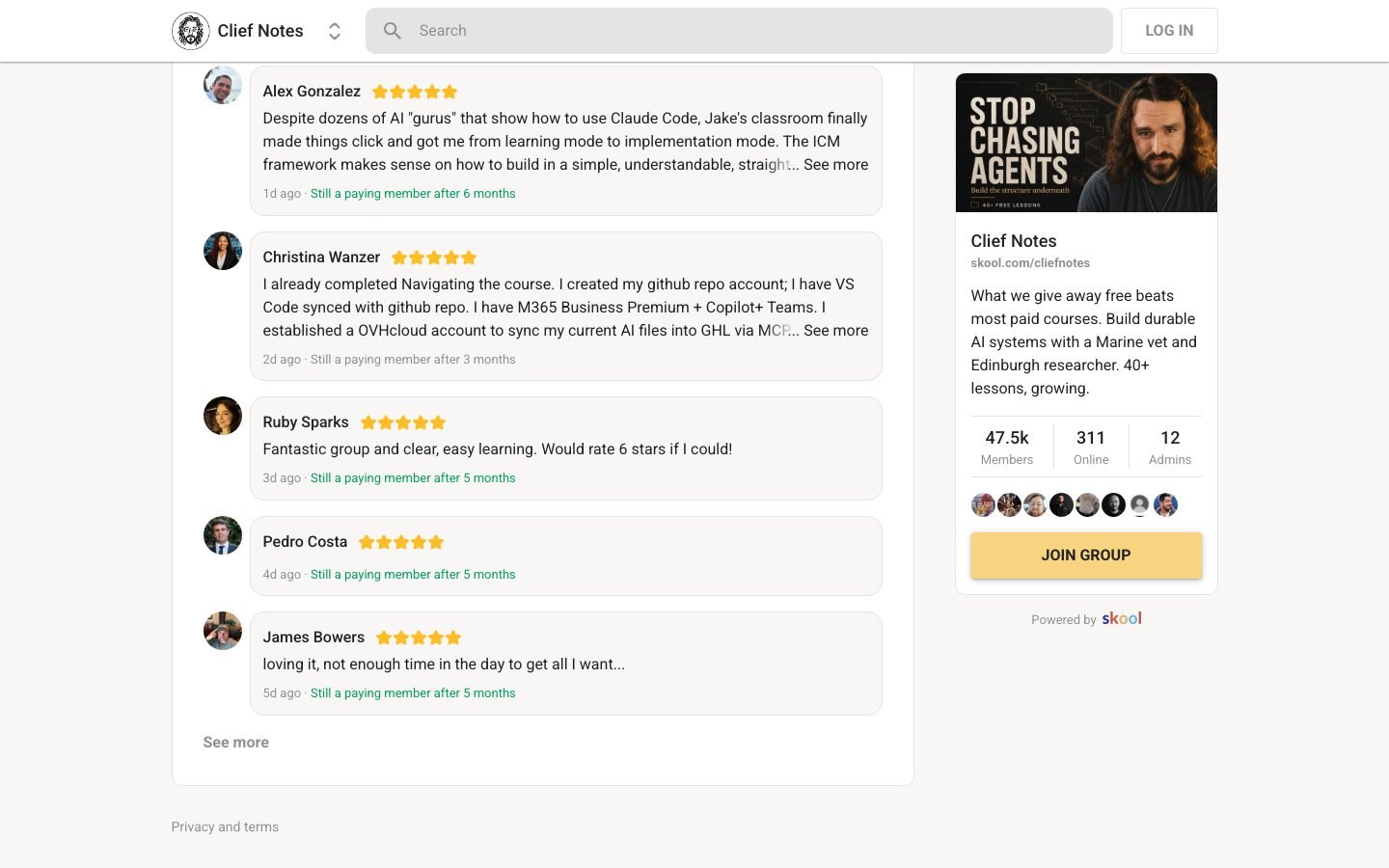
Public thread timestamps put main-feed responses within a few hours. That is strong for a room this size, since most 40,000-plus communities go days without a reply on an ordinary post.
Scale cuts both ways. At 47,500 members the feed moves fast, and a general question in Discussion sinks quickly. A structured post in Show Your Work gets real traction. The pattern is consistent: posts carrying artifacts, screenshots, code snippets, an actual CLAUDE.md file, get useful answers. Posts asking “how do I” without context do not. Post with context.
What Sets Clief Notes Apart From Other AI Skool Communities?
It teaches a method rather than a toolset. McKinsey’s ongoing state-of-AI work keeps landing on the same finding: the constraint on scaling AI inside a business is repeatable process, not access to models. (McKinsey & Company, 2024) ICM aims straight at that gap.

Here is how it compares to the other major AI Skool rooms:
| Community | Free Tier? | Focus | Members | Price |
|---|---|---|---|---|
| Clief Notes | Yes (40+ lessons) | Systems thinking, Claude Code, architecture | 47,500 | Free to $97/mo |
| AI Video Bootcamp | No | UGC video, faceless content | 18,000+ | $27/mo |
| Claude Club | No | Claude Skills, power-user builds | 1,000+ | $97/mo |
| AI Profit Boardroom | No | AI agency offers, lead gen | 5,000+ | $59/mo |
| School of Mentors | No | Personal brand, mentorship | 3,000+ | $79/mo |
| AI Automation Society+ | No | n8n and Make automation builds | 7,000+ | $79/mo |
Clief Notes is the only free entry point in that list with a complete standalone curriculum. Everything else is paywalled from day one. If you have never paid for a Skool community and want to test the format first, this is the lowest-risk place to start.
What Are Real Users Saying About Clief Notes?
Sentiment is positive, and the criticism that does appear is specific rather than vague. The recurring compliment from people who have burned money on AI courses: this was the first thing that explained the why. The recurring complaint: the free room is too big for personal feedback.
One pattern shows up again and again in Show Your Work. New members skip The Foundation, jump to Level 2 or 3, and come back confused. Experienced members have pinned “read the Foundation first” reminders. That is not a knock on the curriculum. It is evidence the sequence is real.
Pricing complaints are rare in the public feed, which is unusual for a community whose main paid tier has doubled. The price talk skews toward “get in before it rises again” rather than grievance.
The mistake members flag most often is skipping the lesson check-ins at the bottom of each video. Most people bypass them. The ones who do them are the same names posting the most advanced work four to six weeks later.
Is Clief Notes Legitimate?
Yes, and that word deserves care around Skool communities. Three things back it.
Jake’s credentials verify directly. Edinburgh MSc, Marine Corps record, Fortune 500 training history, all searchable outside the platform. The free content overdelivers, because The Foundation is a complete method rather than a teaser. And the growth is organic: 47,500 members with no ad funnel means word of mouth from people who got something out of it.
What most reviews will not tell you is that this room is genuinely technical. “Folder architecture” and “Interpretable Context Methodology” sound dry, and if that framing makes you yawn, you will bounce inside a week. If it sounds like the missing layer, join today.
Pros and Cons
Pros
- 40+ free lessons with more usable depth than most $497 courses
- Founder credentials that verify outside the platform, which is rare on Skool
- ICM holds up across model generations
- Show Your Work threads create real accountability
- Grew to 47,500 members organically, with no paid hype
- A genuinely useful free entry point
Cons
- Scale limits personal feedback. At 47,500 members your post competes hard for attention
- Heavy on systems thinking, light on done-for-you templates
- Paid tier prices are not published on the community page, so you have to ask inside
- VIP has doubled since launch and the direction is up
- Skool’s own UI buries settings and navigation under odd menus
- The method is sequential, and skipping The Foundation causes real confusion later
FAQ
Is Clief Notes really free, or is the free tier just a teaser?
Genuinely free, and genuinely complete. The free tier includes 40+ lessons across The Foundation, folder architecture, the Interpretable Context Methodology, computing fundamentals and prompt frameworks. Jake has stated publicly that core access stays free. Paid vaults and VIP go deeper on applied implementation and live access, but The Foundation stands alone. (Skool.com/cliefnotes, 2026)
How long does it take to see results from Clief Notes?
Realistically, a week to work through The Foundation and two to four weeks to apply it to your own workflow. Within a day or two of joining, most members can restructure their Claude Code projects around the folder architecture and stop fighting context loss. The check-ins at the bottom of each lesson are where results compound fastest, so do not skip them.
Who is Jake Van Clief and why does his background matter?
Jake is an 8-year U.S. Marine Corps veteran who worked on F-35 and F-18 cryptographic and avionics systems. He holds an MSc in AI Governance from the University of Edinburgh, consistently ranked in the global top 20 for AI research. (QS World Rankings, 2025) He has also trained 1,000+ employees at Fortune 500 firms including Pacific Life, Colgate-Palmolive and KPMG UK. Real production experience is what separates ICM from prompt-hack content.
Should I pay for VIP?
Only after you have finished The Foundation and applied it to real projects. VIP runs around $97/mo for direct access to Jake, enterprise case studies and live calls. For most people the free tier plus a cheap asset vault covers it. The price has risen before and will rise again, but a higher future price is a weak reason to buy now.
How does Clief Notes compare to other AI Skool communities?
It is the only major AI Skool community whose free tier contains a complete method. The focus is systems thinking and Claude Code architecture, which is different from AI Video Bootcamp (video creation), AI Profit Boardroom (agency offers) or AI Automation Society+ (n8n and Make). Pick on what you are building, not on member count.
What is the Interpretable Context Methodology (ICM)?
ICM is Jake’s framework for holding coherent AI context across long working sessions. It targets context collapse, where a long conversation degrades because the model loses track of your project’s structure and intent. The fix combines folder architecture, structured CLAUDE.md files and prompt frameworks. It is built to survive model generations rather than ride the current one.
Can I cancel a paid tier anytime?
Yes. The paid tiers are monthly subscriptions and cancel through your Skool account settings. The $5,000 Lifetime VIP is a one-time, non-refundable purchase. The free tier takes no payment and has nothing to cancel.
Final Verdict
Clief Notes is the strongest free AI community on Skool in 2026. Jake gives away a complete production method at no cost, his credentials hold up, and the room attracts serious operators instead of people hunting a quick win.
The limits are the ones that come with size. At 47,500 members, personal attention costs $97/mo. And the content is deliberately technical, so plug-and-play template hunters will not enjoy it.
If you build with AI, especially Claude Code, and you have no folder architecture and no consistent context method, this fixes that for free.
Start with the free tier. Do the check-ins. Post in Show Your Work. See whether the method fits how you think before you spend anything.
Join Clief Notes free here, no credit card needed.
Related Reading
Full pros & cons
- 40+ free lessons with more depth than most $497 paid courses
- Founder has a verifiable Marine Corps, Edinburgh MSc and Fortune 500 record
- Grew to 47,500 members with no paid funnel hype
- Systems-first method that survives model updates
- Active Show Your Work threads with real peer accountability
- Scale works against you. Personal attention from Jake sits behind VIP at $97/mo
- Content leans technical, so beginners wanting plug-and-play templates will struggle
- Paid tier pricing is not published on the community page
- Skool's classroom navigation buries some resources under non-obvious menus
Try it yourself
Ready to put it to the test?
We may earn a commission at no extra cost to you. Affiliate disclosure.
Reader feedback
Was this review helpful?
Your feedback helps us write better reviews.
Thanks for your feedback.

AI Funnel Insider is an independent review site covering AI tools, Skool communities, and online courses. Every community and tool reviewed here is personally joined, paid for, and tested before a verdict goes live. Reviews are independent and may contain affiliate links, at no extra cost to you.
Related Posts

Agentic Academy Review 2026 (Simon Scrapes' AI Agent Stack)
Simon Scrapes' Agentic Academy: $37/mo for Claude Code and n8n training plus 20+ hours of builds. Worth it? My honest 2026 review before you join.

AI Innovators Skool Review 2026: Worth $67/mo?
Tyler Germain's AI Innovators teaches Claude Code and AIOS builds with live calls. Is $67/mo worth it? My honest verdict on the curriculum.

Claude Club Skool Review 2026: Worth $97/mo?
Samin Yasar's Claude Club is a $97/mo Skool for AI content creators, with weekly prompt and workflow drops. Is it worth it in 2026? Honest review.

Early AI-dopters Review 2026: Worth $77/mo?
Mark Kashef's Early AI-dopters Skool has 1,300+ members, a Claude Code Magic course, and 92% retention. Is $77/mo worth it in 2026?

Imperio Digital Review 2026 (Benjamin Cordero's AI Community)
Benjamin Cordero's Imperio Digital: a Spanish-language Skool for Claude Code, n8n, and AI agents at $67/mo. Worth it in 2026? My honest review inside.

Ad Creators Lab Review 2026: Worth $99/mo?
Ad Creators Lab is a $99/mo Skool run by a $100M+ ad-spend founder. The pros, cons, and pricing gotchas to know before you join in 2026.
The Insider Newsletter
One honest review, every Sunday.
Get our weekly breakdown of which AI tools and Skool communities are worth buying. Built for marketers, founders & solopreneurs.