Early AI-dopters Review 2026: Worth $77/mo?
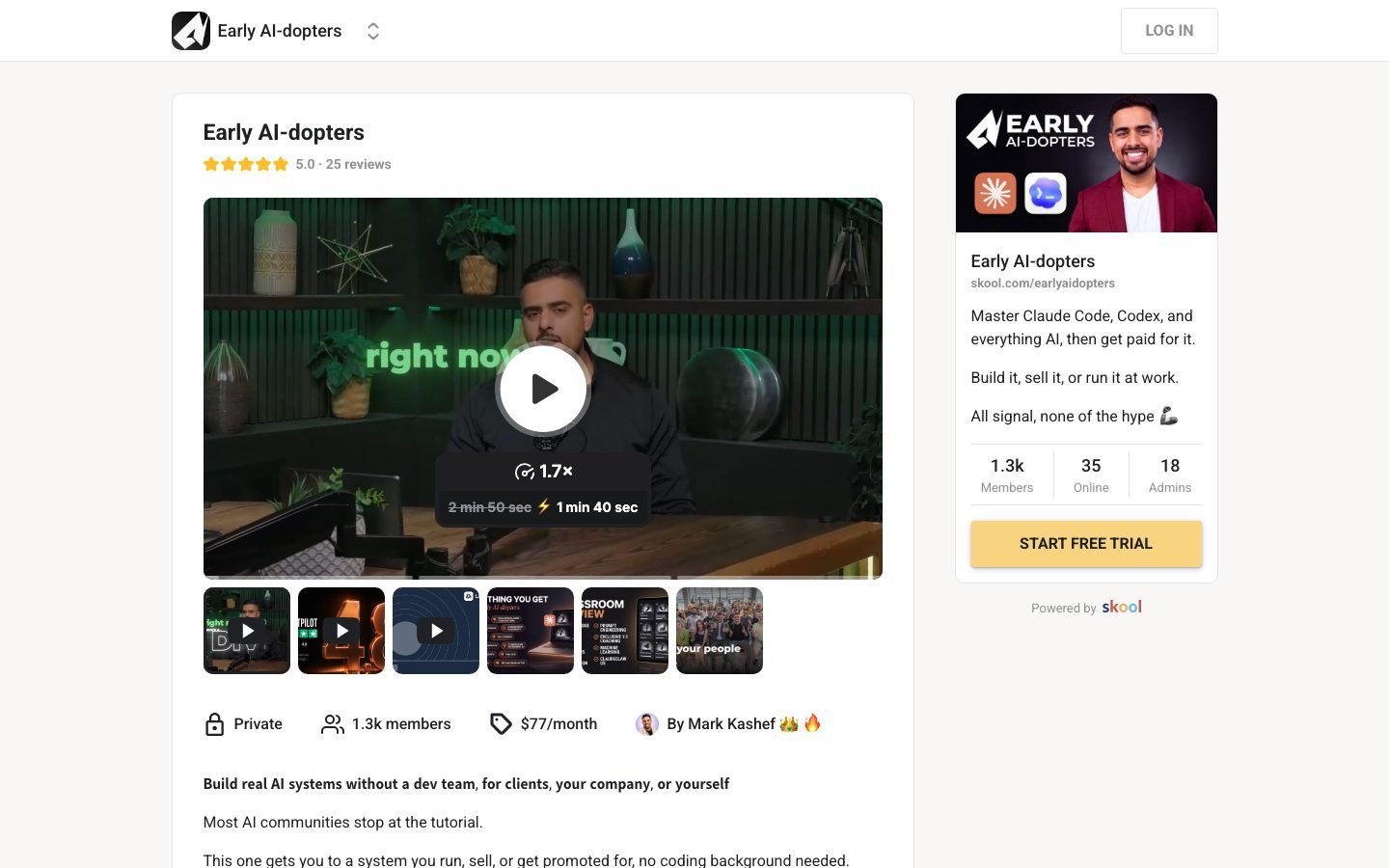
Mark Kashef's Early AI-dopters Skool has 1,300+ members, a Claude Code Magic course, and 92% retention. Is $77/mo worth it in 2026?

Mark Kashef posts every single day, a 365+ day streak with real founder presence
Price went $64 to $77, and a $97 tier has been announced twice without landing
Early AI-dopters is worth $77 a month if you are going to build with Claude Code, n8n, and agentic AI workflows. It is not worth it if you want done-for-you templates, ChatGPT prompt packs, or a library you will never open. That is the whole verdict, and everything below is the evidence for it.
Last updated: August 2026
The community now runs a 5-day free trial, which changes the risk calculation. You can read the classroom, watch the feed for a week, and leave before a charge lands.
TL;DR: Early AI-dopters is a $77/month Skool community run by Mark Kashef, an O’Reilly instructor with a Master’s in AI from Queen’s University. It has 1,300 members, 18 admins, a 92% monthly retention rate, and a founder who posts daily. As of August 2026 it is one of the most technically credible Claude Code communities anywhere.
Quick Decision
Mark posts every single day, and the posts are technical rather than motivational. Claude Code Magic is one of the cleanest end-to-end tracks in the category. The community is small enough that a real person answers your question the same day.
The downside is the pricing theatre. The $97 tier has been announced twice and still has not landed, which reads as urgency stacking even when the content is good. The Anthropic-heavy stack also leaves you on your own if your tooling is GPT-4o or Gemini based.
Worth $77/month if you are serious about Claude Code and agentic AI. Skip it if you want broad AI generalism or passive content.
Who Should Join Early AI-dopters?
Best fit:
- Operators who want to master Claude Code, build real automations, and understand the MCP ecosystem
- Freelancers and consultants packaging AI as a billable service
- People who finished beginner AI courses and want something technically substantive
- Builders already using n8n, Obsidian, or CLI tools who want to go deeper
Skip if:
- Your daily workflow is ChatGPT or Gemini and you will not add a Claude layer
- You want a huge, buzzing community with tens of thousands of members
- $77/month is a stretch and you cannot commit 3-4 hours per week
- You prefer done-for-you templates over learning the underlying skill
Members who show up expecting passive results tend to leave inside 60 days. The ones who work the Claude Code Magic modules and post their builds in the feed stay. The 92% retention figure reflects that self-selection more than it reflects magic.
Pricing: What $77/Month Actually Gets You
Early AI-dopters costs $77/month with no annual plan. It opened at $64/month and raised to $77 in early 2026. Mark has publicly committed to a third increase to $97 once membership crosses a threshold, first quoted at 1,200 members and later at 1,300. Membership sat at exactly 1,300 when I last checked the public Skool listing in August 2026 and the price was still $77.
| Plan | Price | What’s Included |
|---|---|---|
| Free trial | 5 days | Full classroom and feed access before any charge |
| Monthly | $77/month | All courses, weekly group calls, 1:1 coaching credits, AI Expert Network, software discounts |
| Annual | Not offered | No annual option, no commitment discount |
| Announced | $97/month | Same access at the next price tier, not live yet |
Here is the cost math nobody puts on the sales page. At $77/month you pay $924 a year with zero commitment discount. If the $97 tier lands and you joined before it, your rate is grandfathered, so a year at $77 saves $240 against a year at $97. That is the only real reason to hurry, and it only pays off if you actually stay.
One complaint surfaced inside the community during the last price change: a member posted that the landing page showed $64 while checkout charged $77. Mark acknowledged the rollout was mid-funnel and the join page now shows $77 correctly. If you see $77 on the Skool page, that is the live number.
Join Early AI-dopters on Skool
The Classroom Is Wider Than the Marketing Suggests
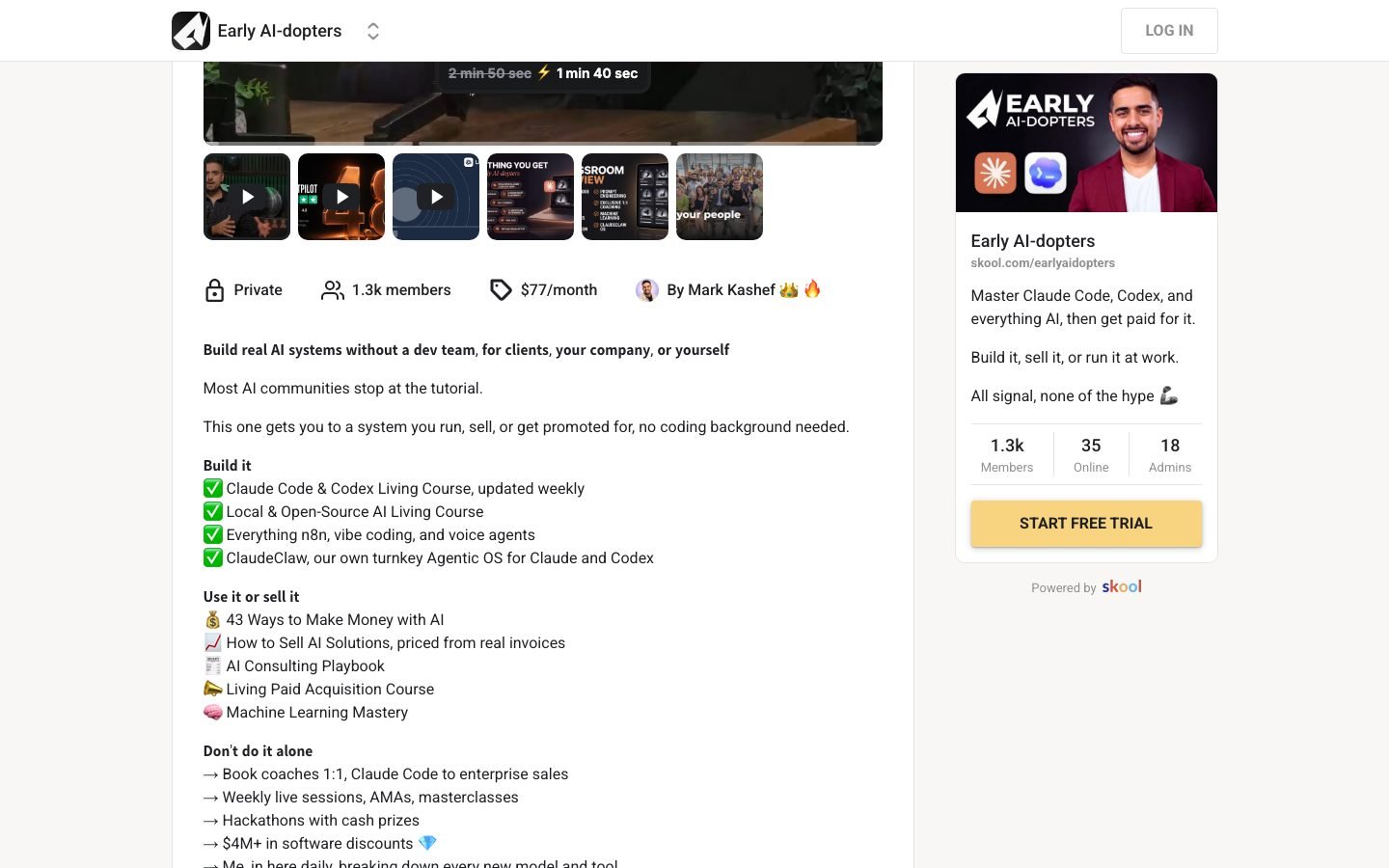
The library has grown past the six courses it launched with. It now covers local AI deployment, Codex alongside Claude Code, agentic operating systems, selling and advertising AI solutions, prompt optimisation, and machine learning fundamentals. A newer module called “43 Ways to Make Money with AI” was added recently.
Claude Code Magic (Beginner to Superhuman) The flagship, and the reason most members join. Claude Code CLI setup, MCP server configuration, agent skill building, real automation workflows. It is written for the current Claude generation, not recycled 2023 material. Members report a functional agent skeleton after a weekend on the first few modules.
Build-Your-Own OpenClaw / ClaudeClaw Mark’s own framework for chaining Claude agents with external tools. This is the proprietary part. ClaudeClaw is not documented on YouTube, and it came out of real client work rather than a course outline.
Obsidian + Claude Code Second Brain Starter Kit Personal knowledge management wired to Claude agents. If you already live in Obsidian, this integration is worth a month on its own.
Prompt Engineering Mastery More advanced than the name suggests. Structured reasoning chains, system prompt architecture, tool-use optimisation. It assumes you already know basic prompting.
Machine Learning Mastery The most technical course in the library. Enough foundational ML to understand what the models you are calling actually do, without pretending to be a data science degree.
AI Consulting Playbook Packaging AI automation as a service, pricing it, selling it. Mark pulls from his Prompt Advisers consulting work, so the positioning advice comes from invoices rather than theory.
New modules drop based on community questions and whatever Mark is building. The Classroom tab shows a “Last updated” date per module, which makes staleness easy to check yourself.
Mark Kashef’s Background Is the Product
Most Skool founders in this category are marketers who picked up a tool six months ago. Mark’s résumé runs the other direction, and it shows in how he teaches.
- O’Reilly Media instructor. He runs hands-on workshops for O’Reilly, including a live Claude Code workshop. O’Reilly trains engineering teams at Google and Microsoft, so the instructor roster is a technical filter, not a marketing one.
- Master’s in Artificial Intelligence. A Master of Management in AI from Queen’s University, not an online certificate.
- A decade in data science. Data scientist and data science manager roles across multiple companies before he started teaching.
- Founder of Prompt Advisers. He launched the consultancy days after ChatGPT shipped in 2022. Entrepreneur reported the business is roughly 70% consulting and education, 30% custom development, on track for $1.5M to $2M in revenue. The AI Consulting Playbook course comes out of that work.
The practical effect: when Mark explains why a Claude Code architecture works, he explains the mechanism. That is the gap between a recipe and knowing why the recipe works. If you plan to adapt and extend rather than copy-paste, the second one is what you are paying for.
His 365+ day posting streak is verifiable. Scroll the feed. The posts range from micro-tutorials to prompt architecture breakdowns to live debugging when members drop a problem in.
Community and Engagement: Is It Actually Active?
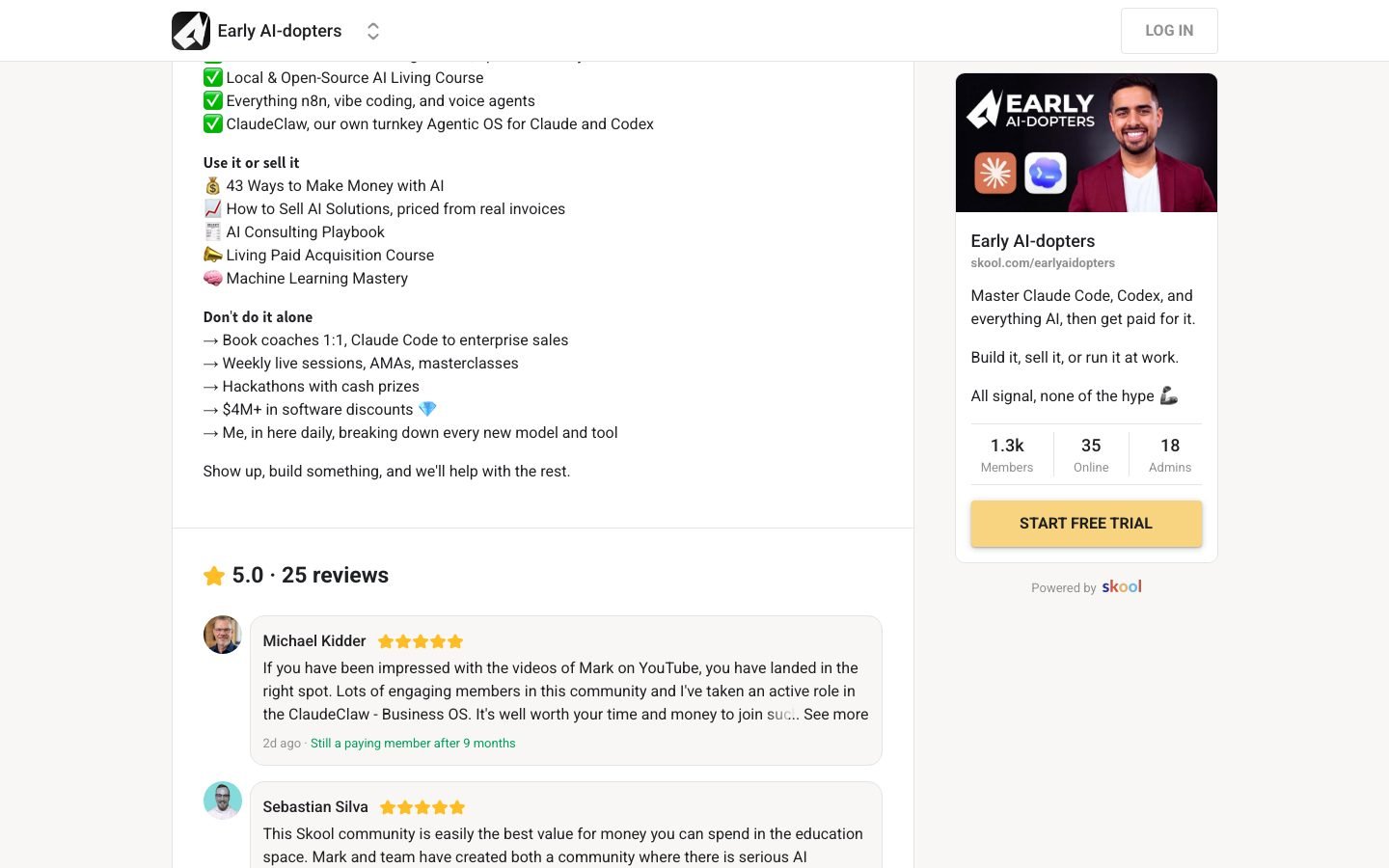
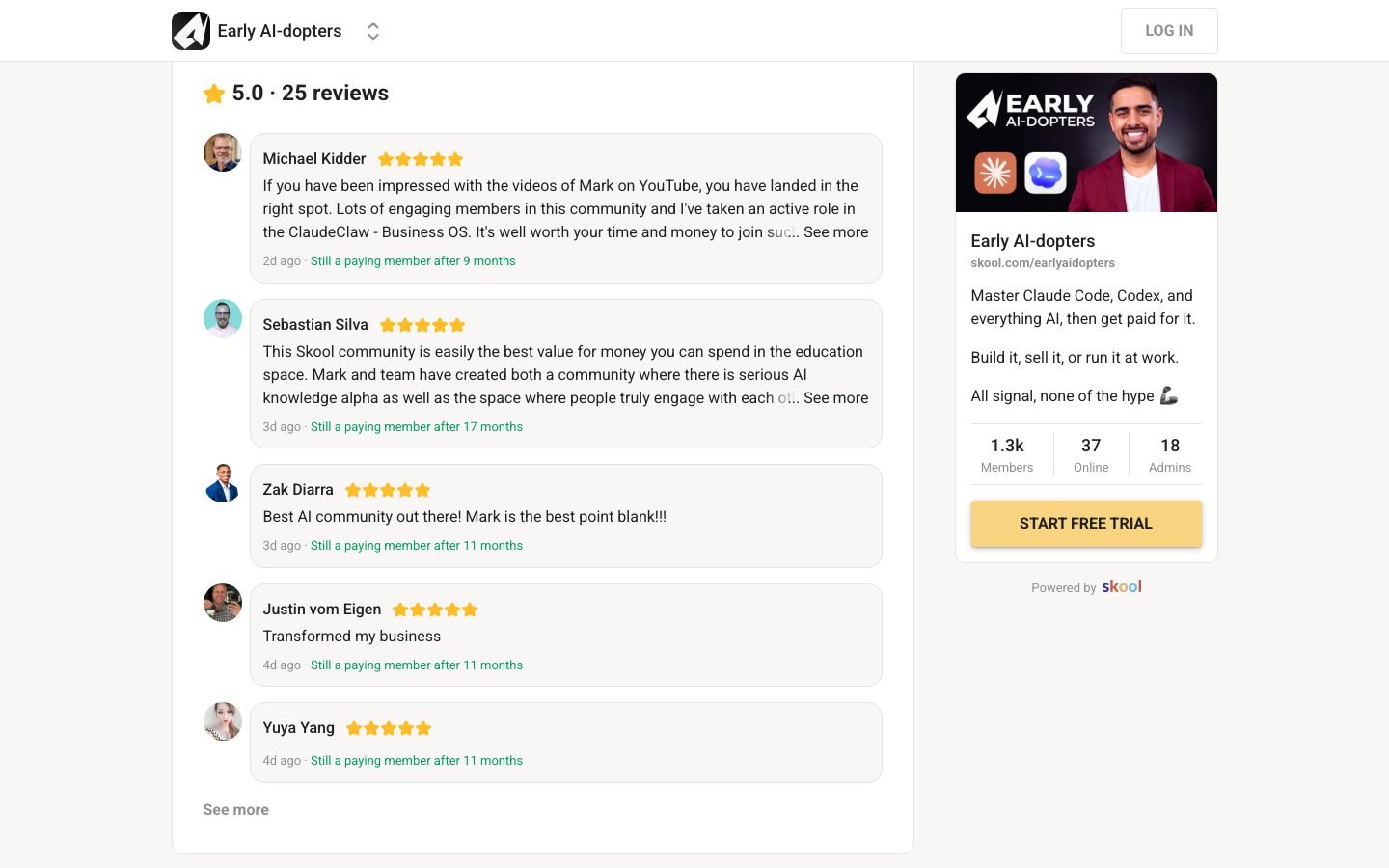
Small communities live or die on founder involvement. Early AI-dopters has 1,300 members, 18 admins, and usually 30 to 70 people online at once. That admin-to-member ratio is high by Skool standards, which is why response quality holds up. Twelve of those admins act as 1:1 coaches across Claude Code, Codex, cybersecurity, n8n, and enterprise sales.
The 92% monthly retention rate Mark cites is the clearest health signal. Skool communities in the $50-$100/month band typically run 60-70% 30-day retention, so losing a third of new members in month one is considered normal. A 92% rate means the people who show up in month one are still there in month two.
Patterns members describe consistently:
- Technical posts get substantive replies, not “great question!” filler
- Mark answers a large share of member posts himself, including the hard ones
- The feed is not drowning in “just joined, excited to be here” noise
- People post actual builds, actual code, actual client wins
The friction point they raise: the feed moves fast enough that missing three days buries things. There is no weekly digest or structured summary. You get out what you put in.
What Sets Early AI-dopters Apart?
1. A proprietary framework, not a tool list ClaudeClaw is not documented anywhere else. Mark built it for his own consulting work and then taught it inside the community. Teaching a system that took real engineering time is a different product from teaching public tools.
2. A technical founder who stayed technical Most founders either vanish after launch or drift into marketing the community rather than contributing to it. Mark keeps shipping frameworks, and the daily posts stay technical instead of turning into AI news reposts.
3. Curriculum that tracks the frontier Claude Code Magic gets updated when Anthropic ships meaningful changes, and module timestamps prove it. When the MCP ecosystem shifted in early 2026, new modules appeared within weeks. Codex coverage landed the same way.
What Real Users Say
Praised consistently:
- How fast the curriculum updates when Anthropic ships something new
- Mark answering technical questions directly instead of routing you to a community manager
- ClaudeClaw as something genuinely unavailable elsewhere
- Signal-to-noise in the feed compared to larger AI communities
Where the frustration sits:
- The price trajectory creates low-grade anxiety. People at $64 knew $77 was coming, people at $77 have now been told twice that $97 is next. Repeated announcements that do not land erode trust more than one clean increase would.
- Members on a GPT-4o or Gemini-first stack find real gaps. The community is Claude-native. If your client work leans elsewhere, you are bridging that yourself.
- The 1:1 coaching credit system is not explained at signup. What a credit is worth and what counts as a session are not spelled out on the join page.
A small gotcha shows up repeatedly: Skool’s Classroom navigation nests modules under non-obvious category labels, so new members lose 20 minutes hunting for ClaudeClaw. That is a Skool platform quirk rather than an Early AI-dopters problem, but it is worth knowing before you go looking.
How It Compares to Other AI Skool Communities

| Community | Price | Members | Best For |
|---|---|---|---|
| Early AI-dopters | $77/mo | 1.3k | Claude Code, AI engineering depth, ClaudeClaw framework |
| Claude Club | Varies | Small | Claude-only workflows, lighter and cheaper entry |
| AI Profit Boardroom | $59/mo | 8k+ | Affiliate marketing plus AI offers strategy |
| AI Video Bootcamp | $59/mo | 18k+ | AI-generated UGC video ads |
| AI Automation Society+ | $39/mo | 28k+ | n8n agency workflows, broader scope |
| Chase AI | Varies | Mid-size | AI agency operators |
Early AI-dopters is the most expensive option at its size, the most technically focused, and the narrowest in scope. That is the trade. Want breadth, go bigger. Want to become genuinely competent with the Claude Code stack, breadth is not what you are buying.
Pros and Cons
Pros:
- Mark Kashef’s credentials (O’Reilly, Queen’s MMAI, a decade in data science) are verifiable, not marketer cosplay
- Claude Code Magic is substantive from module one instead of padded with intro fluff
- 92% monthly retention signals the community delivers for people who engage
- ClaudeClaw is a proprietary framework unavailable outside the community
- Small size means real interaction rather than a feed drowned in noise
- The 5-day free trial removes most of the signup risk
Cons:
- Price rose once and a $97 tier has been announced twice without arriving
- The Anthropic-first stack leaves ChatGPT and Gemini operators with real gaps
- No annual plan and no discount for longer commitment
- 1:1 coaching is credit-based, so you are not buying unlimited time with Mark
- Skool’s feed structure ages content fast and there is no digest
Frequently Asked Questions
Is Early AI-dopters worth $77 per month in 2026?
Yes, if you are going to use it. Claude Code Magic alone justifies the first month if you are starting from scratch with Claude’s CLI. Members who work the course and engage with Mark’s daily posts report a functional automation skill set inside 60-90 days. Collect access without shipping anything and $77/month gets expensive fast.
Who is Mark Kashef and why does his background matter?
Mark Kashef founded Early AI-dopters and Prompt Advisers. He holds a Master of Management in Artificial Intelligence from Queen’s University, spent roughly a decade in data science roles, and teaches live workshops for O’Reilly Media, the publisher whose training Google and Microsoft engineering teams use. His background is verifiable and different from the marketing-first founders who dominate this category.
Is the price really going to $97?
Mark has stated the price moves to $97/month at a membership threshold, first quoted at 1,200 members and later at 1,300. Membership hit 1,300 and the price was still $77 in August 2026. Check the live join price on the Skool page before you decide. Joining at $77 locks that monthly rate for as long as you stay subscribed.
Does Early AI-dopters have a free trial?
Yes. The community now offers a 5-day free trial, which is new as of 2026 and replaces the old payment-first setup. Note that the separate Skool platform free trial applies to creators starting a community, not to joining one as a member.
Can I cancel Early AI-dopters anytime?
Yes. Skool communities are month-to-month with no contract. Cancel from your Skool billing settings and you keep access through the end of the paid period. No cancellation fee.
How long before I see results from the community?
Give it 30 days to internalise the Claude Code Magic fundamentals from a standing start. Members who engage consistently, meaning they finish the course and post their builds, typically report 60-90 days from joining to their first paid AI deliverable. That timeline assumes you show up rather than just holding access.
Is Early AI-dopters good for beginners or is it advanced?
It sits in the middle. Claude Code Magic starts from basics and scales up, so a complete beginner is not lost on day one. The community’s default register is intermediate to advanced though. Members assume you know what a terminal is and have some programming intuition. A true beginner should expect a steeper first few weeks than the marketing implies.
Key Takeaways
- Pricing: $77/month, 5-day free trial, no annual plan, $97 tier announced but not live as of August 2026
- Rating: 4.4/5, best-in-class content depth, narrow focus, genuinely active founder
- Best for: Claude Code builders, consultants packaging AI services, people with basic CLI fluency
- Biggest mistake: joining for “AI in general” rather than the Claude, MCP, and n8n stack specifically
- What moves the needle: finish Claude Code Magic in your first 30 days and spend your coaching credits before day 45
Verdict
Early AI-dopters is the rare AI community where the founder is more technical than the sales page suggests. Mark Kashef gives you a framework and then shows up daily to refine it with you. The price is real, the announced $97 hike makes the math tighter whenever it lands, and the Anthropic-only stack is a genuine limitation for some operators.
If 2026 is the year you get serious about Claude Code and stop treating AI as a novelty, this is one of the few Skool communities worth paying for without overthinking it. Use the 5-day trial and decide from the inside.
Join Early AI-dopters on Skool and check the current price before the next increase lands.
Related Reading
- Best Skool Alternatives 2026 for when Skool is not your platform
- Claude Club Skool Review 2026, a cheaper Claude-focused alternative
- AI Profit Boardroom Review 2026, affiliate-focused AI community
- AI Video Bootcamp Skool Review, UGC ads with AI avatars
- AI Automation Society+ Review, broader n8n automation scope
- Chase AI Skool Review, AI agency operator community
Full pros & cons
- Mark Kashef posts every single day, a 365+ day streak with real founder presence
- Claude Code Magic is the cleanest beginner-to-advanced track in the category
- 92% monthly retention, unusually high for a $77/month community
- Founder credentials check out: O'Reilly instructor, Master's in AI from Queen's University
- 5-day free trial now lets you read the classroom before paying
- Price went $64 to $77, and a $97 tier has been announced twice without landing
- Heavy Claude and Anthropic stack, light coverage of ChatGPT and Gemini workflows
- No annual plan means no discount for longer commitment ($924/year, full rate)
- 1:1 coaching is credit-based, not unlimited Mark access
Try it yourself
Ready to put it to the test?
We may earn a commission at no extra cost to you. Affiliate disclosure.
Reader feedback
Was this review helpful?
Your feedback helps us write better reviews.
Thanks for your feedback.
Who runs it
Mark Kashef
Mark Kashef is an O'Reilly instructor with a Master's in AI from Queen's University, which is a harder credential than most paid-community founders carry.
Full profile and every community Mark runs →
AI Funnel Insider is an independent review site covering AI tools, Skool communities, and online courses. Every community and tool reviewed here is personally joined, paid for, and tested before a verdict goes live. Reviews are independent and may contain affiliate links, at no extra cost to you.
Related Posts

Agentic Academy Review 2026 (Simon Scrapes' AI Agent Stack)
Simon Scrapes' Agentic Academy: $37/mo for Claude Code and n8n training plus 20+ hours of builds. Worth it? My honest 2026 review before you join.

Claude Club Skool Review 2026: Worth $97/mo?
Samin Yasar's Claude Club is a $97/mo Skool for AI content creators, with weekly prompt and workflow drops. Is it worth it in 2026? Honest review.

Imperio Digital Review 2026 (Benjamin Cordero's AI Community)
Benjamin Cordero's Imperio Digital: a Spanish-language Skool for Claude Code, n8n, and AI agents at $67/mo. Worth it in 2026? My honest review inside.

AI Innovators Skool Review 2026: Worth $67/mo?
Tyler Germain's AI Innovators teaches Claude Code and AIOS builds with live calls. Is $67/mo worth it? My honest verdict on the curriculum.

Clief Notes Review 2026: 40+ Free AI Lessons, Real?
Clief Notes gives 40+ free AI lessons on Skool, taught by a Marine vet with an Edinburgh MSc. Is it worth your time in 2026? Honest verdict.

Ad Creators Lab Review 2026: Worth $99/mo?
Ad Creators Lab is a $99/mo Skool run by a $100M+ ad-spend founder. The pros, cons, and pricing gotchas to know before you join in 2026.
The Insider Newsletter
One honest review, every Sunday.
Get our weekly breakdown of which AI tools and Skool communities are worth buying. Built for marketers, founders & solopreneurs.