Skool vs Circle 2026: The 10% Fee Changes Everything
Evidence Review Built from public, vendor and customer evidence. We did not buy or use it.Skool is cheaper upfront but charges a 10% fee. Circle costs more and still takes 2%. Which community platform actually wins for you? Verdict inside.

- Review type
- Evidence Review. Built from public, vendor and customer evidence. We did not buy or use it.
- Last verified
- October 20, 2026
- Affiliate relationship
- Yes, disclosed above
| Closest alternatives | Price | Score |
|---|---|---|
| AI SEO Rainmakers | $319/month for new members (checked October 12, 2026) | 4.2/5 |
Last updated: October 20, 2026
Short answer: Skool wins below $1,000/month in community revenue and for anyone who wants marketplace discovery. Circle wins above that line and for anyone who needs white-label branding. The fee structures decide it. Skool Hobby costs $9/month plus a 10% transaction fee. Circle Professional costs $89/month (billed annually) plus a 2% transaction fee (Skool.com/pricing and Circle.so/pricing, checked August 2026).
One correction from earlier versions of this comparison: Circle is often described as having zero transaction fees. That’s wrong. Circle charges 2% on Professional, 1% on Business, and 0.5% on its custom Plus tier. Lower than Skool’s 10%, but not zero, and it changes the break-even math.
TL;DR: Skool starts at $9/month with a 10% transaction fee. Circle starts at $89/month with a 2% fee. Below $1,000/month in community revenue, Skool Hobby is cheaper. Above it, Circle Professional wins on total cost, and it beats Skool Pro ($99/month + 2.9% processing) at every revenue level. Skool is the stronger pick for creators and AI niche builders because of the marketplace. Circle is the right call for agencies that need white-label control.
Skool vs Circle: The 60-Second Verdict
Skool wins for solo creators, coaches, and AI niche builders who want organic discovery and engagement mechanics without a complex setup. Circle wins for agencies, enterprise teams, and high-revenue community owners who need white-label branding and lower fees at scale. On pure cost, the break-even between Skool Hobby and Circle Professional sits at $1,000/month in community revenue. Below that, Skool Hobby is cheaper. Above it, Circle pulls ahead.
Choose Skool if:
- You’re a solo creator or coach launching your first paid community
- You want marketplace discovery without paying for ads
- Your community is in the AI, business education, or coaching niche
- You’re generating less than $1,000/month in community revenue
Choose Circle if:
- You’re an agency building communities under a client’s brand
- You need white-label or custom domain branding
- You run Zapier/Make automations that must connect to your community
- Your community revenue exceeds $1,000/month and lower fees matter
What Are Skool and Circle?
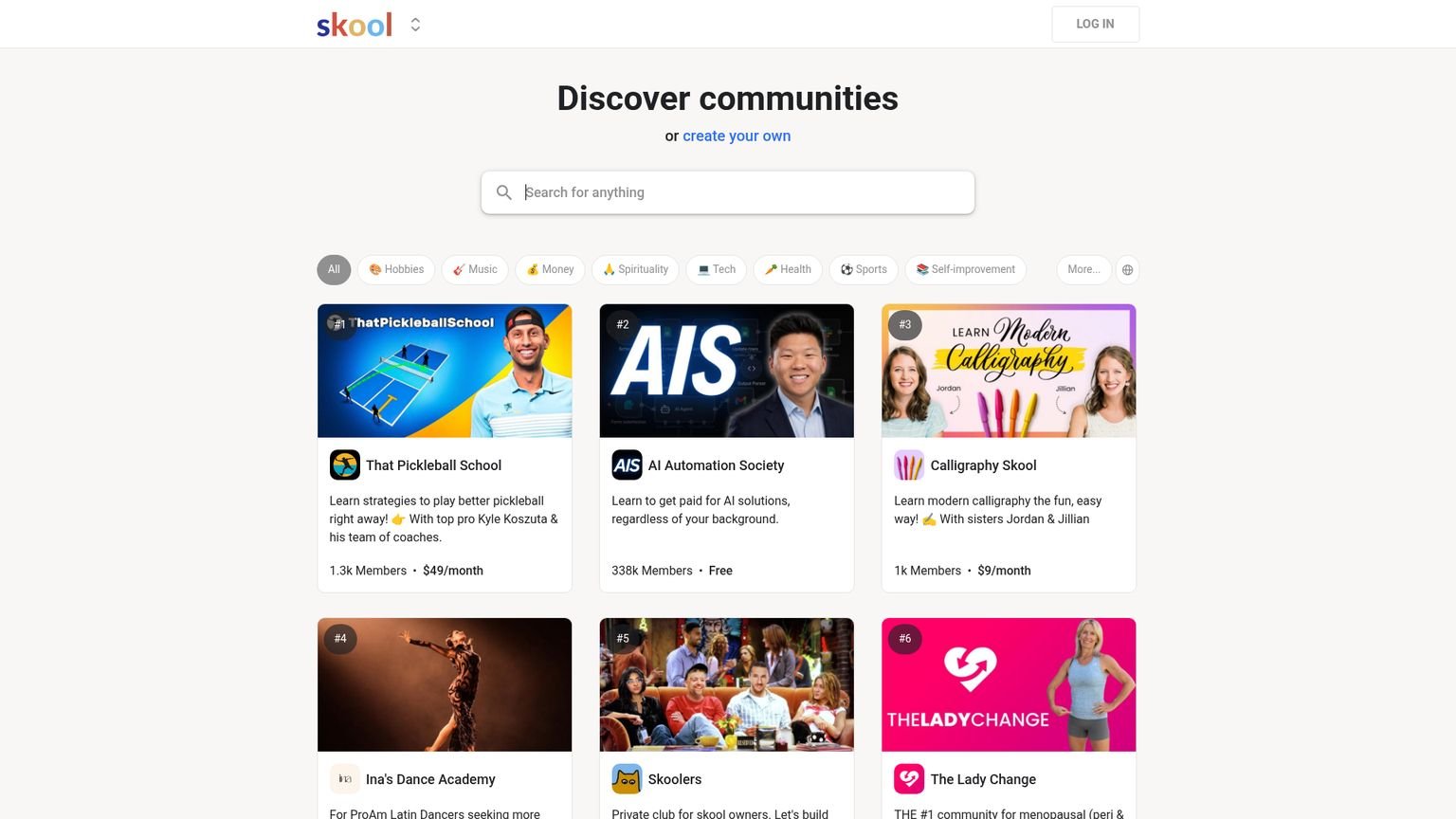
Skool and Circle are paid community platforms. Skool bundles a feed, courses, events and gamification at a flat price, with a public marketplace. Circle is the brandable alternative, with Spaces, custom domains and white-label branding for agencies and professional builders.
Skool launched in 2019 under Sam Ovens, founder of Consulting.com. Skool hosts communities across business education, fitness, AI, and creative niches. The platform packages community feed, course classroom, member directory, events, and gamification into one flat-priced product. Every community is also listed in the public Skool marketplace, which means organic discovery for every community owner regardless of plan. For the full plan-by-plan cost breakdown, see my Skool pricing guide.
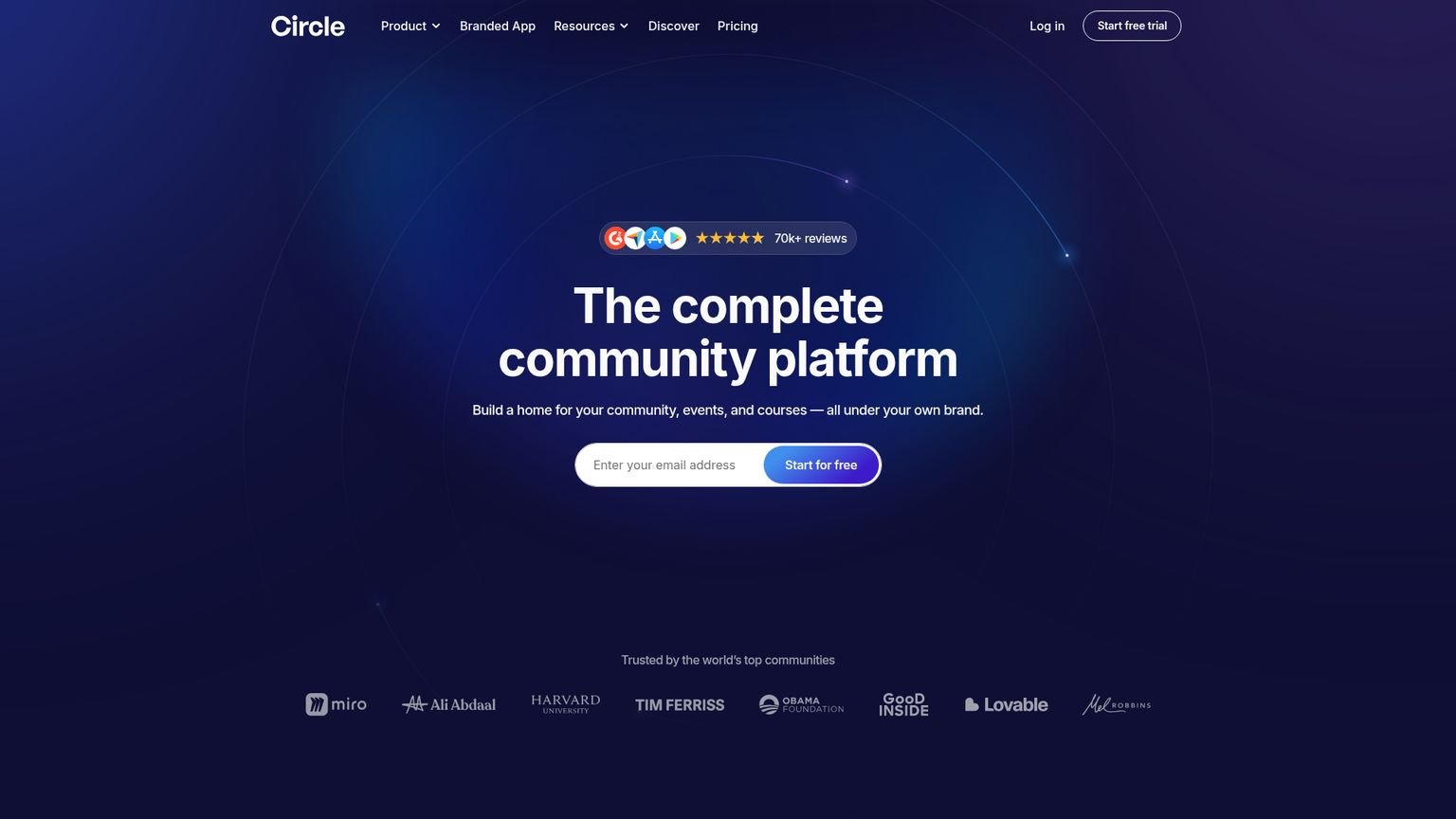
Circle launched in 2020 and positioned itself as the flexible, brandable alternative to Skool for professional community builders. Where Skool bets on simplicity and engagement, Circle bets on customization. You get multiple Spaces, custom domains, white-label branding, native drip content, advanced course types, and deep integrations with Zapier, Make, and a full REST API. Circle targets agencies, SaaS companies, and enterprise teams rather than individual creators. I broke down its full fee structure in my Circle.so pricing guide.
How Do Skool and Circle Fees Compare?
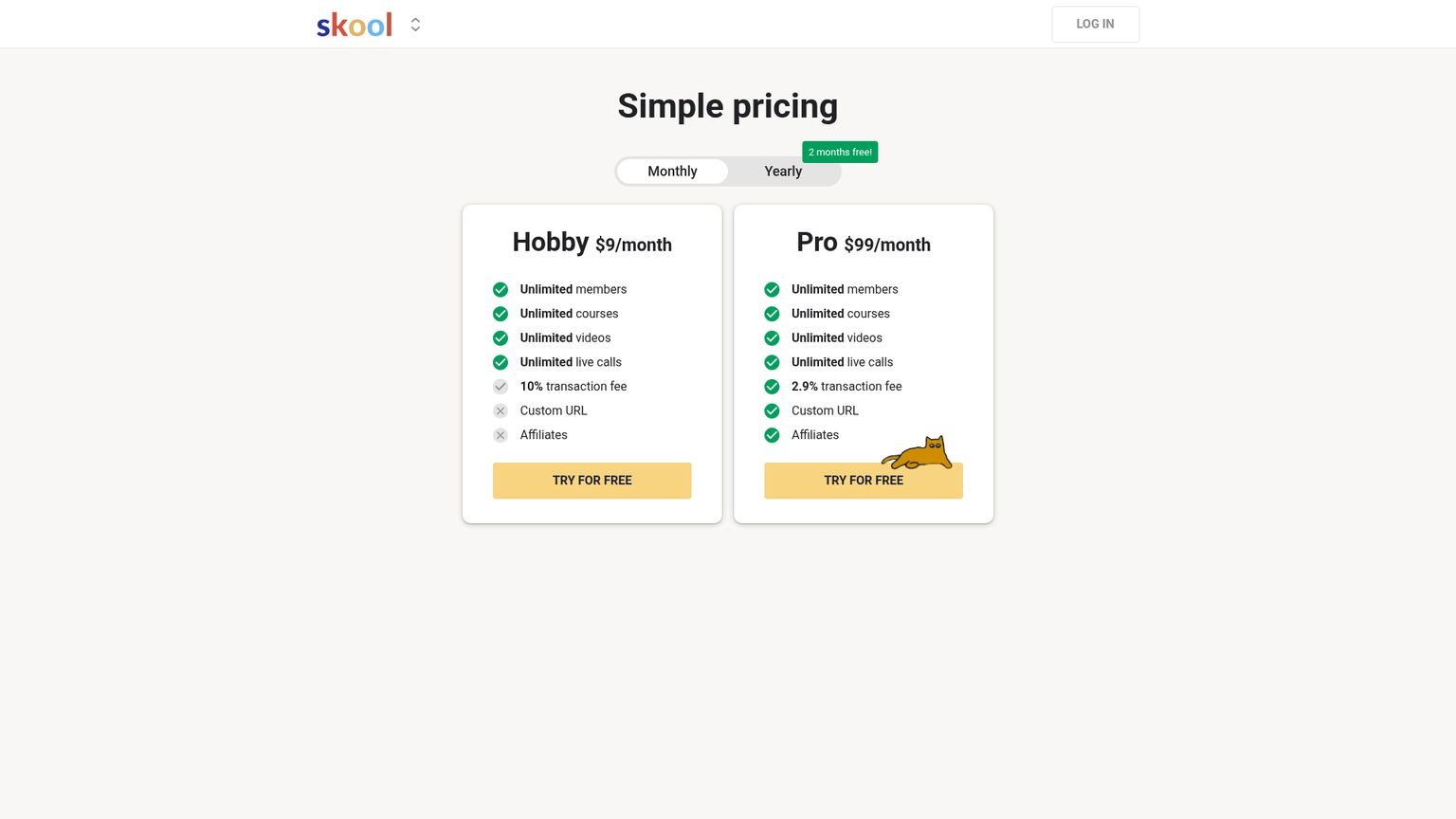
Skool’s pricing has two tiers: Hobby at $9/month plus a 10% transaction fee, and Pro at $99/month plus a 2.9% payment processing fee (Skool.com/pricing, August 2026). Transaction fees decide the Skool vs Circle cost more than subscription prices do.
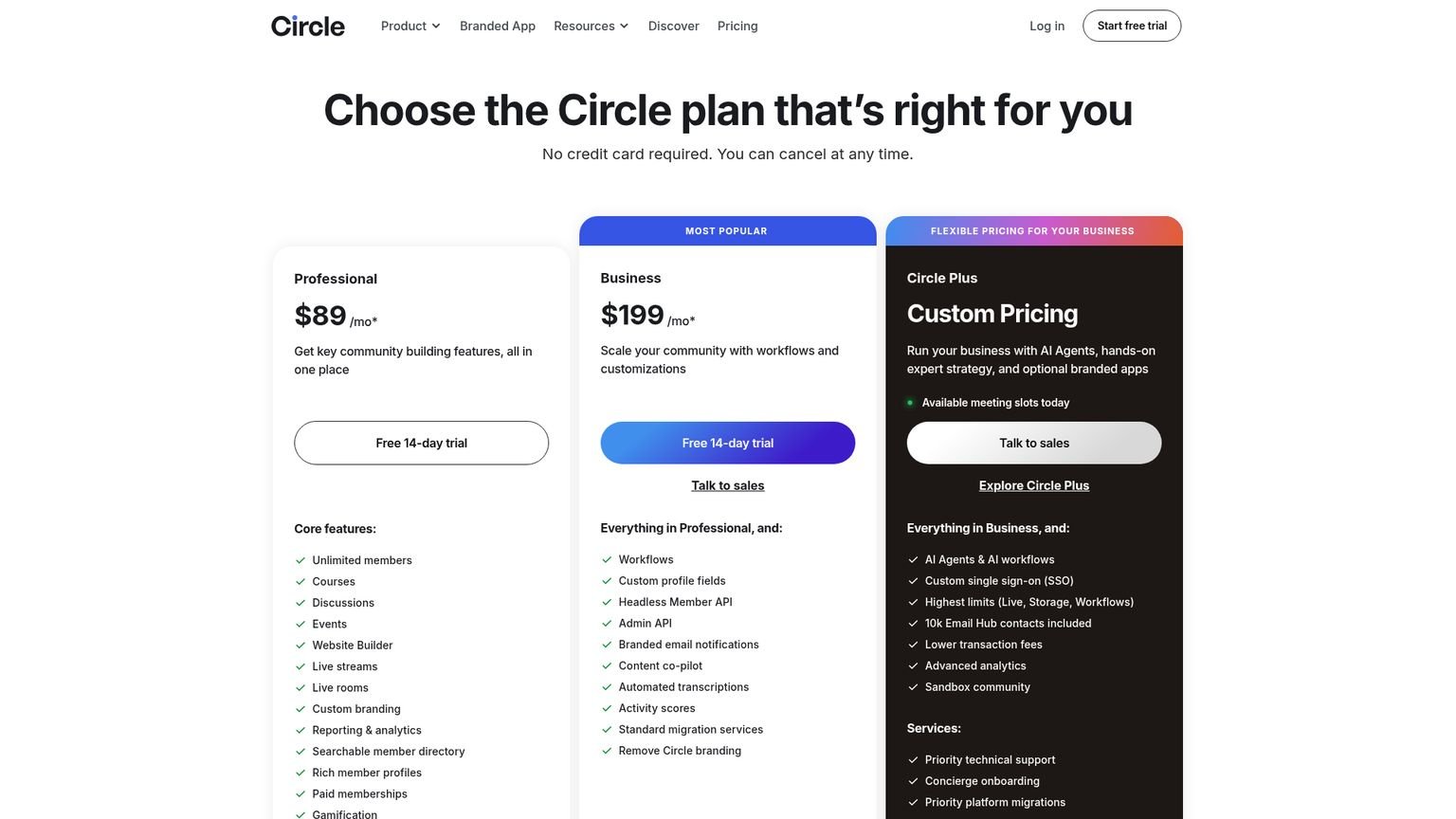
Circle’s pricing starts at $89/month (billed annually) for Professional with a 2% transaction fee, $199/month for Business at 1%, and custom pricing for Circle Plus at 0.5% (Circle.so/pricing, August 2026). The subscription gap between Skool and Circle looks small. The fee gap is where the real cost difference lives.
Skool pricing:
| Plan | Monthly Price | Transaction Fee |
|---|---|---|
| Hobby | $9/month | 10% per transaction |
| Pro | $99/month | 2.9% payment processing |
Circle pricing:
| Plan | Monthly Price | Transaction Fee |
|---|---|---|
| Professional | $89/month (annual billing) | 2% |
| Business | $199/month | 1% |
| Circle Plus | Custom | 0.5% |
Circle Professional includes 3 admin/moderator seats. Extra seats run $10/month each, so a team of six admins adds $30/month before you sell anything.
Here’s what you actually pay at different revenue levels (Circle Professional at $89 + 2%):
| Monthly Revenue | Skool Hobby | Skool Pro | Circle Professional |
|---|---|---|---|
| $500/month | $59 ($9 + $50) | $113.50 ($99 + $14.50) | $99 ($89 + $10) |
| $1,000/month | $109 ($9 + $100) | $128 ($99 + $29) | $109 ($89 + $20) |
| $3,000/month | $309 ($9 + $300) | $186 ($99 + $87) | $149 ($89 + $60) |
| $5,000/month | $509 ($9 + $500) | $244 ($99 + $145) | $189 ($89 + $100) |
| $10,000/month | $1,009 ($9 + $1,000) | $389 ($99 + $290) | $289 ($89 + $200) |
The break-even between Skool Hobby and Circle Professional is $1,000/month in community revenue. Below that threshold, Skool Hobby is cheaper. Above it, Circle wins and the gap widens fast. At $10,000/month, Circle Professional costs $289 against Skool Pro’s $389. That’s $100/month, or $1,200/year, back in your margin.
One more uncomfortable fact for Skool: Circle Professional undercuts Skool Pro at every revenue level. Circle’s base price is $10 lower and its fee is 0.9 points lower, so if you were going to pay $99/month for Skool Pro anyway, Circle is the cheaper subscription. What Skool Pro buys you instead is the marketplace and the gamification engine, which Circle can’t match at any price.
Most creators on Skool Hobby only compare subscription prices and ignore the fee load. At $1,000/month in sales, the “cheap” $9 plan actually costs $109. Do the fee math on your own projected revenue before you pick.
Which Has Better Community Features, Skool or Circle?
Skool’s community features drive higher engagement than Circle’s because of two mechanics Circle doesn’t offer: gamification and marketplace discovery. Circle wins on structure, with multiple Spaces and drip content.
Skool’s built-in leaderboards and level system reward members for posting, commenting, and completing course modules. These mechanics create habit loops without any configuration. Circle offers multiple Spaces and richer content organization, but no native engagement incentive system.
Gamification (Skool only): Members earn points for posting, commenting, and completing lessons. Points unlock levels. Leaderboards are visible to the full community. This creates competitive engagement that keeps members returning daily. Circle has no equivalent native feature. You’d need a third-party tool or Zapier integration to approximate it.
Marketplace discovery (Skool only): Every Skool community is publicly listed in the Skool marketplace. Potential members browsing the marketplace can find and join your community without you spending anything on ads. This is free distribution built into the platform. Circle has no marketplace. Every member you want must come from your own traffic channels.
Multiple Spaces (Circle only): Circle organizes content into separate Spaces. Think of each Space as a distinct channel or room. You can have a welcome Space, a general discussion Space, a course Space, a paid-tier Space, and a live events Space, all under one community. Skool uses a single community feed with topic tags. For complex community architectures, Circle’s Space system is more flexible.
Drip content (Circle only): Circle supports scheduled content release, where course modules unlock on a set schedule after a member joins. This is standard for cohort-based courses. Skool doesn’t offer native drip scheduling; all course content is available immediately on access.
Is Skool or Circle Better for Online Courses?
Circle is better for cohort courses, because Circle supports drip scheduling, multiple course types and finer member progress tracking. Skool is better for simple evergreen courses: the Skool classroom handles modules and lessons clearly, and most solo creators need nothing more complex.
Skool courses:
- Modules and lessons structure
- Video, text, and file uploads
- All content immediately accessible (no drip)
- Integrated with community: course completions trigger points
- No external hosting required
Circle courses:
- Multiple course types (self-paced, cohort, drip)
- Scheduled content release
- Progress tracking per member
- Standalone or bundled with community access
- Integration with Circle Spaces for cohort discussion channels
The decision between Skool and Circle for courses is really a question of delivery model. If you run evergreen, always-available courses, Skool’s simplicity wins. If you run live cohorts with structured release schedules, where the drip timing is part of the experience, Circle handles it natively and Skool doesn’t. This single feature difference drives most serious course creators toward Circle.
One-time product sales: Circle supports one-time payments natively. Skool’s checkout is built around membership subscriptions, and as of mid-2026 its one-time sales options remain limited compared to Circle’s. If standalone one-time course sales are core to your model, Circle handles them with less friction.
Is Skool or Circle Faster to Set Up?
Skool is faster to set up. A functional paid Skool community can run in under an hour. Circle needs an afternoon for Spaces, branding, access rules and automations before the community feels complete.
Skool is also simpler to operate day-to-day. Skool deliberately limits configuration options. There’s one community feed, one course section, one events tab. You can have a functional paid community running in under an hour. Circle has more capabilities, which means more setup. Custom Spaces, branding configurations, automation workflows, and course structures all require time and intentional architecture before your community feels complete.
In building test communities on both platforms, Skool took me about 45 minutes from signup to a publishable community. Circle took 3-4 hours to configure properly: Spaces, branding, access rules, and automation workflows. For solo creators who want speed over customization, this difference matters.
Skool setup checklist:
- Community name and description: 5 minutes
- Upload banner and logo: 5 minutes
- Add course content: 30 minutes
- Set subscription pricing: 5 minutes
- Done. Community is live.
Circle setup checklist:
- Configure community branding and custom domain
- Build Space architecture (welcome, discussion, courses, events)
- Set access rules per Space (free vs paid tiers)
- Configure Zapier/Make automations if needed
- Upload and structure course content
- Set payment options (subscription, one-time, bundles)
- Test member journey end to end
Neither Skool nor Circle is wrong here. Skool’s constraints are a feature for creators who want to ship quickly. Circle’s configuration depth is a feature for builders who need precise control.
How Do Skool and Circle Compare Feature by Feature?
Skool has gamification and marketplace discovery on every plan. Circle has multiple Spaces, drip content, one-time sales, white-label branding, custom domains, SSO and full Zapier/Make support. Both platforms include courses, events and a 14-day free trial.
| Feature | Skool Hobby | Skool Pro | Circle Professional | Circle Business |
|---|---|---|---|---|
| Monthly price | $9 | $99 | $89 (annual billing) | $199 |
| Transaction fee | 10% | 2.9% processing | 2% | 1% |
| Community feed | Single feed + topics | Single feed + topics | Multiple Spaces | Multiple Spaces |
| Gamification | Full (points, levels, leaderboards) | Full | None native | None native |
| Courses | Yes (always-on) | Yes (always-on) | Yes, multiple types | Yes, all types |
| Drip content scheduling | No | No | Yes | Yes |
| One-time product sales | Limited | Limited | Yes | Yes |
| Marketplace discovery | Yes (public directory) | Yes | No | No |
| White-label branding | No | No | Yes | Yes |
| Custom domain | No | No | Yes | Yes |
| Admin seats | n/a | n/a | 3 included (+$10/mo each) | 5 included |
| Zapier/Make integration | Limited | Limited | Full | Full |
| REST API | Limited | Limited | Yes | Yes |
| Branded mobile app | No | No | No | Yes (add-on) |
| Member email sequences | External tool required | External tool required | Via Zapier | Native |
| SSO support | No | No | Yes | Yes |
| Events and livestreaming | Yes | Yes | Yes | Yes |
| Free trial | 14 days | 14 days | 14 days | 14 days |
| SEO-indexed content | Via Skool marketplace | Via Skool marketplace | Custom domain SEO | Custom domain SEO |
Which Is Cheaper Long-Term: Skool or Circle?
The cheaper platform depends entirely on your revenue. Skool Hobby at $9/month beats Circle Professional below $1,000/month in community revenue.
Above that threshold, Circle’s lower fee wins every time, and the margin grows with revenue. At $3,000/month, Skool Pro costs $186/month against Circle Professional’s $149. At $10,000/month the gap is $100/month in Circle’s favor, or $1,200/year.
There’s a second cost dimension most people miss: the value of marketplace discovery. The Skool built-in marketplace sends organic members to your community without ad spend. If that discovery channel generates even 10 new members per month at a $30 subscription, that’s $300/month in revenue Skool surfaces for you that Circle doesn’t. Factor that into your cost model. The value of Skool’s network effect is real and doesn’t appear in a pricing table.
Run the fee math across the range from $200/month to $20,000/month and the pattern holds: Circle Professional becomes the lower total-cost option at $1,000/month in community revenue and keeps the cost advantage at every level above it.
Who Should Use Skool?
Skool is the right platform for solo creators, coaches, affiliate marketers, and AI niche community builders who want organic discovery, fast setup, and engagement-first community mechanics.
The Skool marketplace is the single most underrated feature in the community platform space. It’s free distribution: your community is publicly indexed and browsable by every Skool user on the platform.
The Skool Games mechanic amplifies this further. Community owners compete monthly on new member count. Top-ranked communities in each niche get featured placement in the marketplace, which drives more organic signups, which improves the ranking. It’s a growth flywheel Circle doesn’t have.
Skool is best for:
- Solo creators launching a first paid community (low-risk $9/month entry)
- Coaches in business, fitness, AI, or creative niches
- Affiliate marketers building list + community simultaneously
- Anyone whose target audience overlaps with existing Skool users
- Community owners generating less than $1,000/month in revenue
- Builders who prioritize speed of launch over configuration depth
One honest limitation: Skool has no native email automation. You need an external email platform (ConvertKit, ActiveCampaign, etc.) if you want sequences and segmentation connected to your community behavior. Circle handles this via Zapier natively. Budget for that integration cost when comparing platforms. If neither platform fits, I ranked the best Skool alternatives separately.
Who Should Use Circle?
Circle is the right platform for agencies building communities under a client’s brand, enterprise teams that need SSO and API integrations, and high-revenue community owners where low transaction fees and predictable scaling costs matter more than organic discovery.
The Circle white-label and custom domain features are non-negotiable for agency use cases. You cannot hand a client a community with Circle’s (or Skool’s) branding on every page if the deliverable is a branded product.
Circle is best for:
- Agencies building 3-5 client communities (white-label required)
- SaaS companies running customer success communities
- Enterprise teams needing SSO and REST API integration
- Cohort course creators who need drip scheduling built-in
- Community owners generating $1,000+/month who want lower fees
- Businesses selling one-time courses alongside subscriptions
Circle’s $89/month Professional plan is well-priced for what it delivers. Custom domain, white-label, Zapier, Make, full API, multiple Spaces, cohort course support, one-time payments: all included. Just remember the 2% transaction fee and the $10/month per extra admin seat when you model the real cost.
How Do You Migrate Between Skool and Circle?
Neither Skool nor Circle offers a native migration tool between the two platforms. Moving communities requires manual work in both directions.
A small to mid-size community with 200-500 members and 5-10 course modules takes roughly 1-2 weeks to migrate from Circle to Skool, and 2-3 weeks in the reverse direction because of the more complex structure rebuilding.
Moving from Circle to Skool:
- Export member list as CSV, re-import into Skool member management
- Re-upload video and file assets to Skool’s classroom
- Rebuild module and lesson structure manually
- Reorganize multi-Space architecture into Skool’s single feed with topic tags
- Zapier automations don’t transfer; recreate using Skool’s native options
- Gamification data starts fresh for all migrating members
- Time estimate: 1-2 weeks for a small to mid-size community
Moving from Skool to Circle:
- CSV export of member list, import into Circle member management
- Rebuild course content in Circle’s course builder (no compatible export format)
- Skool points and levels don’t transfer; members start at zero in Circle
- Rebuild branding, custom domain configuration, Space architecture
- Configure Zapier integrations for email tools
- Time estimate: 2-3 weeks, scaling with course content volume
Who should migrate from Skool to Circle: community owners who’ve reached 5,000+ paying members and need agency-level branding, or those whose revenue growth makes Circle’s fee structure cheaper.
Who should stay on Skool: anyone whose growth is materially driven by Skool marketplace discovery, and communities where daily gamification participation is visibly high.
Skool vs Circle: Verdict by Use Case
Solo creator, first paid community: Skool. The $9/month Hobby plan and marketplace discovery let you get your first 50 members without spending on ads. The gamification keeps early members engaged while you’re still building content.
Agency building communities for clients: Circle. You can’t deliver a client community with Skool branding on every page. Circle’s white-label and custom domain features are the only workable option for professional client delivery.
AI niche or business education community: Skool. The AI tools and automation ecosystem is heavily concentrated on Skool. Your target audience is already browsing the marketplace. Network effects favor staying where the audience is.
Enterprise or internal company community: Circle. SSO, REST API, and advanced automation integrations make Circle the fit for corporate use cases where IT requirements exist.
High-revenue community ($10K+/month): Circle. At $10,000/month, Circle Professional costs $289/month against Skool Pro’s $389 and Skool Hobby’s $1,009. That saving scales as revenue grows.
Cohort course creator: Circle. Native drip scheduling and one-time payment support make Circle the better fit when structured content release is core to your course design.
FAQ
Is Skool or Circle cheaper?
Skool Hobby at $9/month with a 10% transaction fee is cheaper than Circle Professional at $89/month with a 2% fee below $1,000/month in community revenue. Above that revenue level, Circle Professional’s lower fee makes it the cheaper option. At $3,000/month in community revenue, Skool Pro costs $186/month against Circle’s $149. (Skool.com/pricing and Circle.so/pricing, August 2026)
Does Circle really have zero transaction fees?
No. Circle charges a 2% transaction fee on the Professional plan, 1% on Business, and 0.5% on the custom Circle Plus tier (Circle.so/pricing, August 2026). The zero-fee claim shows up in a lot of comparisons and it’s outdated. Circle’s fees are much lower than Skool Hobby’s 10%, but they exist.
Does Skool have a free trial?
Yes. Skool offers a 14-day free trial on both Hobby and Pro plans. You can build your full community, add course content, set pricing, and test the platform before committing. Check the fine print on payment details before you start; I covered the details in my Skool free trial guide.
Which platform is better for online courses?
It depends on your course model. For evergreen, always-available courses with a community component, Skool’s classroom is simpler and more than sufficient. For cohort-based courses with drip scheduling, one-time payment options, or multiple course types, Circle is the stronger choice. Circle supports drip content natively; Skool does not.
Can you white-label Skool?
No. Skool shows its own branding across all community pages. There is no white-label option on either the Hobby or Pro plan. If you need your community to appear fully branded under your name with no Skool branding visible, for a client project or a branded product, Circle is the only option of the two platforms.
Which platform is better for the AI niche?
Skool. The AI tools, automation, and business education space is heavily concentrated on Skool’s platform as of 2026. The public marketplace means your AI community can be discovered organically by users already browsing Skool, without ad spend. Major AI communities including AI Video Bootcamp and AI Profit Boardroom operate on Skool.
Is Skool better than Circle for paid communities?
For solo creators, coaches and AI niche builders, yes. Skool’s marketplace discovery and gamification help a paid community grow without ad spend, and Skool Hobby is cheaper below $1,000/month in revenue. Circle is better for agencies that need white-label branding and for owners above $1,000/month, where Circle’s 2% fee costs less than Skool’s.
I already run a 300-member community on Circle. Is moving to Skool worth the migration hassle?
Only if your community earns under about $1,000 a month or you want Skool’s marketplace discovery. Below that revenue, Skool Hobby at $9 a month beats Circle Professional at $89. Above it, Circle’s 2% fee makes Circle cheaper, and at $3,000 a month Skool Pro costs $186 against Circle’s $149. The move itself takes 1 to 2 weeks for a 200 to 500 member community: export members as CSV, re-upload course files, and rebuild modules by hand. Gamification data starts from zero. If the numbers favor Skool, run the 14-day trial before you export anything. Try Skool free for 14 days
Related Reading
- Skool Reviews 2026
- 7 Best Skool Alternatives
- Skool Pricing 2026
- Circle.so Pricing 2026
- Skool vs Kajabi 2026
- Skool Free Trial 2026
Both platforms offer free trials. If you’re a solo creator or AI niche builder, try Skool free for 14 days and test the marketplace discovery firsthand. If you need white-label control for a client project, Circle’s 14-day trial is at circle.so.
Full pros & cons
- Flat predictable pricing with no complicated tier matrix
- Built-in marketplace for organic community discovery
- Gamification (points, leaderboards) drives member engagement
- All-in-one: community, courses, and events in one place
- Active AI and automation niche communities already on platform
- 10% transaction fee on Hobby plan eats into revenue fast
- No white-label or custom domain branding
- Limited advanced automation and third-party integrations vs Circle
Try it yourself
Ready to put it to the test?
We may earn a commission at no extra cost to you. Affiliate disclosure.
Reader feedback
Was this review helpful?
Your feedback helps us write better reviews.
Thanks for your feedback.

AI Funnel Insider is an independent review site covering AI tools, Skool communities, and online courses. Every review states what was paid for, what was accessed and what was verified before a verdict goes live. Reviews are independent and may contain affiliate links, at no extra cost to you.
Related Posts

Skool vs Kajabi 2026: Which Costs Less, Really?
Skool looks cheaper than Kajabi until you do the math on transaction fees. Which one actually costs less in 2026, with real numbers.

AI Profit Boardroom vs AI Video Bootcamp: Pick Right
AI Profit Boardroom vs AI Video Bootcamp: different goals, very different price tags. The honest side-by-side to pick the right one for you.

Skool vs Mighty Networks 2026: Which Fits You?
Skool vs Mighty Networks compared for 2026 on real pricing, transaction fees, engagement, and mobile apps, so you pick right before you commit.

Whop vs Skool 2026: The Fee Math Decides It
Whop takes 3% per sale, Skool charges a flat $99/mo. Which one actually costs less at your revenue level? Real fee math and a clear verdict inside.

ClickFunnels vs Systeme.io 2026: $17 Wins Until Ads Do
Systeme.io costs $17/month, ClickFunnels $97. I run funnels on ClickFunnels and tested Systeme.io's free plan. Here's which one wins for your stage.

8 Best Skool Alternatives 2026 (Ranked by Fees)
The 8 best Skool alternatives for 2026, compared on price, transaction fees, and features. See which one wins before you switch.
The Insider Newsletter
New Skool communities, scored.
Each Sunday: one newly reviewed Skool community, plus any price changes in the communities we track.