Skool vs Kajabi 2026: Which Costs Less, Really?
Evidence Review Built from public, vendor and customer evidence. We did not buy or use it.Skool looks cheaper than Kajabi until you do the math on transaction fees. Which one actually costs less in 2026, with real numbers.

- Review type
- Evidence Review. Built from public, vendor and customer evidence. We did not buy or use it.
- Last verified
- August 20, 2026
- Affiliate relationship
- Yes, disclosed above
| Closest alternatives | Price | Score |
|---|---|---|
| AI SEO Rainmakers | $319/month for new members (checked October 12, 2026) | 4.2/5 |
Short answer: Skool Hobby is cheaper below roughly $1,900/month in community revenue. Above that, Kajabi’s Basic plan at $143/month annual costs less than a fully working Skool setup, because Skool has no email marketing and you have to buy that separately. The $9 sticker price is real. It just stops being the whole bill fast.
Most “Skool vs Kajabi” posts copy two pricing pages into a table and end with “it depends on your needs.” That helps nobody. So I pulled both live pricing pages in August 2026, checked the fee schedules, and ran the break-even math at four revenue levels.
Last updated: August 2026
TL;DR: Skool wins if your product IS the community. Kajabi wins if you run a full creator business (courses, email, funnels, and a website in one place). Skool Hobby is $9/month with a 10% transaction fee, Skool Pro is $99/month with 2.9% + $0.30 (Skool, 2026). Kajabi’s cheapest publicly priced plan is now Basic at $179/month, or $143/month billed annually (Kajabi, 2026). The old $69 and $89 Kajabi entry prices are gone. Full math below.
Quick Navigation: Which Section Is Right for You?
Skip to the part that matters to you right now:
- I want to run a paid community with gamification and engagement → Who Should Use Skool
- I want an all-in-one business: courses + email + funnels + site → Who Should Use Kajabi
- I want the real pricing math, not the marketing version → Is Skool Really Cheaper
- I want a feature-by-feature verdict → Feature Comparison Table
What Are Skool and Kajabi? (They Solve Different Problems)
These two get compared because both serve the creator economy. They are built for different jobs. Skool is community-first: the feed, the gamification, and marketplace discovery ARE the product. Kajabi is a business operating system that happens to include a community module.
Skool was built by Sam Ovens and is backed by Alex Hormozi’s Skool Games initiative. The whole design runs on one thesis: engagement drives retention, retention drives revenue. Leaderboards, XP points, and discover-page traffic do the heavy lifting. Courses exist, but they play a support role. Skool reported more than 174,000 communities on the platform as of mid-2026.
Kajabi bundles courses, email marketing, sales funnels, a website builder, landing pages, checkout, affiliate management, and community under one monthly fee. Kajabi says creators have earned more than $12 billion on the platform (Kajabi, October 2026). Their community module got a full rebuild in early 2025.
One platform answers “how do I build a community people don’t abandon after 30 days?” The other answers “how do I run my whole creator business without paying for eight separate tools?” If you don’t know which question is yours, you are not ready to pick yet.
Is Skool Really Cheaper Than Kajabi?
At low revenue, yes. At real revenue, no.
The comparison people quote is “$9 vs $179.” That ignores the fee schedule on both sides. Skool Hobby takes 10% of every sale. At $3,000/month in community revenue that is $300 in fees sitting on top of a $9 subscription (Skool, 2026). Kajabi charges 2.9% + $0.30 per transaction through Kajabi Payments, and adds a surcharge if you route payments through a third-party processor instead (Kajabi, 2026).
Skool pricing (verified August 2026):
| Plan | Monthly | Annual | Transaction Fee |
|---|---|---|---|
| Hobby | $9/mo | 2 months free (about $7.50/mo) | 10% per sale |
| Pro | $99/mo | 2 months free (about $82.50/mo) | 2.9% + $0.30 per sale |
Both plans include unlimited members, unlimited courses, unlimited videos, community features, gamification, a built-in affiliate program, and a 14-day free trial.
Kajabi pricing (verified August 2026):
| Plan | Monthly | Annual | Kajabi Payments Fee | 3rd Party Surcharge | Products / Contacts |
|---|---|---|---|---|---|
| Basic | $179/mo | $143/mo | 2.9% + $0.30 | +2% | 5 / 2,500 |
| Growth | $249/mo | $199/mo | 2.8% + $0.30 | +1% | 50 / 25,000 |
| Pro | $499/mo | $399/mo | 2.7% + $0.30 | +0.5% | Unlimited / 100,000 |
This is the change most comparison posts have not caught up with. Kajabi used to sell a $69 or $89 Starter plan. It is no longer publicly priced. Starter still appears in Kajabi’s feature-comparison grid (1 product, 250 contacts, 5% third-party surcharge), but the entry point you can actually buy today is Basic. If an article quotes you $71/month for Kajabi, it is running on 2025 data.
Kajabi also runs promotional discounts on the annual plans at various points in the year, and currently offers a 30-day free trial rather than the old 14-day one. Check kajabi.com/pricing for the live offer before you commit.
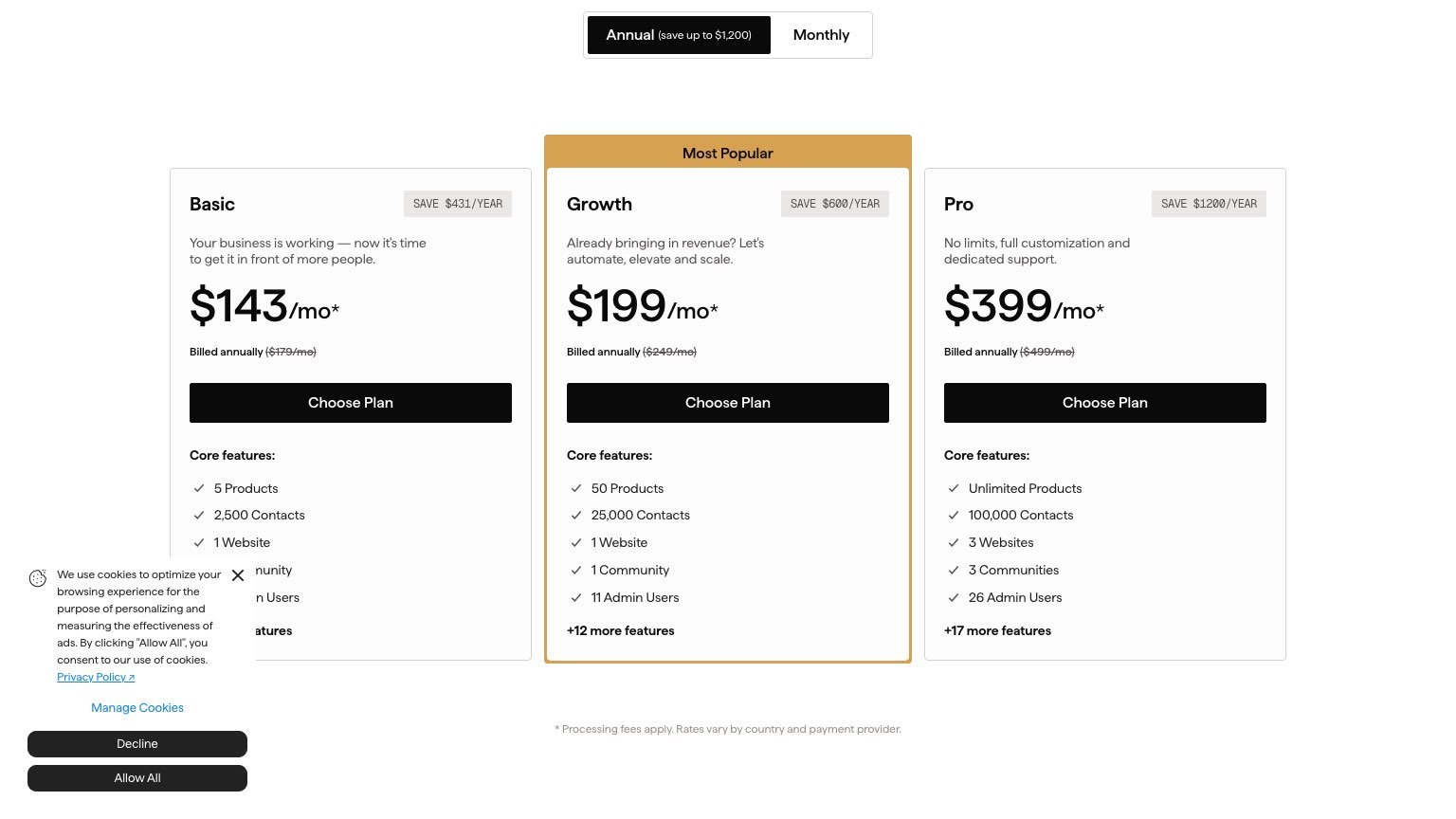 Kajabi’s current lineup: Basic, Growth, Pro. Processing fees apply on every plan through Kajabi Payments.
The Math Most Reviews Skip
I ran four revenue levels. Fee math assumes Kajabi Payments and Skool Pro’s 2.9%, and I have folded in a rough $0.30 per transaction at an average $100 order value.
| Monthly community revenue | Skool Hobby | Skool Pro | Kajabi Basic (annual) |
|---|---|---|---|
| $1,000 | $109 | $132 | $175 |
| $3,000 | $309 | $186 | $230 |
| $5,000 | $509 | $259 | $303 |
| $10,000 | $1,009 | $419 | $463 |
Two break-even points fall out of that.
The first: Skool Hobby stops making sense at about $1,270/month in revenue. Above that, the 10% fee costs more than the $90 gap between Hobby and Pro. If you are past that line and still on Hobby, you are donating money.
The second: Skool Hobby costs more than Kajabi Basic annual from about $1,900/month upward. That is a low bar, and it is a lot lower than it was when Kajabi’s entry plan was $71.
Then there is the cost layer nobody puts in the table. Skool has no email marketing at all. To run a business on it you need Kit (formerly ConvertKit) or ActiveCampaign at $29-$79/month, plus Zapier at $20-$49/month to connect them. That is $49-$128/month before you send a single email.
Working Skool Pro setup: $99 + $49-$128 email stack = $148-$227/month before transaction fees. Kajabi Basic annual: $143/month flat, with email, funnels, courses, community, checkout, and website included.
Kajabi Basic annual undercuts a fully equipped Skool Pro stack at every revenue level, because both charge the same 2.9% + $0.30 through their default processor. The fees cancel out and you are left comparing $143 against $148 minimum. That is the finding that actually matters, and it is the opposite of what the $9 headline suggests.
The $9 Skool story stays true for one specific case: a small community where the feed is the whole product and you have no list to email. For a real business, the math flips.
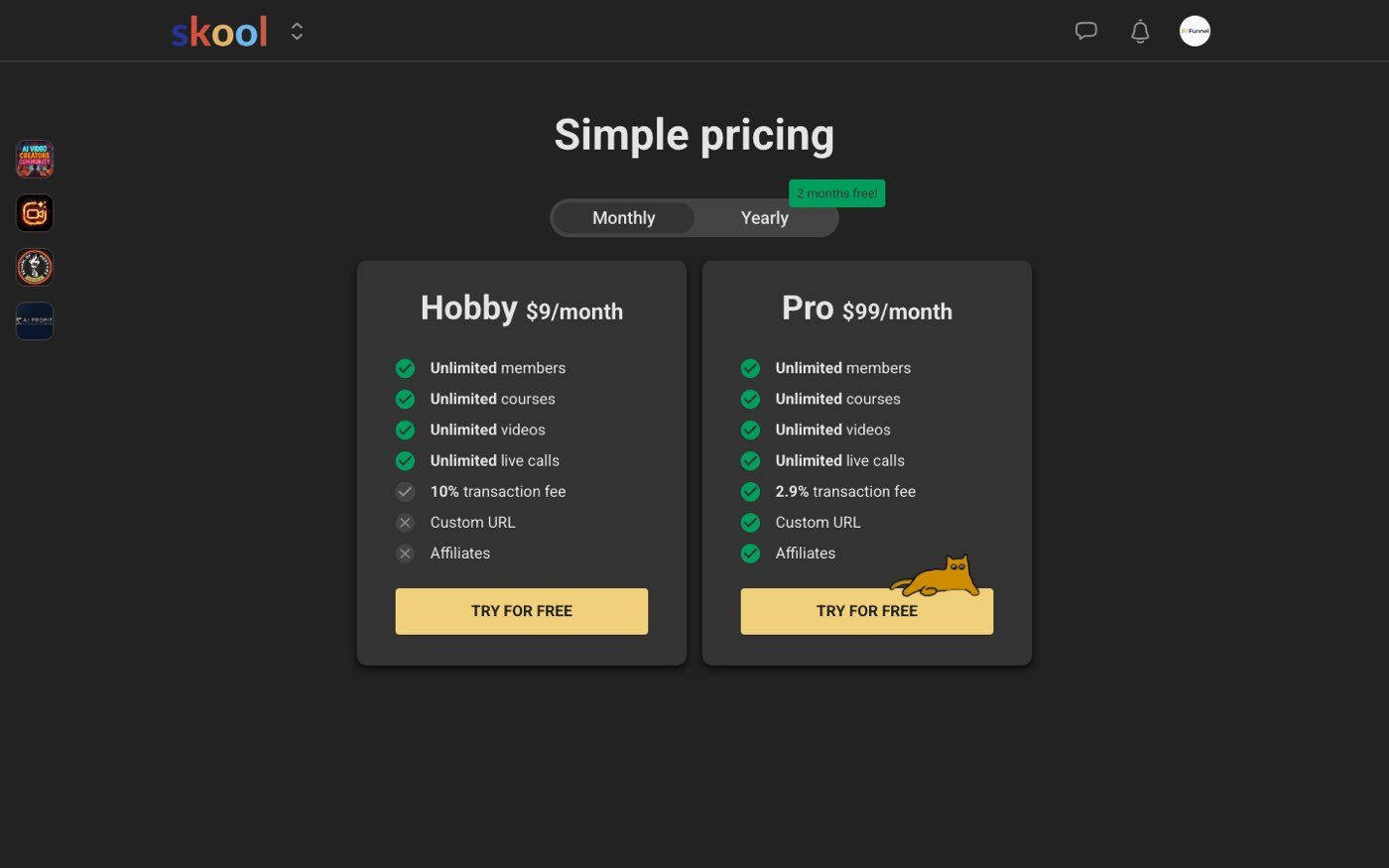 Skool’s two-tier pricing. The transaction fee is where the real cost lives for a high-revenue community.
If you want the fee breakdown on its own, I did a deeper pass in the Skool pricing 2026 guide.
Does Skool Have Email Marketing?
No, and this is the single biggest gap.
Skool sends automated community notifications for new posts, comments, and member activity. There is no broadcast email, no sequence builder, no subscriber list, no segmentation (Skool, 2026). You cannot send a promotional email to your own members from inside Skool. That was a deliberate call by Sam Ovens, who built the platform around feed engagement instead of email funnels.
If email is part of how you make money, you get two choices.
Option 1: external tool plus Zapier. Wire up Kit or ActiveCampaign through Zapier. It works. It adds $49-$128/month and a small amount of friction every single time you want to message your list.
Option 2: use Kajabi. Email is native. Behavioral triggers fire on member actions, and you can A/B test subject lines from the same dashboard where your courses live. Broadcasts, sequences, segmentation, and unlimited marketing sends are included on every paid tier.
The gap widens as your community ages. In month one the Skool feed is plenty, because everyone who joined is still excited. By month six you need email to reach the members who went quiet, win back churned trials, and announce new content. A community with no list outside Skool is renting its audience.
Kajabi Wins Course Delivery, and It Is Not Close
Kajabi offers drip scheduling, quizzes, assignments, completion certificates, cohort-based courses, and AI-assisted content creation through Creator Studio (Kajabi, 2026). Skool offers none of those. Skool’s classroom is closer to organized video storage: modules, lessons, and completion tracking.
Kajabi courses include:
- Drip content scheduling (release lessons over time)
- Quizzes with pass/fail logic
- Assignments with instructor review
- Completion certificates
- Cohort-based learning (fixed start dates, group progress)
- Video transcription and translation
- AI Creator Studio for content generation
Skool courses include:
- Modules and lessons
- Video embedding (native hosting added 2024)
- Level-gated content (unlocks at gamification level X)
- Completion tracking
- One-click purchase for standalone courses
 Kajabi’s course builder. Drip scheduling, quiz logic, and cohort options are all native.
 A Skool classroom. Clean and fast to build, with no drip or assessment tools. The simplicity is the strength and the ceiling.
Here is the test. If your promise is “transform in 8 weeks with our step-by-step program,” you need Kajabi’s structure to deliver it. If your promise is “join an active community and get daily accountability,” Skool’s classroom is enough, because the feed carries the value.
Feature-by-Feature Comparison Table
| Feature | Skool Hobby ($9/mo) | Skool Pro ($99/mo) | Kajabi Basic ($143/mo) | Kajabi Growth ($199/mo) |
|---|---|---|---|---|
| Community | Yes | Yes | Yes | Yes |
| Gamification (points, levels, leaderboards) | Yes | Yes | No | No |
| Marketplace discovery | Yes | Yes (boosted) | No | No |
| Online courses | Basic | Basic | Advanced | Advanced |
| Drip content | No | No | Yes | Yes |
| Quizzes and certificates | No | No | Yes | Yes |
| Email marketing | No | No | Yes | Yes |
| Sales funnels | No | No | Yes | Yes |
| Landing pages | No | No | Yes | Yes |
| Affiliate program | Yes | Yes | No | Yes |
| Analytics | Basic | Advanced | Standard | Advanced |
| Branded mobile app | No | No | No | No (Pro only) |
| Member limit | Unlimited | Unlimited | 2,500 contacts | 25,000 contacts |
| Transaction fee | 10% | 2.9% + $0.30 | 2.9% + $0.30 | 2.8% + $0.30 |
| Website builder | No | No | Yes | Yes |
| Free trial | 14 days | 14 days | 30 days | 30 days |
Two differences that don’t fit in a table:
Skool’s marketplace is the platform’s most underrated asset. Every public community shows up on the Skool discover page, which people actually browse when they are looking for somewhere to join. A well-run community in an active niche pulls organic new members from that browse traffic every month with no ad spend. Kajabi has no equivalent. Every Kajabi sale comes from marketing you paid for.
Kajabi’s limits are counted in contacts, not community members. Basic gives you 5 products and 2,500 contacts. Growth jumps to 50 products and 25,000 contacts for $199/month annual. Most people building a real list hit the contact ceiling before they hit the product one.
What Does Skool Actually Look Like Inside?
The feed is where Skool earns its retention reputation. Members open the app and land on a social-style stream of posts, wins, and questions instead of a static course library. That is the screen they come back to.
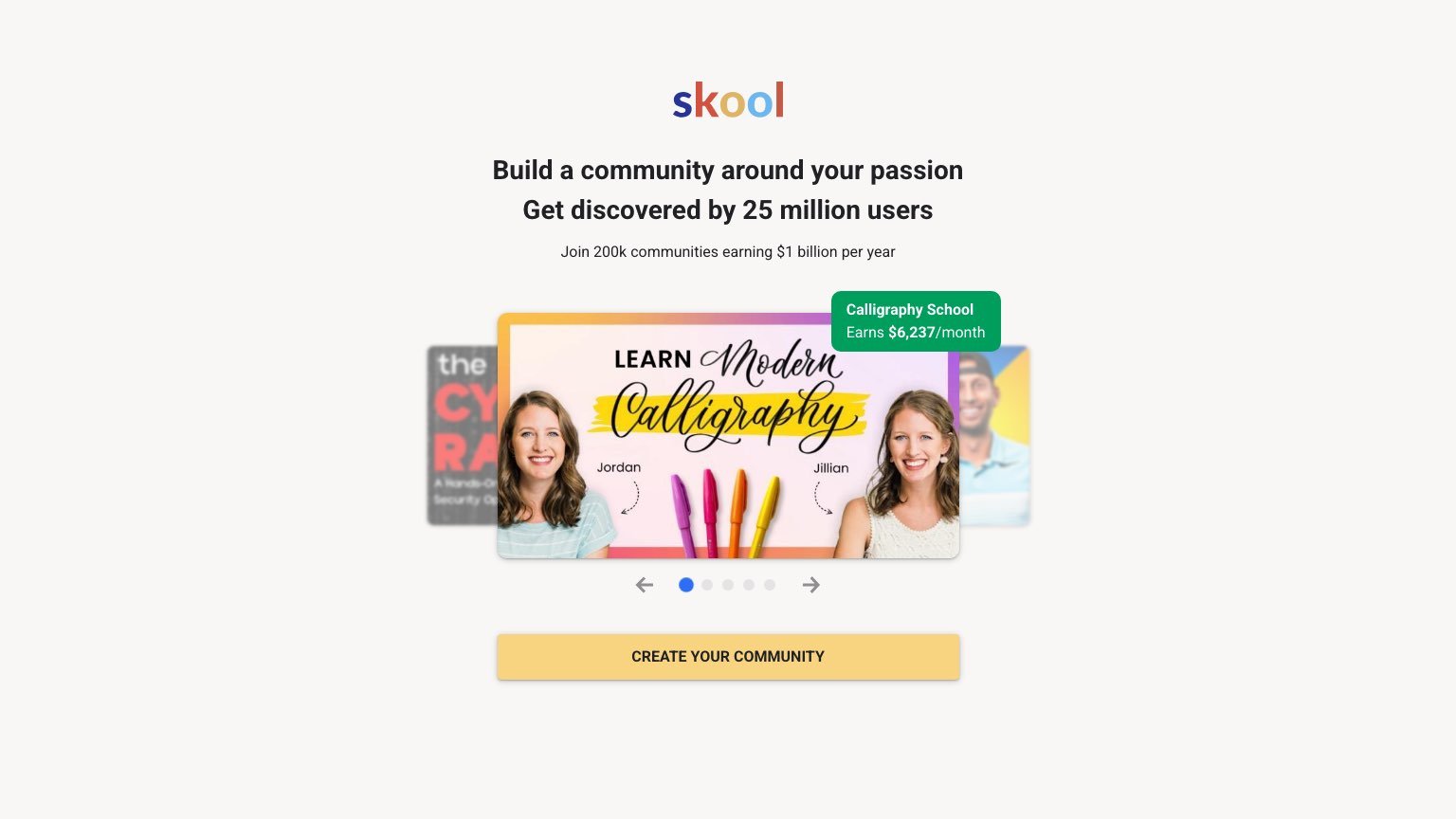 The Skool community feed. Members post wins, ask questions, share progress. Engagement happens here, not in the classroom.
The gamification loop runs in the background. Members earn XP for every post, comment, and completed lesson, and points unlock levels 1 through 9. You can gate a course so it only opens at a specific level, which gives people a reason to stay active. Weekly and all-time leaderboards restart the cycle.
Skool Games runs every 90 days: a competition where communities compete on new paid member growth, with Hormozi’s involvement. No competing platform has copied it. Communities that enter usually see a spike in both signups and existing-member activity during the contest window.
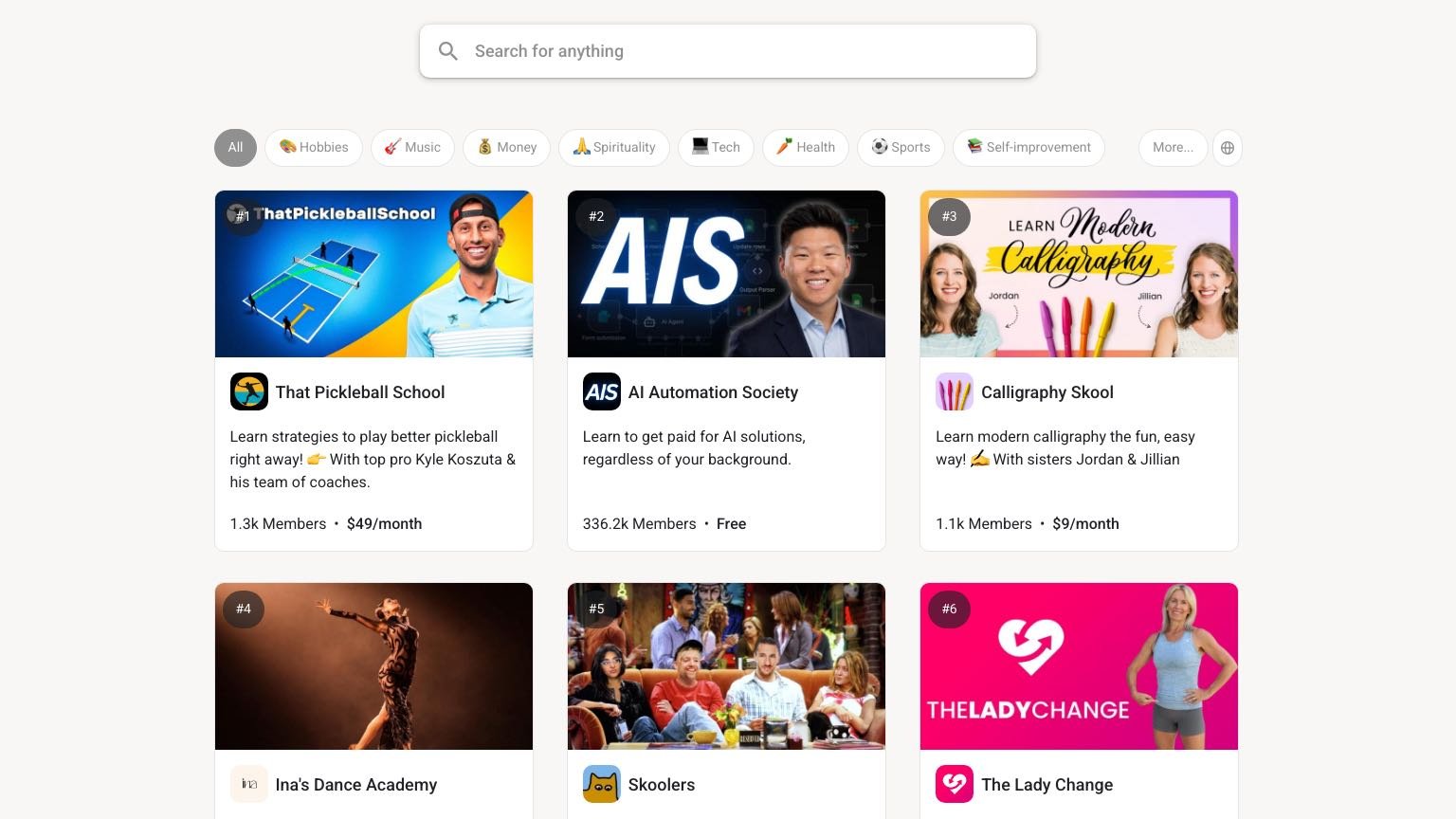 The Skool discovery page. Public communities are listed here for anyone browsing to find and join.
One real constraint: the mobile app is the shared Skool app, not yours. Your members open something with Skool’s branding on it, same as every other community on the platform. For a premium high-ticket offer where the experience signals the price, that matters.
What Does Kajabi Actually Look Like Inside?
Kajabi’s dashboard shows the whole business at once: products, revenue, contacts, funnel performance, email metrics. It is heavier than Skool. The learning curve is measured in days rather than minutes, and that is the price of the breadth.
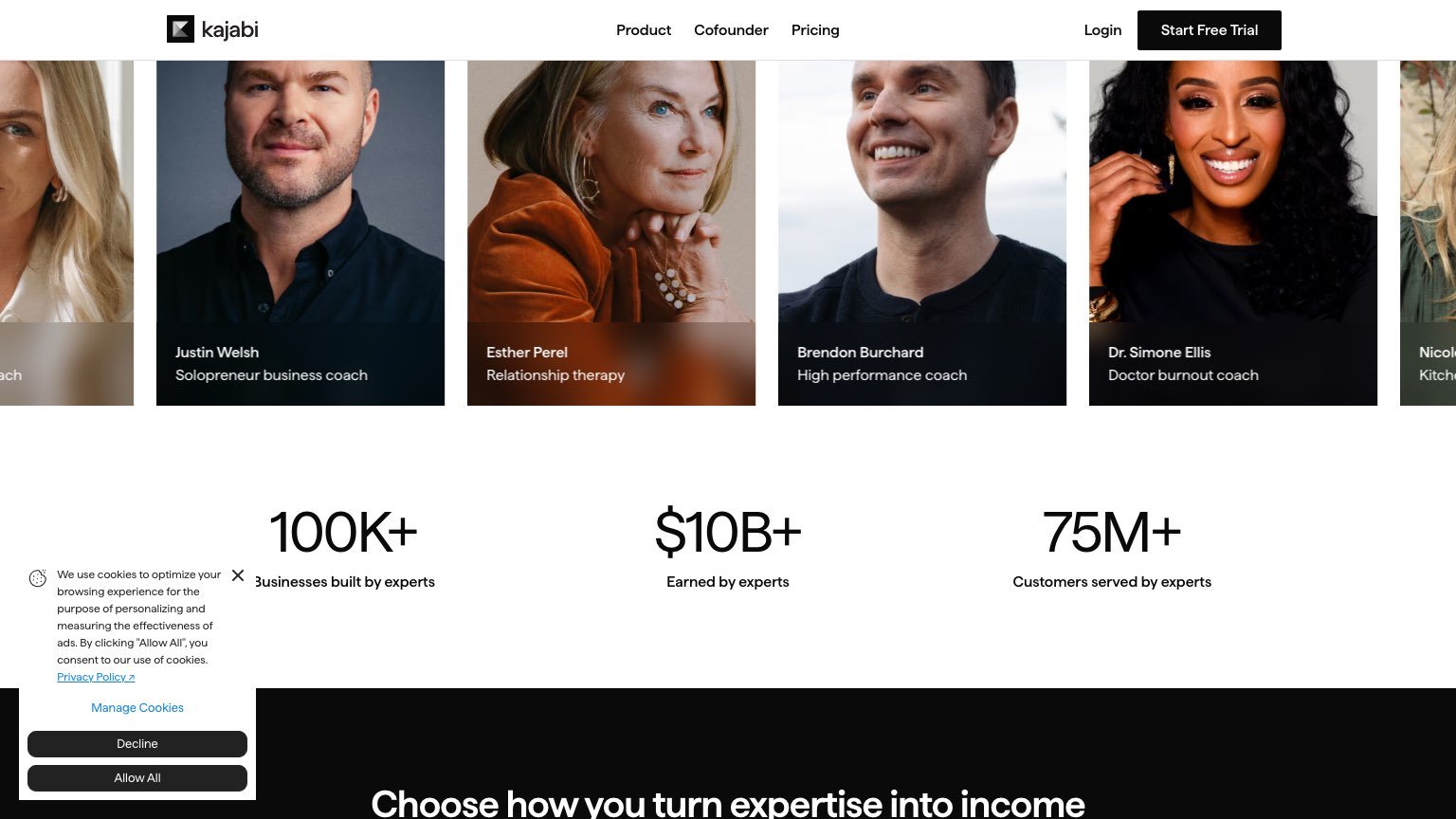 Kajabi’s product suite: courses, memberships, coaching, communities, newsletters, digital downloads.
The community module was rebuilt in early 2025. Kajabi now has Circles for segmented sub-groups, Meetups, Live Rooms, Challenges, and Check-ins. The old “Kajabi community is weak” complaint from 2023 is mostly out of date.
What Kajabi still does not have is gamification. No points, no levels, no leaderboards, no Games-style competition. The 2025 rebuild added structure and left the engagement mechanic untouched.
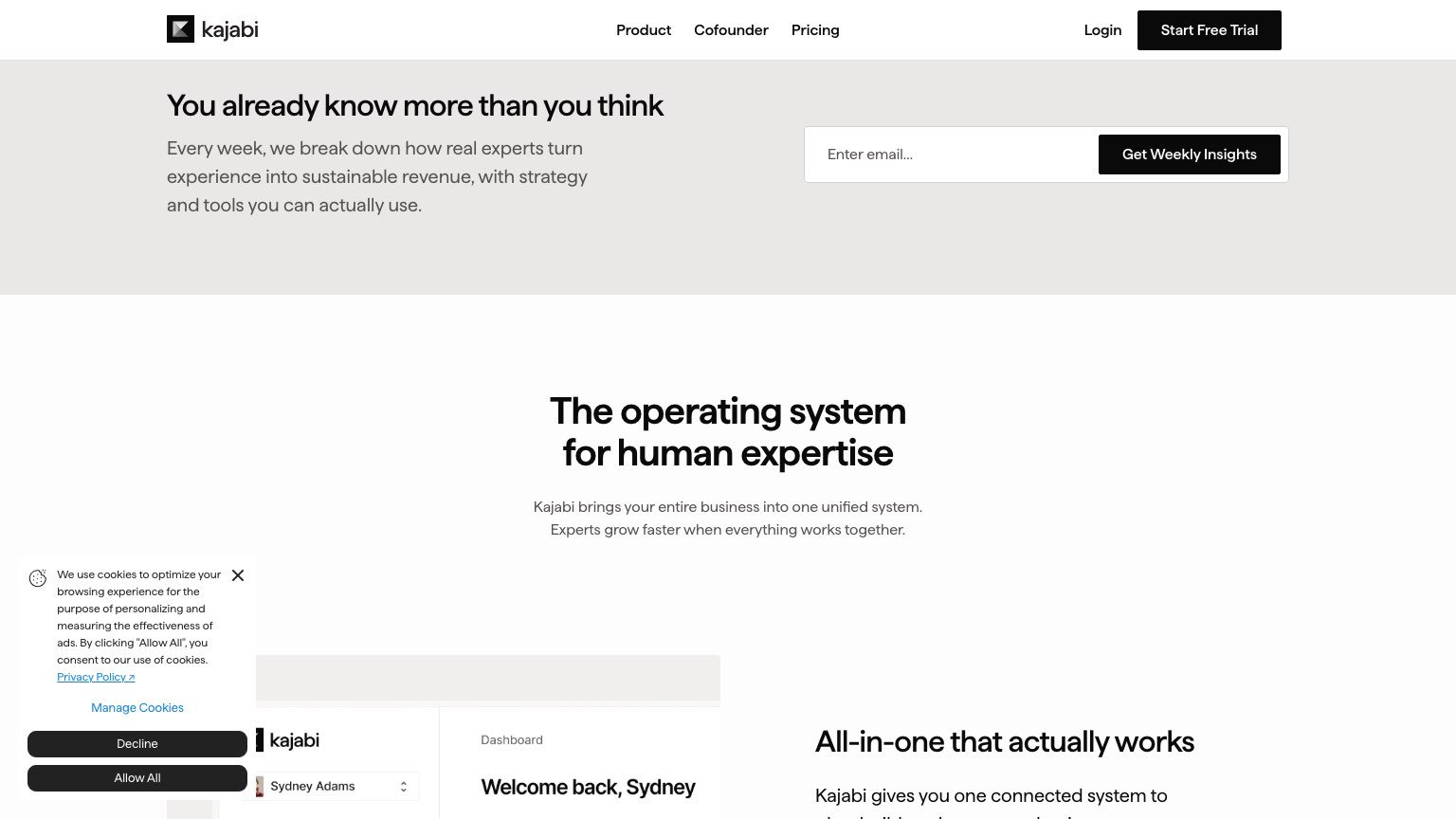 Kajabi’s community features: Circles, Meetups, Live Rooms, Challenges, Check-ins. Solid infrastructure, no gamification.
For coaching, Kajabi handles session scheduling, intake forms, Zoom integration, and payment collection in one product. For memberships with multiple tiers and drip access, it is more capable than Skool. The pipeline builder puts a full funnel together (opt-in page, email sequence, sales page, order form, upsell, delivery) without a second tool.
Which Has a Better Free Trial?
Kajabi does, right now. Kajabi is currently running a 30-day free trial, up from the 14 days it used to offer (Kajabi, 2026). Skool gives you 14 days on either plan. Skool’s trial does not ask for a card upfront. Kajabi’s does.
During your Skool trial you can:
- Build and publish your community
- Set up your course classroom
- Configure gamification and level gates
- Invite real members (they are not charged until your trial ends)
- Set up your affiliate program
During your Kajabi trial you can:
- Build a complete course with drip settings
- Set up an email sequence
- Create a landing page and checkout
- Test funnels with real opt-ins
- Configure community settings
Run them one after the other, not at the same time. Do Skool first, since it is faster to set up and you will know inside a week whether community engagement is genuinely your product. Then trial Kajabi if you need the infrastructure layer. Six weeks of hands-on beats thirty comparison articles. The Skool free trial guide covers the card requirement in more detail.
Who Should Use Skool
Coaches running group programs. The gamification does retention work you would otherwise do by hand. Members stay because the feed is alive, they are climbing levels, and the leaderboard publishes their progress in front of everyone.
Creators who want to launch this afternoon. Skool takes 15-30 minutes from signup to a live community. Configure the about page, set pricing, build a few modules, switch on gamification, done. Kajabi takes days. If you are validating an idea, that gap is worth real money.
Niches with strong community identity. Skool’s user base skews toward AI, automation, digital marketing, and personal development. Building in one of those means your audience already knows how the platform works, and discover-page traffic is a genuine acquisition channel.
Anyone running an affiliate offer. Both Skool plans include the affiliate program at no extra cost. Kajabi gates affiliate management to Growth at $199/month annual. Against Skool Pro at $99, that is a $100/month difference for the same capability.
The tax you pay for choosing Skool is not the transaction fee. It is managing email in a separate system forever and keeping the two in sync.
Who Should Use Kajabi
Kajabi earns its price in one specific situation: your business has enough moving parts that you would otherwise be paying for four or five tools.
You run a multi-product creator business. Courses, a coaching program, a newsletter, maybe a community. Kajabi consolidates them. At $143/month on Basic annual you are replacing an email tool ($29-$79), a landing page builder ($29-$49), a checkout tool ($29-$49), and a course platform ($29-$99). That stack runs $116-$276/month on its own.
Email is a revenue channel for you. If you nurture leads, send a weekly newsletter, and run launch sequences, Kajabi’s engine handles it natively. Triggers fire automatically when someone finishes a course, upgrades, or abandons checkout.
You need structured course delivery. If your offer promises a specific transformation with quizzes, progress gates, certificates, and reviewed assignments, Kajabi does it and Skool does not. The cohort feature lets you run synchronous group programs with a fixed start date.
Brand matters at your price point. Kajabi Pro at $399/month annual includes a fully branded mobile app in the App Store with your name and logo on it. For a premium offer, that beats sending customers to a generic shared app.
Basic at $143/month annual is the realistic entry point now that Starter is no longer sold. My rule: if you have not signed 20 paying customers yet, validate on Skool. Move to Kajabi when the business is real and the stack needs to hold weight.
Side-by-Side: Who Wins Each Category?
Community and engagement: Skool wins. Gamification, leaderboards, Skool Games, marketplace discovery. Kajabi’s 2025 rebuild competes on features but not on mechanics.
Online courses: Kajabi wins. Drip, quizzes, certificates, cohorts, AI content assist. Skool’s classroom handles basic delivery, not structured programs.
Email marketing: Kajabi by default. Skool has none. Kajabi includes unlimited sends, sequences, segmentation, and behavioral triggers on every plan.
Sales funnels: Kajabi only. Landing pages, order bumps, upsells, pipelines. On Skool, the community is the funnel.
Affiliate programs: Skool on both plans, Kajabi from Growth up. Kajabi Basic at $143/month does not include affiliate management. Skool includes it at $9.
Discovery: Skool, uniquely. The marketplace is a real acquisition channel. Kajabi has no equivalent.
Website and landing pages: Kajabi only. Skool has no website builder, so you need an external tool for sales pages.
Branded mobile app: Kajabi Pro. Skool uses the shared app for everyone.
Setup speed: Skool wins. Half an hour versus several days.
What Are the Alternatives If Neither Fits?
- Circle: cleaner community UX than Kajabi, more customization than Skool, with no funnels or email. See the Skool vs Circle comparison and the Circle.so pricing breakdown.
- Mighty Networks: more segmentation than Skool, lower engagement velocity. Full breakdown in Skool vs Mighty Networks.
- Whop: better for digital product storefronts than community-first offers. See Whop vs Skool.
- GoHighLevel: Kajabi-style infrastructure with more customization at a lower price. See the GoHighLevel review 2026.
- Teachable and Thinkific: course-first platforms with weak community. See Kajabi vs Teachable.
If you want the wider field, I ranked eight options in best Skool alternatives 2026.
Our Verdict
The decision splits on one question. Is the community your product, or does the community support another product?
If you are building a coaching group, a mastermind, or a niche membership where daily engagement is the value, go Skool. Get on Pro once you clear roughly $1,270/month in revenue, because the 10% Hobby fee overtakes the subscription gap right there. The marketplace traffic and the gamification are worth paying for.
If you are launching a full creator business with structured courses, a list you actually mail, several products at different price points, and evergreen funnels, go Kajabi. Basic at $143/month annual is now cheaper than Skool Pro plus the email stack you would need to bolt on, and you stop paying the integration tax on six separate tools.
If you are early and have not validated demand, trial Skool first. It costs less while you find product-market fit, sets up in half an hour, and forces you to think about engagement from day one. Graduate to Kajabi when the infrastructure starts to matter.
Key Takeaways
- The Kajabi entry price changed. Starter at $69-$89 is no longer publicly sold. Basic at $179/month, or $143 annual, is the real starting point in 2026. Any post still quoting $71 is out of date.
- Two break-even points: Skool Hobby loses to Skool Pro above about $1,270/month in revenue, and loses to Kajabi Basic annual above about $1,900/month.
- The hidden Skool cost is email. Budget $49-$128/month for Kit or ActiveCampaign plus Zapier. That pushes a working Skool Pro stack past Kajabi Basic.
- Course depth goes to Kajabi: drip, quizzes, certificates, cohorts. Skool’s classroom covers modules and video.
- Engagement goes to Skool: points, levels, leaderboards, and Skool Games still have no Kajabi equivalent after the 2025 rebuild.
- Trial length flipped. Kajabi now runs 30 days, Skool runs 14.
FAQ
Is Skool cheaper than Kajabi?
Below about $1,900/month in community revenue, yes. Skool Hobby is $9/month plus 10% per sale. Kajabi’s cheapest publicly priced plan is Basic at $179/month, or $143 billed annually, plus 2.9% + $0.30 through Kajabi Payments. At $1,000/month in revenue Skool Hobby costs about $109 against Kajabi Basic’s $175. At $5,000/month, Skool Hobby’s fees hit $500 and Kajabi Basic comes in around $303. Add the email tool Skool does not include and Kajabi Basic is the cheaper working setup at essentially any revenue level.
How much does Kajabi cost in 2026?
Basic is $179/month, or $143/month billed annually, with 5 products and 2,500 contacts. Growth is $249/month, or $199 annual, with 50 products and 25,000 contacts. Pro is $499/month, or $399 annual, with unlimited products and 100,000 contacts. Kajabi Payments charges 2.9% + $0.30 on Basic, 2.8% on Growth, 2.7% on Pro. A third-party processor adds 2% on Basic, 1% on Growth, 0.5% on Pro. The old Starter plan is no longer publicly priced.
Does Skool have email marketing?
No. Skool sends automated community notifications only: new posts, comments, member activity. There is no broadcast email, sequence builder, list segmentation, or behavioral trigger. To email your members you need a separate tool like Kit or ActiveCampaign connected through Zapier, which adds $49-$128/month to Skool’s real cost.
Which is better for online courses?
Kajabi, clearly. It includes drip scheduling, quizzes, assignments, completion certificates, cohort learning, and AI-assisted content creation. Skool’s classroom handles modules and video hosting with no drip, assessments, or certificates. If structured delivery with milestone tracking is your core offer, Kajabi is the right call.
Does Kajabi have transaction fees?
Yes. Kajabi Payments charges 2.9% + $0.30 per transaction on Basic, 2.8% + $0.30 on Growth, and 2.7% + $0.30 on Pro. Using a third-party processor other than PayPal adds a surcharge on top: 2% on Basic, 1% on Growth, 0.5% on Pro. The “no transaction fees” line in Kajabi’s marketing means no extra platform cut on top of payment processing. The processing fee itself still applies.
Which one has a better free trial?
Kajabi, currently. Kajabi runs a 30-day free trial and asks for a credit card. Skool runs 14 days on either plan with no card required upfront. Trial Skool first anyway, since it sets up in half an hour and you will know quickly whether the community-first model fits your offer.
Which is better for community engagement?
Skool, by a wide margin. XP points, levels 1 to 9, weekly leaderboards, level-gated content unlocks, and the quarterly Skool Games competition build loops that keep members active between your content drops. Kajabi’s 2025 rebuild added Circles, Meetups, Live Rooms, and Challenges, but there is still no points system, no leaderboard, and nothing like Skool’s discover page.
Can you migrate from Skool to Kajabi later?
Yes, with manual work. Member data exports from Skool as a CSV. Course content has to be rebuilt inside Kajabi, since there is no automated import. For a community of 100-500 members and five or more courses, plan on 1-2 weeks. The culture does not migrate. Rebuilding member activity on a new platform takes deliberate re-onboarding.
Try it yourself
Ready to put it to the test?
We may earn a commission at no extra cost to you. Affiliate disclosure.
Reader feedback
Was this review helpful?
Your feedback helps us write better reviews.
Thanks for your feedback.

AI Funnel Insider is an independent review site covering AI tools, Skool communities, and online courses. Every review states what was paid for, what was accessed and what was verified before a verdict goes live. Reviews are independent and may contain affiliate links, at no extra cost to you.
Related Posts

Skool vs Circle 2026: The 10% Fee Changes Everything
Skool is cheaper upfront but charges a 10% fee. Circle costs more and still takes 2%. Which community platform actually wins for you? Verdict inside.

AI Profit Boardroom vs AI Video Bootcamp: Pick Right
AI Profit Boardroom vs AI Video Bootcamp: different goals, very different price tags. The honest side-by-side to pick the right one for you.

8 Best Skool Alternatives 2026 (Ranked by Fees)
The 8 best Skool alternatives for 2026, compared on price, transaction fees, and features. See which one wins before you switch.

Skool vs Mighty Networks 2026: Which Fits You?
Skool vs Mighty Networks compared for 2026 on real pricing, transaction fees, engagement, and mobile apps, so you pick right before you commit.

Whop vs Skool 2026: The Fee Math Decides It
Whop takes 3% per sale, Skool charges a flat $99/mo. Which one actually costs less at your revenue level? Real fee math and a clear verdict inside.

ClickFunnels vs Systeme.io 2026: $17 Wins Until Ads Do
Systeme.io costs $17/month, ClickFunnels $97. I run funnels on ClickFunnels and tested Systeme.io's free plan. Here's which one wins for your stage.
The Insider Newsletter
New Skool communities, scored.
Each Sunday: one newly reviewed Skool community, plus any price changes in the communities we track.