Circle.so Pricing 2026: Real Cost After the Fees
Circle.so's sticker price is $89 to $199, but transaction fees and add-ons change the math. Full 2026 cost breakdown vs Skool before you commit.

TL;DR: Circle.so pricing in 2026 starts at $89/month (Professional, annual) and climbs to $419/month (Scale), with 0.5-2% transaction fees stacked on Stripe’s 2.9% + $0.30. Per Circle.so pricing, there is no free plan. Add Email Hub ($99/mo) and the fees, and a 100-member paid community runs roughly $277-$405/month. That is about double Skool Pro at $99/mo.
How much does Circle.so cost in 2026?
Circle.so pricing starts at $89/month on the Professional plan (annual billing) and $99/month on monthly billing, per the Circle.so pricing page as of October 2026. Business is $199/month annual or $219/month monthly. Scale is $419/month, and Circle Plus is custom pricing above that. Every tier includes unlimited members and a 14-day free trial.
Transaction fees run 2% on Professional, 1% on Business and Scale, and 0.5% on Plus. Those sit on top of Stripe’s 2.9% + $0.30 processing rate (Stripe, 2026). I re-checked all of these numbers on Circle’s live pricing page in October 2026.
Every Circle shopper I’ve talked to underestimates the real monthly number. They see $89 and budget $89. The first invoice lands closer to $230 once Email Hub and the first transaction fee cycle hit.
Pay Circle if you need multi-space architecture, white-label, API access, and you charge $100+ per member.
Skip Circle if you’re a solo creator, running a single community, or testing the model. Skool Pro at $99/mo flat with no platform fee is cheaper until roughly 500 paid members.
What’s included in each Circle.so tier?
Circle.so runs four tiers as of October 2026: Professional ($89/mo annual), Business ($199/mo annual), Scale ($419/mo), and Circle Plus (custom). Every Circle.so plan includes unlimited members. Admin seats, spaces, storage, and fee rates scale by tier (Circle.so pricing, 2026).
The old Basic plan at $39-49/month was retired in 2024, so the Circle.so entry floor is now $89/mo.
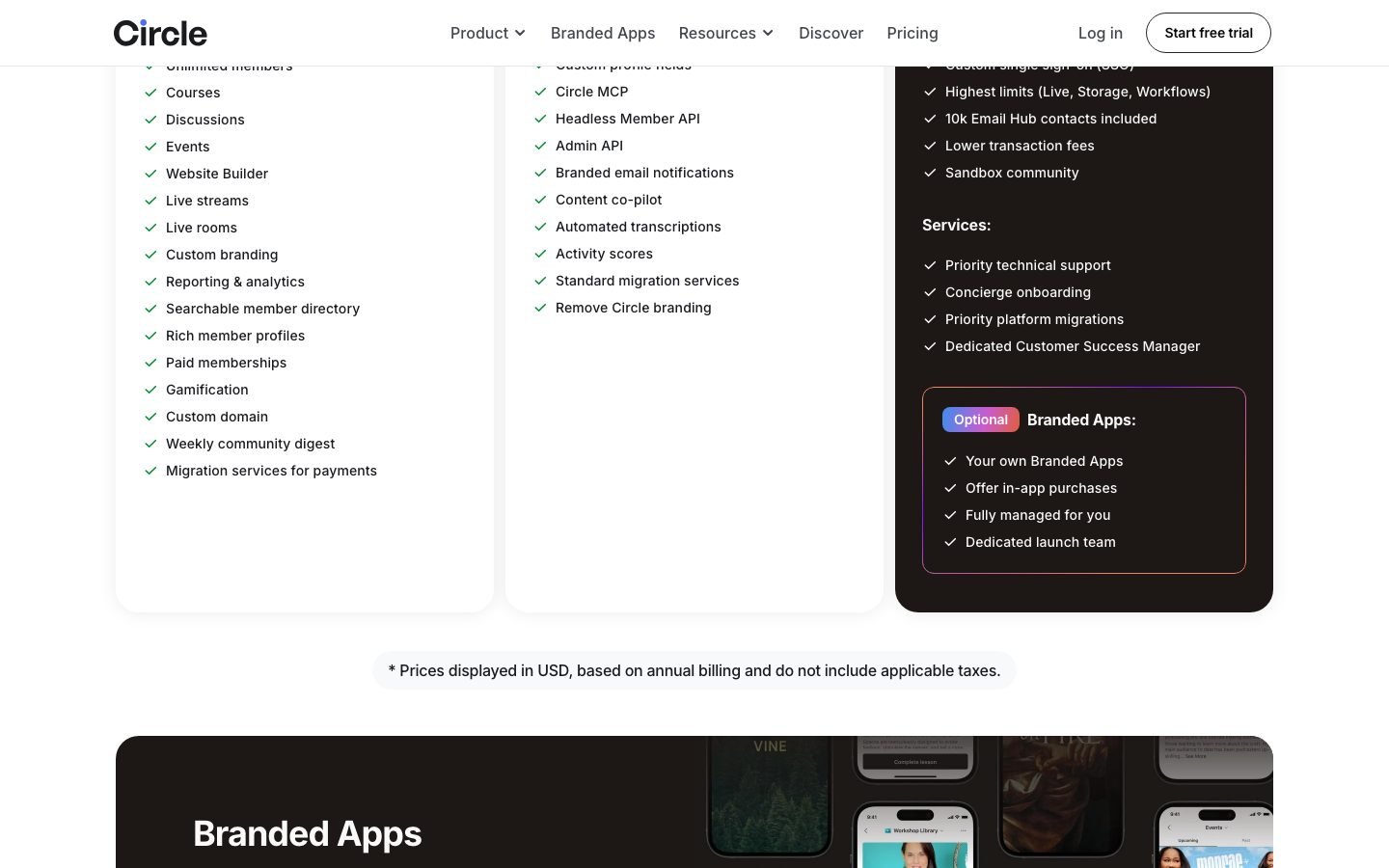
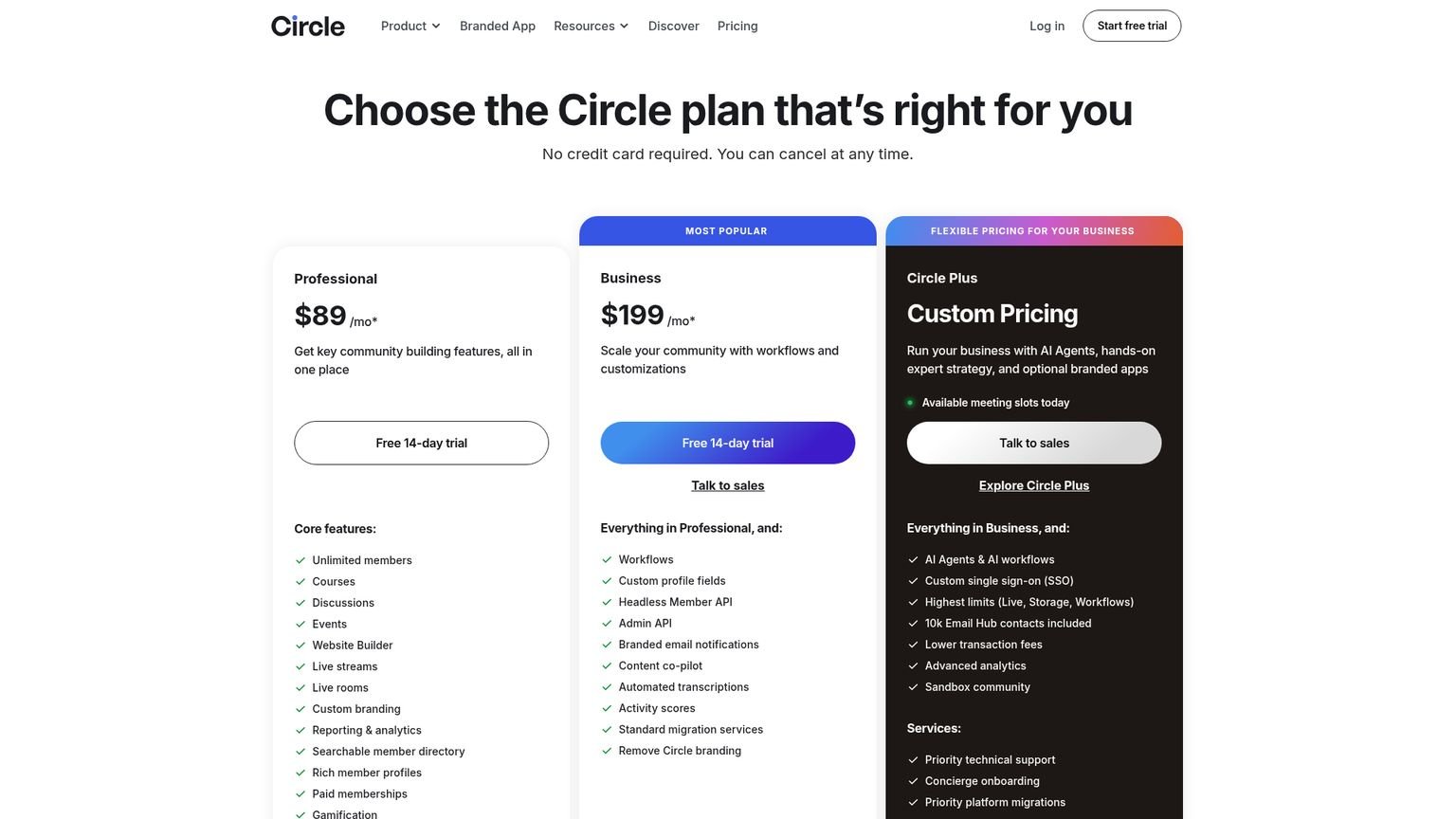
Full pricing table (all tiers)
| Plan | Monthly | Annual (effective) | Members | Admins | Spaces | Storage | Live attendees | Transaction fee | Best for |
|---|---|---|---|---|---|---|---|---|---|
| Basic (legacy) | Discontinued | Discontinued | n/a | n/a | n/a | n/a | n/a | n/a | No longer sold |
| Professional | $99/mo | $89/mo | Unlimited | 3 | 20 | 200 GB | 100 | 2% | Solo creators, single community |
| Business | $219/mo | $199/mo | Unlimited | 5 | 30 | 500 GB | 200 | 1% | Paid communities needing API + workflows |
| Scale | $419/mo | $419/mo | Unlimited | 10 | 100 | 1 TB | 500 | 1% | AI agents, webhooks, custom SSO |
| Circle Plus | Custom | Custom | Unlimited | Unlimited | Flexible | Negotiable | Custom | 0.5% | Agencies, enterprise, branded apps |
| Enterprise | Retired, merged into Plus | n/a | n/a | n/a | n/a | n/a | n/a | n/a | Replaced by Circle Plus |
Professional locks you out of automation, API access, workflows, and white-label. Most serious operators want at least one of those within 60 days. Getting them means jumping to Business at $199/month, a 2.2x price hike.
Does Circle.so have a free plan?
No, Circle.so does not have a free plan in 2026. The cheapest paid tier is Professional at $89/month (annual), and the only free access is a 14-day trial with no credit card required (Circle.so, 2026).
Skool, by contrast, sells a $9/month Hobby tier, so Circle.so has no budget entry point at all. The old Circle Basic tier was killed off. Circle now positions itself as a mid-to-high-end platform and prices accordingly.
What are Circle.so’s transaction fees?
Circle.so transaction fees in 2026 are 2% on Professional, 1% on Business and Scale, and 0.5% on Circle Plus, charged on top of Stripe’s 2.9% + $0.30 per transaction (Circle.so pricing, October 2026). Effective total processing cost is 4.9%, 3.9%, or 3.4% depending on tier. No public tier removes the platform fee entirely.
On a $49 membership sold through Professional, the combined cut is about 4.9%, or nearly $2.40 per transaction, before you count the subscription itself.
Here’s the math on a $49/month membership with 200 paying members (~$9,800 MRR):
| Plan | Circle fee | Stripe fee (~2.9%) | Plan sub | Total monthly cost | % of revenue |
|---|---|---|---|---|---|
| Professional ($89) | $196 | $284 | $89 | $569 | 5.8% |
| Business ($199) | $98 | $284 | $199 | $581 | 5.9% |
| Scale ($419) | $98 | $284 | $419 | $801 | 8.2% |
Professional and Business basically tie on total cost at this scale. The “lower fee” on Business only pays back above ~$22k MRR.
Same 200 members on Skool Pro pay $99 + ~$284 in processing = $383/month. Circle Professional costs about 49% more at this volume.
What add-ons does Circle.so charge extra for?
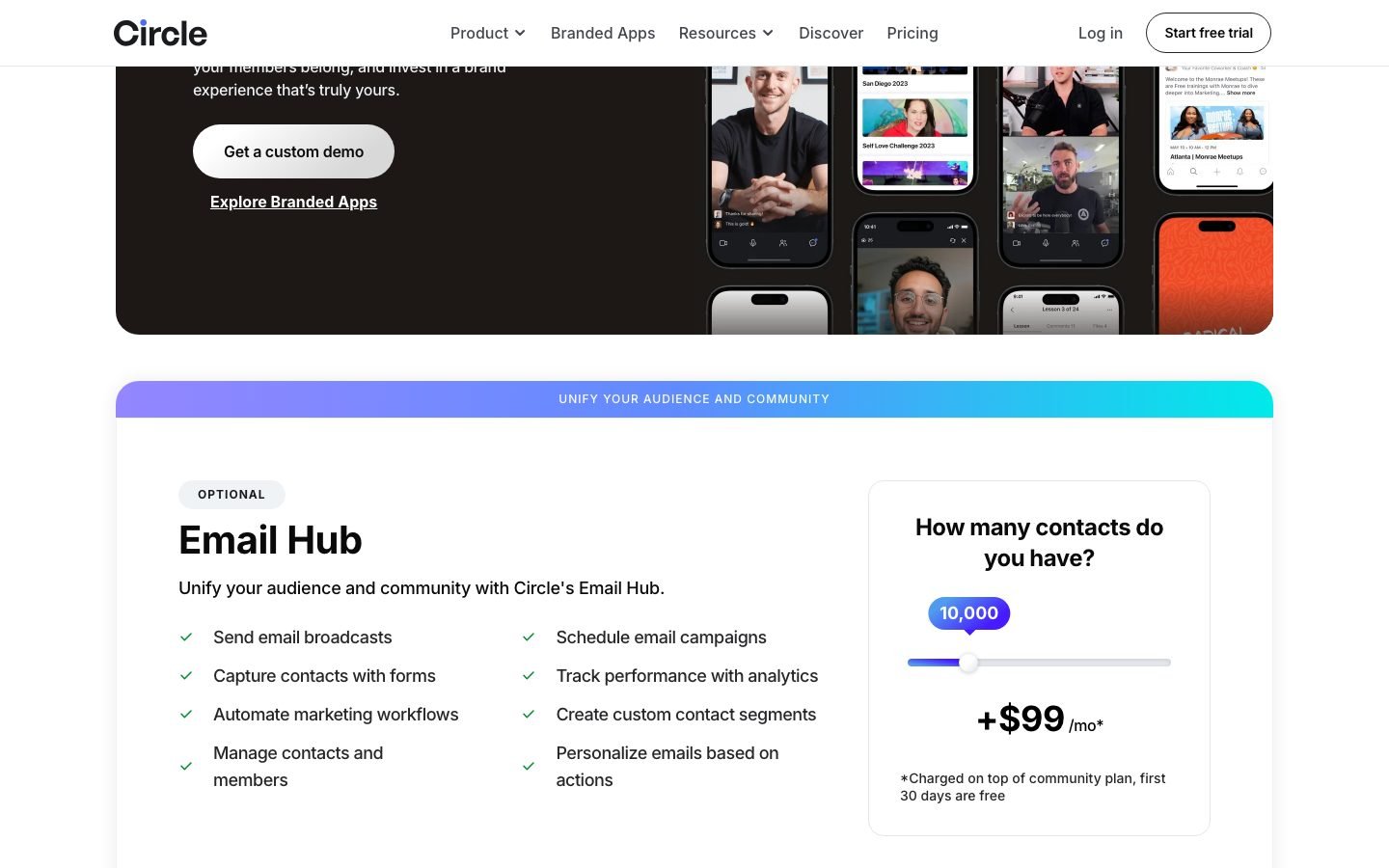
Circle.so’s extra costs include Email Hub at $99/month (10k contacts), Customizable Profile Fields at $49/month, Sender Email Customization at $40/month, and overage charges on live streams and storage. A Professional plan advertised at $89/month routinely lands at $188-$277/month once real features are added (Circle.so pricing, 2026).
Add-on and overage costs table
| Add-on / Overage | Cost | Included in | Notes |
|---|---|---|---|
| Email Hub (10k contacts) | $99/mo | None by default | Required to email members from inside Circle |
| Email Hub (25k contacts) | ~$199/mo | None | Scales with list size |
| Customizable Profile Fields | $49/mo | Business, Plus | Paid extra on Professional |
| Sender Email Customization | $40/mo | Business, Plus | Send from your own domain |
| AI Agents | Included | Scale, Plus | Custom AI assistants inside community |
| AI Workflows | Included | Scale, Plus | Automations and triggers |
| Branded Mobile App | Custom quote | Circle Plus add-on | Typically $1,000+/mo committed |
| Headless Member API | Included | Circle Plus | API-first deployment |
| Live stream attendee overage | $20/mo per 100 | n/a | Above plan cap |
| Live stream hour overage | $50/mo per 10 hours | n/a | Above plan cap |
| Extra admin seats | $10/mo per admin | n/a | Extra moderators: $20/mo per 10 |
The branded mobile app on Circle Plus is the single most misunderstood line item in community SaaS. Operators see “branded app” and assume it’s a checkbox. In practice it’s a separately quoted contract that often lands above $1k/month and requires a multi-month commit. If a branded app is core to your offer, price it out before signing anything.
Stack the basics a paid Circle.so community actually needs (Professional + Email Hub + profile fields + custom sender) and you’re at $89 + $99 + $49 + $40 = $277/month. The $89 sticker was never the real price.
What does Circle.so really cost in practice?
Real Circle.so cost for a 100-member community at $30/month lands at $405/month, about 13.5% of revenue, once Professional, Email Hub, custom sender, Stripe fees, and the 2% platform fee are stacked (Circle.so pricing, 2026).
The same 100 members on Skool Pro cost $216/month, or 7.2% of revenue. That is roughly half the Circle.so all-in cost.
Example 1: Solo creator, 100 members at $30/month
- Revenue: $3,000 MRR
- Plan: Professional ($89/mo annual)
- Email Hub: $99/mo
- Sender customization: $40/mo
- Stripe (~2.9% + $0.30): $117
- Circle 2% fee: $60
- Total: $405/mo = 13.5% of revenue
Example 2: Established operator, 500 members at $49/month
- Revenue: $24,500 MRR
- Plan: Business ($199/mo annual)
- Email Hub: $99/mo
- Stripe (~2.9%): $740
- Circle 1% fee: $245
- Total: $1,283/mo = 5.2% of revenue
Same 500 members on Skool Pro: $99 + ~$740 processing = $839/month = 3.4% of revenue.
Is Circle.so cheaper than Skool or Mighty Networks?
No. For most operators, Circle.so is the most expensive of the three at $89+/month plus a $99 email add-on and 0.5-2% platform fees. Skool is the cheapest at $99/month flat with no extra platform fee on Pro.
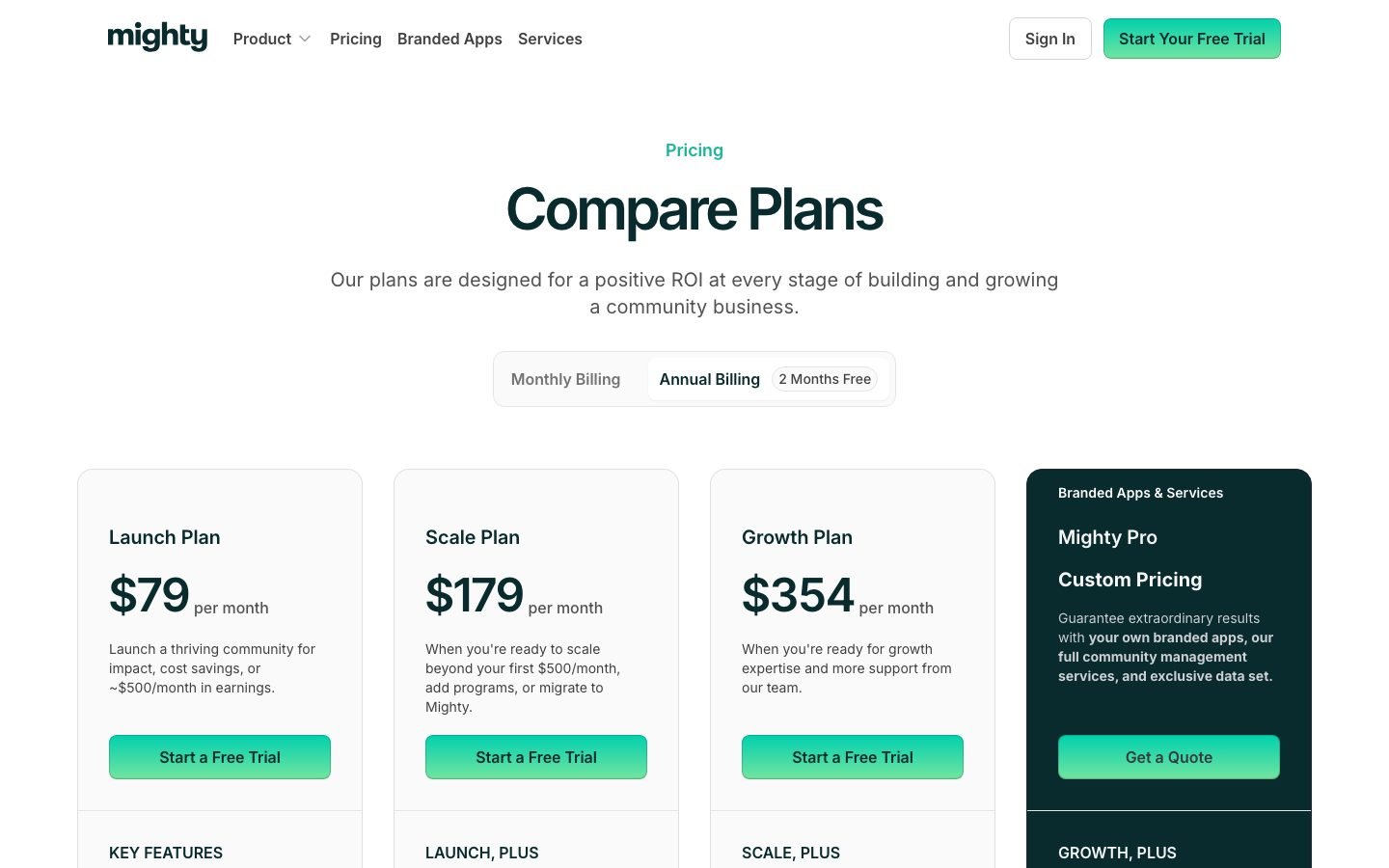
Mighty Networks sits in the middle at $79-$179/month with 1-2% fees after its 2026 price bump (Skool pricing, 2026 and Mighty Networks pricing, 2026).
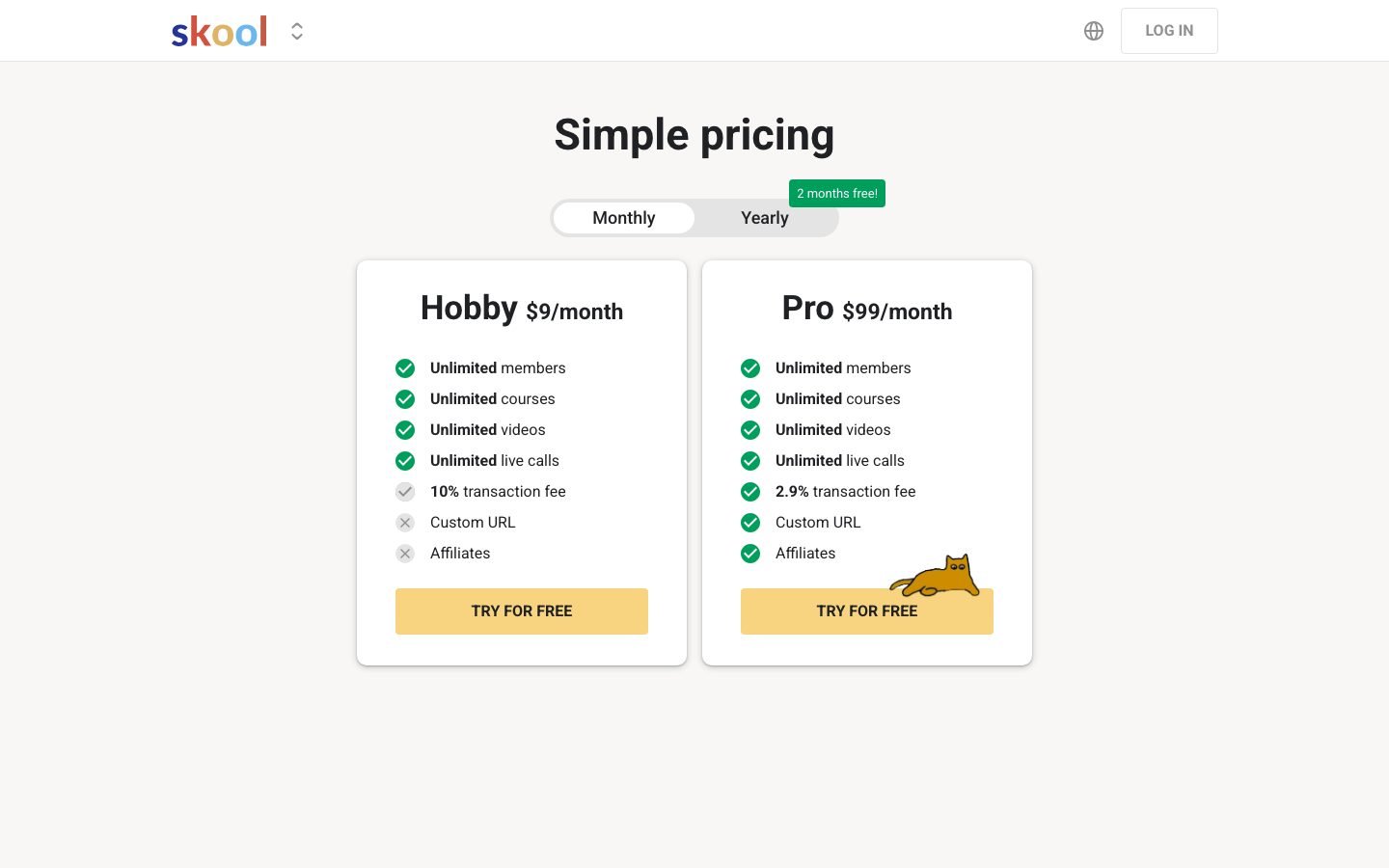
Pricing comparison table
| Platform | Entry plan | Main plan | Platform fee | Email included | Branded app | Best fit |
|---|---|---|---|---|---|---|
| Skool | $9/mo (Hobby) | $99/mo (Pro) | 2.9% on Pro (processing only); 10% on Hobby | Basic | No | Single community, engagement-first |
| Circle.so | $89/mo (Pro, annual) | $199/mo (Business) | 2% / 1% / 0.5% + Stripe | No (+$99/mo) | Plus only (custom) | Multi-space, white-label, API |
| Mighty Networks | $79/mo (Launch) | $179/mo (Scale) | 2% / 1% / 0.5% | Basic | Mighty Pro only | Course-led networks |
I’ve helped operators migrate from all three. The single biggest predictor of regret is paying annually on Circle without first running a trial month of real transactions. The sticker price is not the price you’ll pay.
See the deep dives: Skool pricing 2026, best Circle alternatives 2026, best Skool alternatives 2026.
Is Circle.so’s annual billing worth it?
Circle.so annual billing saves $120/year on Professional ($89 vs $99/month = 10% discount) and $240/year on Business ($199 vs $219/month = 9% discount), per the Circle.so pricing page. Annual commits are paid upfront, roughly $1,068 for Professional or $2,388 for Business, and are non-refundable after the 14-day trial window.
Both annual discounts are modest, 10% on Professional and 9% on Business, so if you’re unsure, month-to-month at $99 or $219 is a reasonable bet.
Practical warning: annual commitments are locked after day 14. Operators who paid annually and left early stayed on the hook for the balance.
Does Circle.so run a Black Friday deal?
Circle.so had not announced a 2026 Black Friday offer by October 19, 2026. In 2025 Circle.so offered 25% off annual Business and Enterprise plans, with no discount on Professional.
BloggingX reported 25% off the annual Business and Enterprise plans for Black Friday and Cyber Monday 2025, ending December 3, with no discount on Professional (BloggingX, 2025). Circle’s own summit page carried a matching “only discount of the year” offer that has since been taken down, so I could not check the terms on Circle’s site.
What a possible Circle.so Black Friday deal means for your plan:
- Professional: do not wait. No 2025 source shows a Professional discount, and annual billing already takes it from $99 to $89 a month.
- Business: waiting can pay. If last year’s 25% comes back on the $199 annual price, the first year drops by about $600.
The 14-day Circle.so free trial helps here. Start it in mid-November and it ends during Black Friday week, when you will know whether the offer is back. I track the other tools I review in my Black Friday software deals tracker.
Who should pay Circle.so’s prices?
Circle.so’s pricing is worth it for operators with 500+ paying members, course creators selling $500+ products who need white-label, and agencies running multi-brand communities. Solo creators under $5k MRR should start elsewhere.
For solo creators or single-community testers, the Circle.so $89/month floor plus stacked fees and add-ons pushes real cost above $200/month before validation. At that stage Skool’s $9/month Hobby tier is the correct starting point (Skool pricing, 2026). Hobby takes a 10% cut on sales, which is fine while your revenue is still small.
Pay Circle if you match two or more:
- Running 3+ paid communities or multi-brand ops (multi-space architecture pays back).
- Need full white-label with zero Circle branding visible.
- Charge $100+ per member per month, so 1-2% is a rounding error.
- Have a developer who will actually use the API and workflows.
- A specific feature (headless member API, branded mobile app) has no cheaper equivalent.
Skip Circle if:
- You haven’t yet proven people will pay. Start on Skool Hobby at $9/mo and validate.
- You charge under $30/month per member.
- Daily engagement matters more than feature breadth.
- You only need one community, one feed, one leaderboard.
How does the Circle.so free trial work?
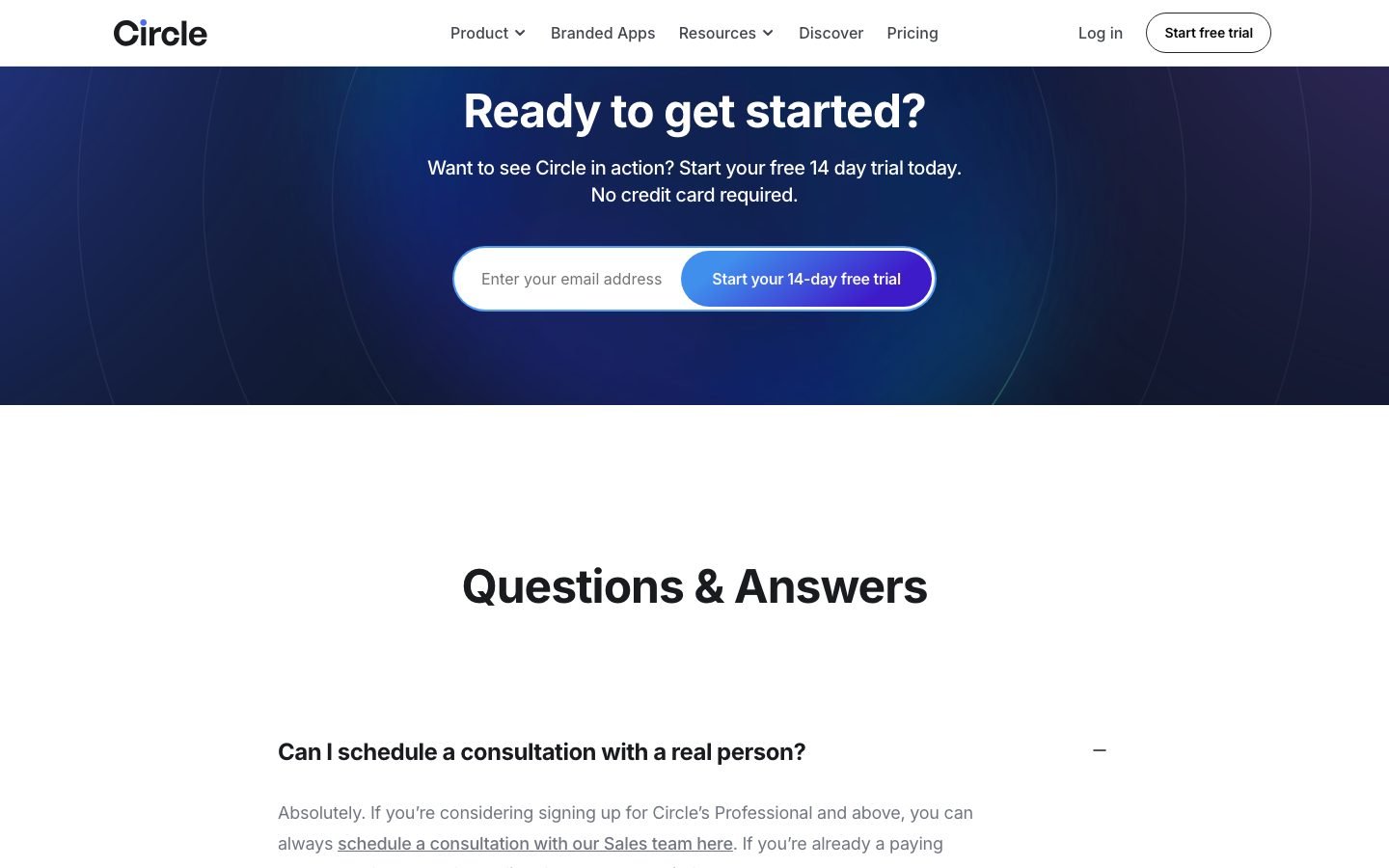
Circle.so’s free trial is 14 days on any plan with no credit card required, per the Circle.so pricing page. You get full access to the Professional or Business feature set you select.
During the Circle.so trial, build at least 3 spaces, set up a paid membership, run one live event, and export member data before deciding. Do not sign up annually until you’ve calculated your real all-in cost.
The 14-day window is tight if you’re also running a business. Block two afternoons: one to build, one to stress-test.
Before the trial ends, price out month one’s real Circle.so cost: add Email Hub, pick the tier you’d actually use, estimate transaction volume, multiply by the fee percentage. Commit to that number, not to $89.
Frequently asked questions about Circle.so pricing
How much does Circle.so actually cost per month in 2026?
Circle.so costs $89/month on Professional (annual) or $99/month monthly. Business is $199/month annual or $219/month monthly, Scale is $419/month, and Circle Plus is custom (Circle.so pricing, October 2026). Add ~$99/month for Email Hub plus 2%, 1%, or 0.5% transaction fees depending on tier.
Does Circle.so have a free plan?
No. The previous Basic tier at $39-49/month was discontinued. Professional at $89/month on annual billing is the floor, and the only free access is a 14-day trial with no credit card required (Circle.so, 2026).
What are Circle.so’s transaction fees?
Circle.so transaction fees are 2% on Professional, 1% on Business and Scale, and 0.5% on Circle Plus. They stack on top of Stripe’s standard 2.9% + $0.30 per transaction, producing effective total fees of 4.9%, 3.9%, and 3.4% (Circle.so, 2026).
Is Circle.so cheaper than Skool?
No. Circle starts at $89/month with a 2% transaction fee and a $99/month Email Hub add-on. Skool Pro is $99/month flat with no extra platform fee. For a 100-member community, Skool typically costs about half of Circle’s all-in total (Skool pricing, 2026).
What’s the difference between Circle Professional and Business?
Professional at $89/month lacks automation, workflows, API, white-label, and activity scores. Business at $199/month adds all of those, 5 admins (vs 3), 30 spaces (vs 20), 500GB storage (vs 200GB), and a 1% transaction fee (vs 2%) (Circle.so pricing, 2026).
What is Circle Plus and how much does it cost?
Circle Plus replaces the old Enterprise tier. It includes AI Agents, AI workflows, custom SSO, 0.5% fees, headless member API, branded mobile app options, and a dedicated CSM. Pricing is custom. It sits above the $419/month Scale tier, with branded apps adding real cost on top (Circle.so, 2026).
Should I pay Circle.so annually to get the $89 rate, or stay monthly at $99 in case I switch to Skool?
Stay monthly until you have run one full month of real transactions. Annual Professional saves $120 a year, but the roughly $1,068 upfront payment is non-refundable once the 14-day trial ends. Operators who paid annually and left early stayed on the hook for the balance. Model your true monthly cost first: $89 plus the $99 Email Hub plus 2% of sales. If that total looks heavy for your current revenue, test Skool instead. Skool Pro is $99 flat with no extra platform fee. Try Skool free for 14 days
Is Skool Pro at $99 cheaper than Circle Business at $199 once I add Circle’s Email Hub?
Yes, by a wide margin. Circle Business costs $199 a month on annual billing, plus about $99 a month for Email Hub, plus a 1% transaction fee on top of Stripe. That is roughly $298 a month before you sell anything. Skool Pro costs $99 a month flat, with no extra platform fee beyond payment processing. Circle Business earns its price only if you need automation, API access, white-label, or 30 spaces. For a single community, Skool Pro leaves about $200 a month in your account. Try Skool free for 14 days
Related reads: Skool pricing 2026 · Skool reviews 2026 · Best Circle alternatives 2026 · Best Skool alternatives 2026 · Best Mighty Networks alternatives 2026 · Skool vs Circle
Reader feedback
Was this review helpful?
Your feedback helps us write better reviews.
Thanks for your feedback.

AI Funnel Insider is an independent review site covering AI tools, Skool communities, and online courses. Every review states what was paid for, what was accessed and what was verified before a verdict goes live. Reviews are independent and may contain affiliate links, at no extra cost to you.
Related Posts

Skool Pricing 2026: Real Cost After the 10% Fee
Skool's plans look simple until you add the transaction fees. The real monthly cost, the break-even point, and how it compares before you commit.

Skool vs Mighty Networks 2026: Which Fits You?
Skool vs Mighty Networks compared for 2026 on real pricing, transaction fees, engagement, and mobile apps, so you pick right before you commit.

Whop vs Skool 2026: The Fee Math Decides It
Whop takes 3% per sale, Skool charges a flat $99/mo. Which one actually costs less at your revenue level? Real fee math and a clear verdict inside.

Maker School Review: $552 to Test Nick Saraev's 90-Day Guarantee
Maker School costs $184/mo, so testing its 90-day client guarantee costs $552. I priced year one. The refund fine print isn't public.

AI SEO Rainmakers Review: I Paid $269/mo. Read This Before You Join
I've paid $269/mo for AI SEO Rainmakers since September. Charles answers almost every question, but the best courses stay locked until you post.

AI Experts Club Review 2026: Worth $47/mo?
Is Alicia Lyttle's $47/mo AI Experts Club worth it? An honest take on the coaching, the 4,900+ members, what is inside, and who it fits.
The Insider Newsletter
Funnel software price drops and trial changes.
One email when a funnel or course platform changes its pricing or trial, plus our Sunday review.