Free Teachable Alternatives 2026
Teachable starts at $39/month with a 7.5% transaction fee. 6 free and low-cost alternatives that let you sell courses with zero monthly fees.
 By Alex Cooper · · 🔄 Updated
⚡ Quick Verdict
Multiple platforms with $0/month entry points
Free plans always come with trade-offs: lower limits or higher per-sale fees
Detailed Score Breakdown
Teachable doesn’t have a free plan. The cheapest option is $39/month — and it still charges a 7.5% transaction fee on every sale. That’s a real cost for anyone starting out or validating an idea before spending money on a platform.
The good news: there are solid course platforms that either cost nothing per month or charge significantly less than Teachable at the entry level. Some take a cut only when you make a sale. Others bundle funnels, email, and courses into a single cheap subscription.
We’ve verified the pricing on all six platforms below. No outdated numbers. No platforms that “used to be free.” These are the current options as of April 2026.
Last updated: April 2026
TL;DR: Teachable charges $39/month plus a 7.5% transaction fee before you’ve made a single dollar. Systeme.io offers a genuinely free plan covering courses, funnels, and email for up to 2,000 contacts — no credit card required. (Systeme.io, 2026) Gumroad has no monthly fee at all — it takes 10% + $0.50 per transaction only when you sell. For community-based courses, Skool starts at $9/month. One of these fits your situation.
What Does Teachable Actually Cost in 2026?
Teachable’s current pricing is $39/month (Starter) with a 7.5% transaction fee, $89/month (Builder) with 0% fees, $189/month (Growth), and $399/month (Advanced). (Teachable, 2026) The Starter plan limits you to 5 published products. There is no free plan — only a 7-day free trial.
That 7.5% fee is the one that stings. Earn $1,000 in a month on the Starter plan and you’re handing $75 directly to Teachable — on top of the $39 subscription. That’s $114 in platform costs before payment processing fees. The math gets painful fast.
To get rid of the transaction fee entirely, you need to pay $89/month. That’s more than most solo creators want to spend before they have consistent sales.
Citation capsule: Teachable charges a 7.5% transaction fee on its $39/month Starter plan, limiting creators to 5 published products. The $89/month Builder plan eliminates the transaction fee but costs more than double the entry-level price. (Teachable pricing, 2026)
Is There a Truly Free Alternative to Teachable?
Yes. Systeme.io offers a permanent free plan with no credit card required, supporting 1 course, 3 sales funnels, 1 affiliate program, and up to 2,000 contacts — all with 0% transaction fees. (Systeme.io, 2026) It’s the closest thing to a genuine Teachable replacement at zero cost.
Gumroad is another genuinely free option, though the model is different. There’s no monthly subscription. Instead, Gumroad takes 10% + $0.50 from each sale. (Gumroad, 2026) You can host unlimited products, build a storefront, and sell to a global audience without touching your wallet until a buyer shows up.
These two serve different needs. Systeme.io is for creators who want funnel infrastructure and email marketing alongside their course. Gumroad is for creators who want to list a course or digital product and start selling with absolutely zero upfront cost.
Citation capsule: Systeme.io’s free plan covers 1 course, 3 sales funnels, unlimited email sends, 1 affiliate program, and up to 2,000 contacts — permanently free, no credit card required, 0% transaction fees on every plan. (Systeme.io, 2026)
The 6 Best Free and Low-Cost Teachable Alternatives
Quick Comparison
| Platform | Monthly fee | Transaction fee | Free plan? | Best for |
|---|---|---|---|---|
| Systeme.io | $0 (Free) / $17+ | 0% on all plans | Yes | Courses + funnels + email |
| Gumroad | $0 | 10% + $0.50 | Yes (no monthly fee) | Simple digital product sales |
| LearnWorlds | $24/mo | $5/sale (Starter) / 0% (Pro) | No (30-day trial) | Interactive video courses |
| Skool | $9/mo | 10% (Hobby) / 2.9% (Pro) | No (14-day trial) | Community + courses |
| Podia | $39/mo | 5% (Mover) / 0% (Shaker) | No (30-day trial) | All-in-one simple setup |
| Thinkific | $49/mo | 0% on all plans | No (30-day trial) | Pure course delivery |
Teachable, for comparison: $39/month with 7.5% transaction fee. The $89/month Builder plan drops that to 0%.
1. Systeme.io — Best Free Plan for Course Creators
Systeme.io is the most complete free alternative to Teachable. The free plan is permanent, requires no credit card, and covers 1 course, 3 sales funnels, unlimited email sends, and up to 2,000 contacts — all with 0% transaction fees on every plan including free. (Systeme.io, 2026)
The gap between Systeme.io and Teachable isn’t just price. Systeme.io bundles tools that most course creators buy separately. A comparable stack using ClickFunnels, Mailchimp, and Teachable would cost around $245/month combined. The Systeme.io free plan replaces all three at no cost. (Systeme.io FAQ, 2026)
In practice, the free plan’s main limit is the 1-course cap. If you’re launching a single flagship course, you won’t hit it. If you’re building a library, you’ll need the $17/month Startup plan, which allows 5 courses and 5,000 contacts. Still a fraction of Teachable’s cost.
The course builder is functional but not polished. There are no certificates, no advanced quizzes, and no interactive video. For straightforward video-based courses with a simple module structure, it works well. For anything requiring drip scheduling, complex assessments, or compliance-style learning paths, you’ll need a different tool.
Who this is for: creators who want a free course platform with email marketing and funnels built in, and don’t need advanced LMS features.
2. Gumroad — Best Zero-Monthly-Fee Option
Gumroad has no subscription at all. You list your course, someone buys it, Gumroad takes 10% + $0.50. That’s it. (Gumroad, 2026) No monthly commitment, no platform fee before your first sale.
The trade-off is the per-transaction fee. At 10% + $0.50, Gumroad is more expensive per sale than most paid platforms. On a $97 course, you’re paying roughly $10.20 per transaction. That’s worse than Teachable’s 7.5% Starter fee ($7.28 per sale) — but the absence of a monthly subscription means you’re ahead until you’re making consistent sales.
The break-even calculation matters here. If you’re selling a $97 course, Gumroad’s 10% + $0.50 fee equals about $10.20 per sale. Teachable’s 7.5% fee equals $7.28 per sale, but adds a $39 monthly subscription. Gumroad becomes the cheaper option until you’re clearing roughly 17 sales per month — at which point Teachable’s per-sale cost starts to win out (assuming you stay on Starter). At that volume, you should probably switch to Thinkific at $49/month with 0% fees anyway.
Gumroad handles global tax compliance as a Merchant of Record since January 2025. (Gumroad, 2026) That removes a significant administrative burden for international sellers. The platform also has a built-in marketplace, Gumroad Discover, which can drive organic sales — though marketplace purchases cost 30% instead of 10%.
Where Gumroad falls short: no community features, no drip content, no certificates, and no funnel builder. It’s a storefront, not a course platform. If the learning experience matters to your audience, Gumroad is the wrong choice.
3. LearnWorlds — Best Budget Paid Option
LearnWorlds starts at $24/month — cheaper than Teachable’s $39/month entry point — and includes features that Teachable locks behind higher tiers. (LearnWorlds, 2026) The $5-per-sale fee on the Starter plan disappears on the $79/month Pro Trainer plan.
The standout feature is interactive video. LearnWorlds lets you embed quizzes, clickable buttons, and branching choices directly into video playback. Students answer questions mid-video, not after. No other platform on this list does this at any price point. For corporate training programs, compliance courses, or skill-based curricula where engagement is measurable, that’s a genuine differentiator.
The platform also supports SCORM compliance, graded assessments, printable certificates, and a built-in website builder. On paper, it’s more capable than Teachable’s mid-tier plans at a lower entry price.
The downside: the $5-per-sale fee on the $24/month Starter plan can add up quickly. If you’re selling a $200 course and making 20 sales a month, that’s $100/month in per-sale fees on top of the subscription. At that point, upgrading to the $79/month Pro plan makes more sense financially.
Who this is for: course creators who want interactive video or corporate LMS features at a lower price than Teachable’s Pro tier.
4. Skool — Best for Community-Driven Courses
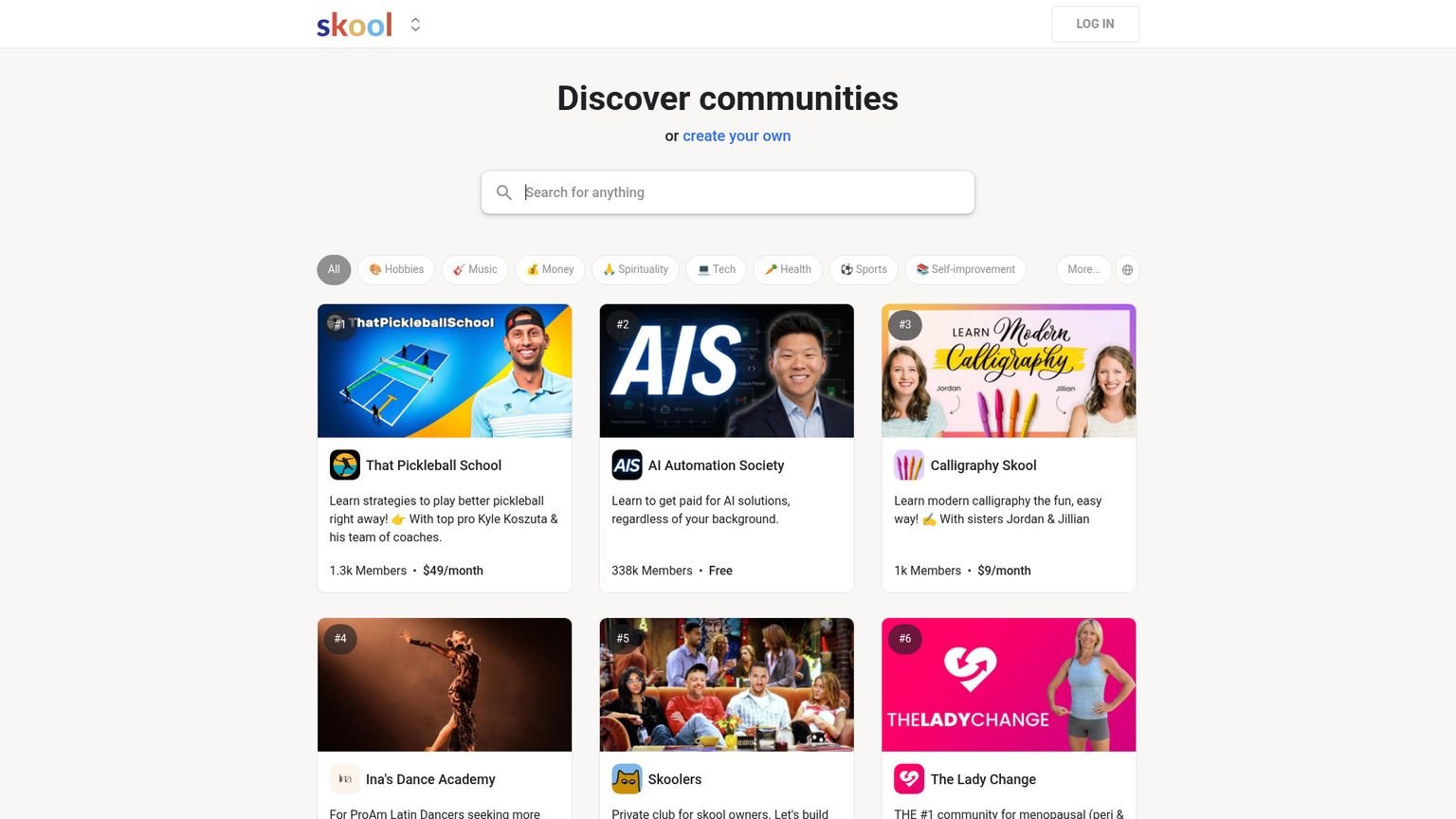
Skool starts at $9/month — cheaper than any paid Teachable plan — and includes unlimited members, unlimited courses, unlimited videos, and unlimited live calls. (Skool, 2026) The trade-off at $9/month is a 10% transaction fee. The $99/month Pro plan drops that to 2.9%.
Skool works differently from every other platform on this list. Courses aren’t isolated video libraries. They live inside a community feed alongside discussion posts, member activity, and gamification layers — points, levels, and leaderboards. That structure changes how students behave. Community-driven memberships average 85–92% retention rates, compared to 60–70% for passive content-only platforms. (ResearchGate, 2019)
The free discovery page is worth mentioning separately. Every Skool community gets a public-facing page in the Skool marketplace, which currently handles over 29 million monthly visits. (SimilarWeb, 2026) That’s organic distribution you’d otherwise have to buy.
Where Skool falls short: there’s no advanced quiz system, no completion certificates, and no drip content sequencing. If your course requires formal assessments or compliance certifications, Skool won’t cover it. And if community isn’t central to your course model — if students prefer to learn in isolation and move at their own pace — the social layer is a feature you’re paying for but won’t use.
Citation capsule: Skool’s Hobby plan costs $9/month with a 10% transaction fee and supports unlimited members, courses, videos, and live calls. The Pro plan at $99/month reduces the fee to 2.9% and adds unlimited admin accounts. Over 250,000 communities run on the platform. (Skool, 2026)
5. Podia — Best Simple All-in-One Under $50
Podia’s Mover plan costs $39/month — the same as Teachable’s Starter — but charges a 5% transaction fee instead of 7.5%. (Podia, 2026) That’s not a dramatic difference. Where Podia pulls ahead is in what’s included: digital downloads, webinars, coaching sessions, community features, email marketing, and a website builder all on the base plan.
The Shaker plan at $89/month removes transaction fees entirely and matches Teachable’s $89/month Builder plan price-for-price. At identical prices, Podia Shaker includes more product types. Teachable Builder focuses more on LMS depth — drip content, quizzes, certificates — that Podia doesn’t fully match.
The interface is clean and notably simpler than Teachable’s backend. If the learning curve of Teachable has been a source of friction, Podia will feel lighter. The flip side is that simplicity has limits. Advanced quiz logic, compliance tools, and SCORM support aren’t there.
6. Thinkific — Best 0% Fee Paid Platform
Thinkific’s Basic plan starts at $49/month with 0% transaction fees on every paid plan. (Thinkific, 2026) That’s $10/month more than Teachable’s Starter, but it immediately removes the 7.5% transaction fee. At any meaningful revenue level, Thinkific Basic costs less than Teachable Starter.
The math is straightforward. A creator doing $2,000/month in course sales on Teachable Starter pays $150 in transaction fees plus $39 in subscription — $189 total. The same creator on Thinkific Basic pays $49. That’s $140/month saved, enough to justify the slightly higher sticker price within the first two sales.
Thinkific confirmed in 2026 that their platform serves 35,000 customers across more than 100 countries, who have earned a combined $3.7 billion in revenue since launch. (Thinkific, 2026) The course builder includes quizzes, completion certificates, drip scheduling, structured learning paths, and completion tracking — a closer LMS match to Teachable than any other platform on this list.
There’s no free plan, only a 30-day free trial. But if you want the closest feature match to Teachable at a lower total cost, Thinkific Basic is that option.
Which Free Teachable Alternative Should You Pick?
The right choice depends on where you are in the revenue curve and what you’re actually building.
If you haven’t made a single sale yet: Start with Systeme.io’s free plan or Gumroad. Both cost nothing until you have customers. Systeme.io is better if you need funnels and email. Gumroad is better if you want a simple product listing without setup.
If you’re making under $500/month: Skool at $9/month or LearnWorlds at $24/month are worth the small investment. Skool is the right call if community engagement is part of your value proposition. LearnWorlds makes sense if you want interactive video or certifications.
If you’re making $500–$2,000/month: Thinkific Basic at $49/month is almost certainly cheaper than Teachable Starter once you factor in transaction fees. The LMS depth is comparable. The upgrade math is clear.
If you want everything under one roof without transaction fees: Podia Shaker at $89/month or Thinkific Start at $99/month both clear transaction fees and cover most course creator needs.
Does Moving Away from Teachable Actually Save Money?
At the $39/month Starter tier, yes — and often significantly. Here’s the realistic cost comparison at different revenue levels.
A creator earning $1,000/month on Teachable Starter pays $39 (subscription) + $75 (7.5% fee) = $114/month in platform costs. On Thinkific Basic, that same $1,000/month costs $49. On Systeme.io Startup ($17/month), it costs $17. The fee gap only widens as revenue grows.
We ran the fee comparison at three revenue levels using verified 2026 pricing. At $500/month revenue: Teachable Starter costs $76.50 (sub + fee), Thinkific Basic costs $49, Systeme.io Startup costs $17. At $2,000/month: Teachable Starter costs $189, Thinkific Basic costs $49, Gumroad (no monthly) costs $201 (10% + $0.50 × ~20 sales at avg $97) — showing Gumroad’s model works at low volume but breaks down at scale.
The one scenario where staying on Teachable Starter makes sense: you’re earning under $150/month in course sales. At that level, the 7.5% fee is under $11.25, making the total cost around $50.25 — roughly comparable to Thinkific Basic. Below that threshold, Gumroad or Systeme.io free win on pure cost.
FAQs About Free Teachable Alternatives
Is there a completely free Teachable alternative?
Yes. Systeme.io has a permanent free plan — no credit card, no time limit — that covers 1 course, 3 sales funnels, unlimited email, and up to 2,000 contacts with 0% transaction fees. (Systeme.io, 2026) Gumroad is also free to start: no monthly fee, you only pay 10% + $0.50 per transaction when you make a sale. Neither matches Teachable’s LMS depth on quizzes and certificates, but both are fully functional for basic course and digital product sales.
What is the cheapest paid Teachable alternative with no transaction fees?
Thinkific Basic at $49/month charges 0% transaction fees on all paid plans. (Thinkific, 2026) That’s the lowest monthly price you’ll find with no per-sale cut. LearnWorlds starts at $24/month but charges $5 per sale on its entry plan — the Pro plan at $79/month drops that to 0%.
Can I migrate my courses from Teachable for free?
Most platforms don’t have an automated Teachable import tool. You’ll need to export your student list from Teachable’s Reports section, download your course videos manually, and rebuild your course structure on the new platform. Systeme.io and Thinkific both have migration guides. The process takes a few days depending on course volume but isn’t technically complex.
Is Skool cheaper than Teachable for community courses?
At $9/month versus $39/month, Skool’s Hobby plan is significantly cheaper than Teachable’s entry price. The 10% transaction fee on Skool Hobby is higher than Teachable’s 7.5%, so the gap narrows as revenue grows. At around $600/month in course sales, the total costs converge. Above that, Skool Hobby starts costing more — at which point upgrading to Skool Pro ($99/month, 2.9% fee) makes more sense than comparing to Teachable Starter.
What does Teachable charge in transaction fees in 2026?
Teachable’s Starter plan ($39/month) charges a 7.5% transaction fee. The Builder plan ($89/month), Growth plan ($189/month), and Advanced plan ($399/month) all charge 0% transaction fees. (Teachable, 2026) Standard payment processing fees (2.9% + $0.30 via teachable:pay) apply separately on every plan.
Which Teachable alternative is best for beginners?
Systeme.io’s free plan is the lowest-risk starting point. It covers courses, funnels, and email marketing at zero cost. Gumroad is the simplest option if you just want to sell a course or digital product without building a funnel. Both let you validate demand before committing to a monthly subscription.
Teachable’s pricing structure makes sense once you’re on the $89/month Builder plan with 0% fees and a stable course library. Before that point — when you’re validating ideas, building an audience, or watching every dollar — you’re paying Teachable for features you may not fully use.
The platforms on this list are all genuine alternatives. Systeme.io and Gumroad cost nothing to start. LearnWorlds and Skool come in under $25/month. Thinkific eliminates transaction fees at $49/month. Podia bundles more tools at the same $39 price point without the 7.5% tax.
Pick based on where you are now, not where you hope to be. Start free, validate the idea, upgrade when the math makes sense.
Related Reading
📊 Full Pros & Cons Breakdown
👍 What I Liked
- Multiple platforms with $0/month entry points
- Systeme.io free plan covers courses, funnels, and email
- Gumroad charges 0 monthly fees — only takes a cut when you sell
- Skool Hobby plan at $9/month with unlimited members
👎 What Could Be Better
- Free plans always come with trade-offs: lower limits or higher per-sale fees
- No free plan matches Teachable's LMS depth on quizzes and certificates
🎯 Ready to try it yourself?
Try Skool Free →⚡ We may earn a commission at no extra cost to you. Read our affiliate disclosure
Was this review helpful? 🤔
Your feedback helps us write better reviews.
Thanks for your feedback! 🎉
I'm obsessed with AI automation — especially Claude Code. I constantly join new Skool communities and online courses to stay ahead of what's actually working right now. Everything I learn, I put to the test. The reviews here are my honest take, so you can make the right call before spending your money.
Related Reviews

Skool vs Kajabi 2026: Honest Verdict
Skool starts at $9/mo with a 10% fee. Kajabi starts at $71/mo with 2.9% processing. Which actually costs less? Real numbers inside.

AI Profit Boardroom vs AI Video Bootcamp
AIPB costs $49–$71/month; AIVB costs $9/month. Different goals, different formats. Here's the honest side-by-side to pick the right one.

Best Skool Alternatives 2026
8 best Skool alternatives tested in 2026. Circle from $89/mo, Kajabi from $69/mo, Podia from $33/mo. Pricing, pros, cons, transaction fees compared.
Get Honest AI Tool Reviews
Join smart marketers who get our weekly breakdown of what's worth buying — and what's not. Zero fluff.
🔒 No spam, ever. Unsubscribe in one click.