Systeme.io Review 2026: The Free Plan's Real Limits
Evidence Review Built from public, vendor and customer evidence. We did not buy or use it.Systeme.io's free plan gives 2,000 contacts, 3 funnels and zero fees. I went through every tier to find where the real limits kick in.

Genuinely free plan with 2,000 contacts, 3 funnels, 1 course. No credit card, no expiry
Funnel builder and course tools feel budget. Templates lack polish
- Review type
- Evidence Review. Built from public, vendor and customer evidence. We did not buy or use it.
- Last verified
- August 2026
- Evidence reviewed
- Free plan tested · Startup plan tested · Vendor pricing page · Trustpilot reviews
- Affiliate relationship
- No
| Closest alternatives | Price | Score |
|---|---|---|
| ClickFunnels 2.0 | $97/month | 4.2/5 |
| LearnWorlds | $24/mo (annual) - custom enterprise | 4/5 |
| Podia | $42/month to $150/month | 3.8/5 |
Short version: Systeme.io’s free plan is real. You get 2,000 contacts, 3 funnels, 1 course, and unlimited email sends with zero transaction fees, no credit card, no expiry. The limit that actually bites is the single automation rule, and the fix costs $17/month.
Systeme.io launched in 2018 when founder Aurelien Amacker set out to prove that a solopreneur could run funnels, email marketing, online courses, and an affiliate program from one dashboard without paying $200+ per month. By 2026, the platform has processed transactions for hundreds of thousands of users and the free plan still has no credit card requirement. (Systeme.io, 2026)
I went through every feature across the free and paid tiers using the vendor’s documentation, public pricing, and verified user reviews. Here’s exactly what you get, what you don’t, and whether it makes sense for your business this year.
TL;DR: The $17/month Startup plan dropped from $27 in late 2025, which makes Systeme.io the cheapest all-in-one funnel platform I’ve priced out. Best for solopreneurs validating a digital product. Wrong fit for brand-conscious businesses and SEO-first content strategies.
Systeme.io Verdict (60-Word Summary)
Systeme.io is a legitimate all-in-one marketing platform founded by Aurelien Amacker in 2018. The free plan covers 2,000 contacts, 3 sales funnels, 1 course, and unlimited emails with 0% transaction fees. The $17/month Startup plan makes it the cheapest full-stack funnel tool available. It earns a 4.1/5 for solo creators, dropping points only for design limitations and a weak blog engine. (Systeme.io, 2026)
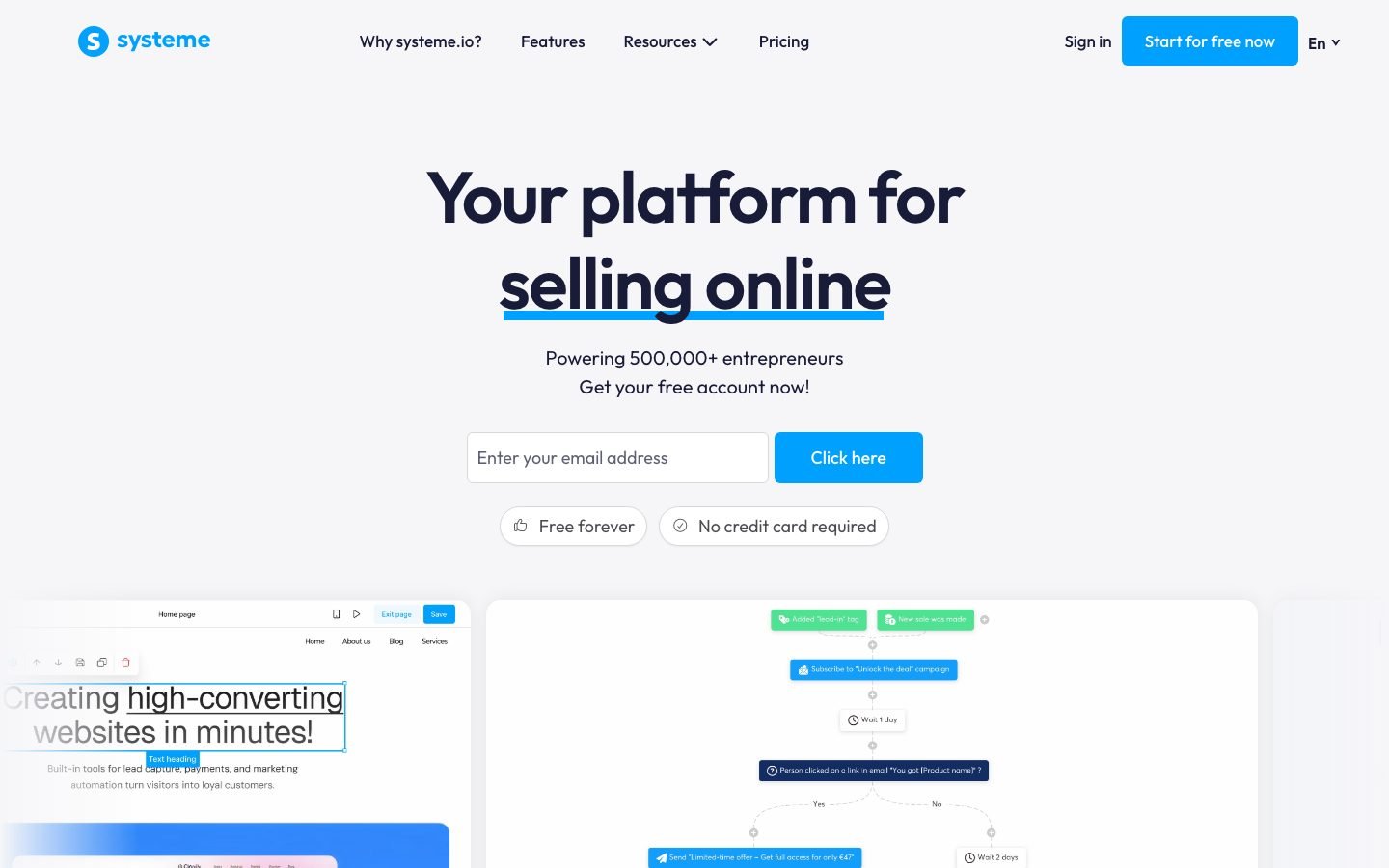
My pick if you can spend more: Systeme.io wins on price. But if you want the most proven all-in-one, with a far bigger template library and deeper funnel features, I run my own funnels on ClickFunnels. Start the free trial and compare the two before you commit.
Is Systeme.io Really Free?
Yes. The Systeme.io free plan is permanent, requires no credit card, and carries no trial countdown. It covers 2,000 contacts, 3 sales funnels (up to 15 steps each), 1 online course, 1 community, 1 blog, 1 custom domain, unlimited email sends, and 0% transaction fees.
I know of no other funnel platform that offers that combination without an expiry date. Most competitors either kill the free tier after a trial period or add transaction fees on entry-level plans. (Systeme.io Pricing, 2026)
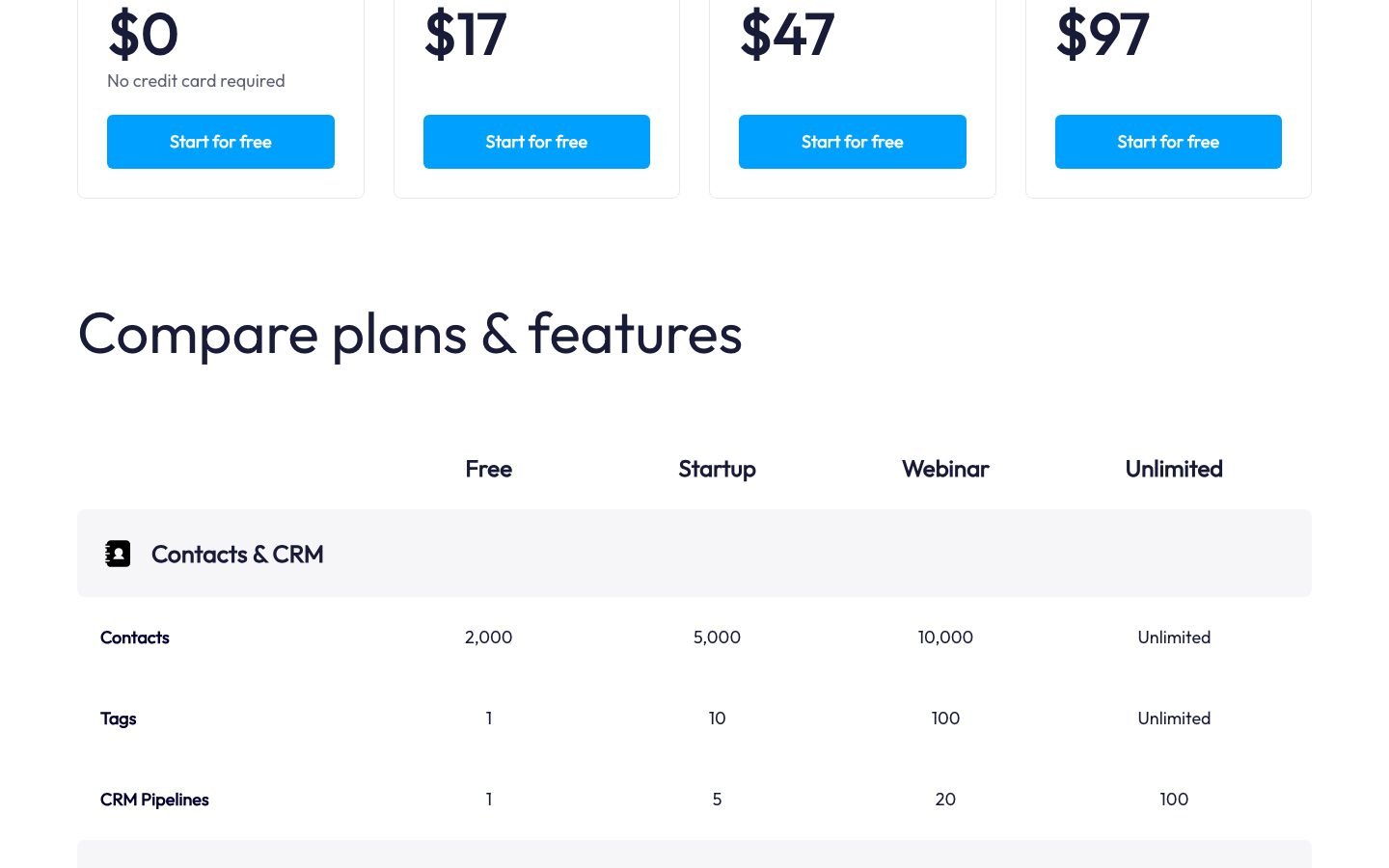
Full free plan limits at a glance:
| Feature | Free Limit |
|---|---|
| Contacts | 2,000 |
| Sales funnels | 3 |
| Funnel steps | 15 |
| Online courses | 1 |
| Students | 500 |
| Automation rules | 1 |
| Email campaigns | 1 |
| Blogs | 1 |
| Custom domains | 1 |
| A/B tests | 1 |
| 1-click upsells | 1 |
| Order bumps | 1 |
| Transaction fees | 0% |
| Email sends | Unlimited |
| File storage | Unlimited |
The real constraint on the Systeme.io free plan is the single automation rule. Contacts are rarely the problem. If you need behavior-triggered sequences (bought product A → start sequence B), you’ll hit that wall fast and need the $17/month Startup plan.
The single Systeme.io automation rule forces you to choose between email nurture OR post-purchase onboarding. Anyone running a full lead magnet funnel on the free tier hits that limit quickly.
What Does Systeme.io Cost in 2026?
Systeme.io runs four pricing tiers. The Startup plan dropped from $27 to $17/month in late 2025, a 37% cut that made it the cheapest funnel-plus-email stack on the market. Annual billing saves the equivalent of two months. (Systeme.io Pricing, 2026)
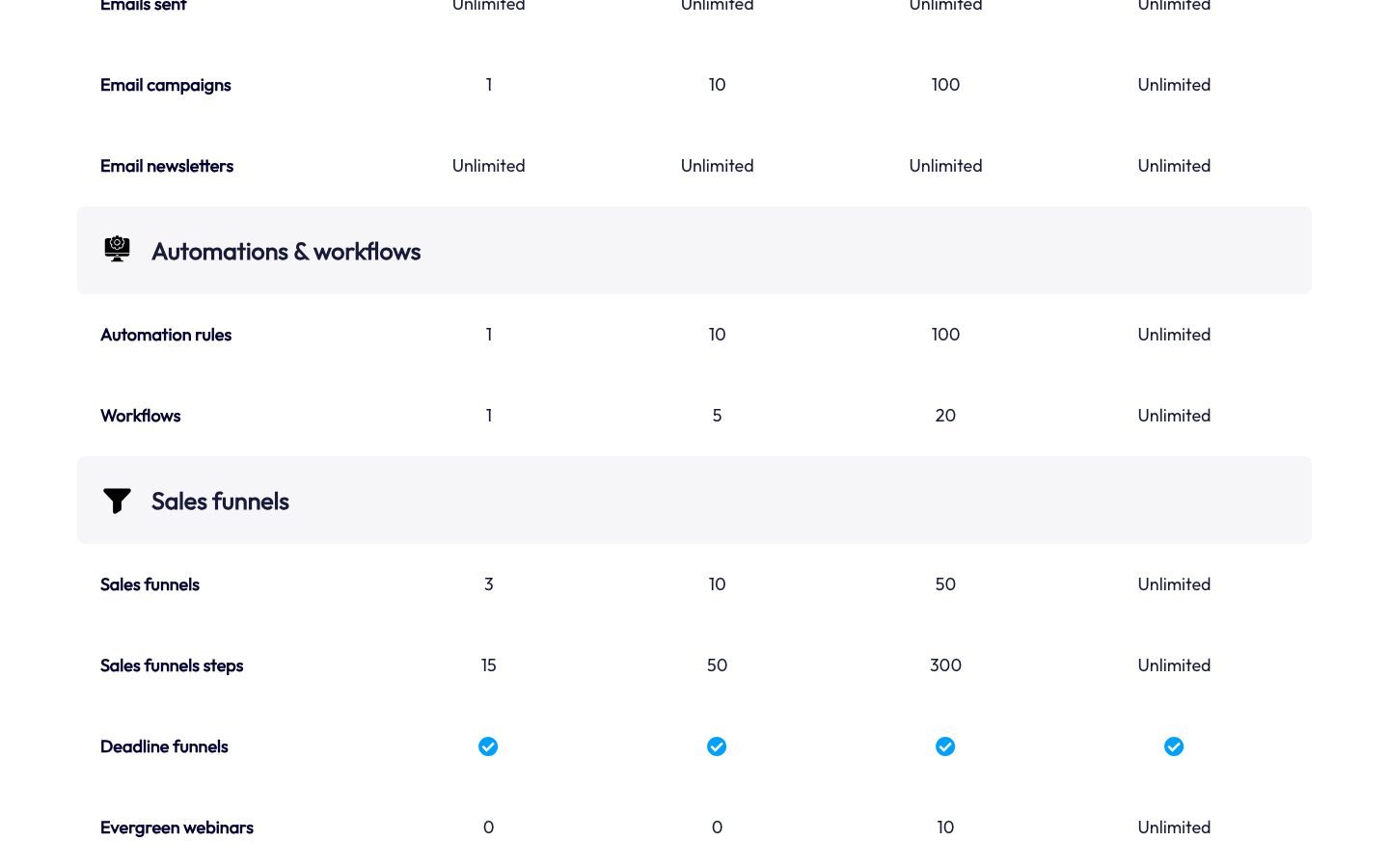
Full pricing table:
| Plan | Monthly | Annual | Contacts | Funnels | Courses | Automation Rules |
|---|---|---|---|---|---|---|
| Free | $0 | $0 | 2,000 | 3 | 1 | 1 |
| Startup | $17 | $170/yr | 5,000 | 10 | 5 | 10 |
| Webinar | $47 | $470/yr | 10,000 | 50 | 20 | 100 |
| Unlimited | $97 | $970/yr | Unlimited | Unlimited | Unlimited | Unlimited |
What each paid plan adds:
- Startup ($17/month): Jumps to 5,000 contacts, 10 funnels, 5 courses, 10 automation rules, 3 custom domains. Most solopreneurs live here.
- Webinar ($47/month): Adds 10 evergreen webinar funnels, plus 10,000 contacts, 50 funnels, and 100 automation rules. Built for list-builders running automated webinar traffic.
- Unlimited ($97/month): No caps anywhere. Adds a 1-on-1 kickstart coaching session, free migration service, and early access to new features.
The tool-stack comparison: Systeme.io’s own pricing FAQ prices the stack as ClickFunnels ($97/month) for funnels, Mailchimp ($20/month) for email, Teachable ($39/month) for courses, and Tapfiliate ($89/month) for affiliates, which totals $245/month before you even connect them. Systeme.io’s Unlimited plan at $97/month covers all four. (Systeme.io Pricing Page FAQ, 2026)
Does Systeme.io Have a Black Friday Deal?
I could not verify a Systeme.io Black Friday deal. On October 19, 2026, the Systeme.io pricing page showed no Black Friday offer.
For 2025 the sources disagree: the deal tracker ColorMango lists no extra Systeme.io discount for Black Friday 2025, while some affiliate pages claim “up to 40% off” the Startup annual plan with no date or source. I found no Systeme.io announcement either way.
Waiting for a Systeme.io deal is a weak bet on the numbers. Startup costs $17 a month, or $170 a year on annual billing, which is two months free. Even a 40% cut on that annual plan would save $68 for the year. The free plan has no time limit, so you can build on it now and upgrade later without losing work.
If Systeme.io announces a 2026 offer, I will add it here and to my Black Friday software deals tracker.
How Good Is the Systeme.io Funnel Builder?
The Systeme.io drag-and-drop editor gets you from a blank canvas to a live page faster than most competitors. A first page can go live within a couple of hours of signing up. Design control is the weak spot.
Systeme.io templates are grouped by goal (lead capture, product launch, webinar registration, bridge page) and each one includes pre-wired conversion elements. Swap copy, add your images, connect a domain, and publish. (Systeme.io, 2026)
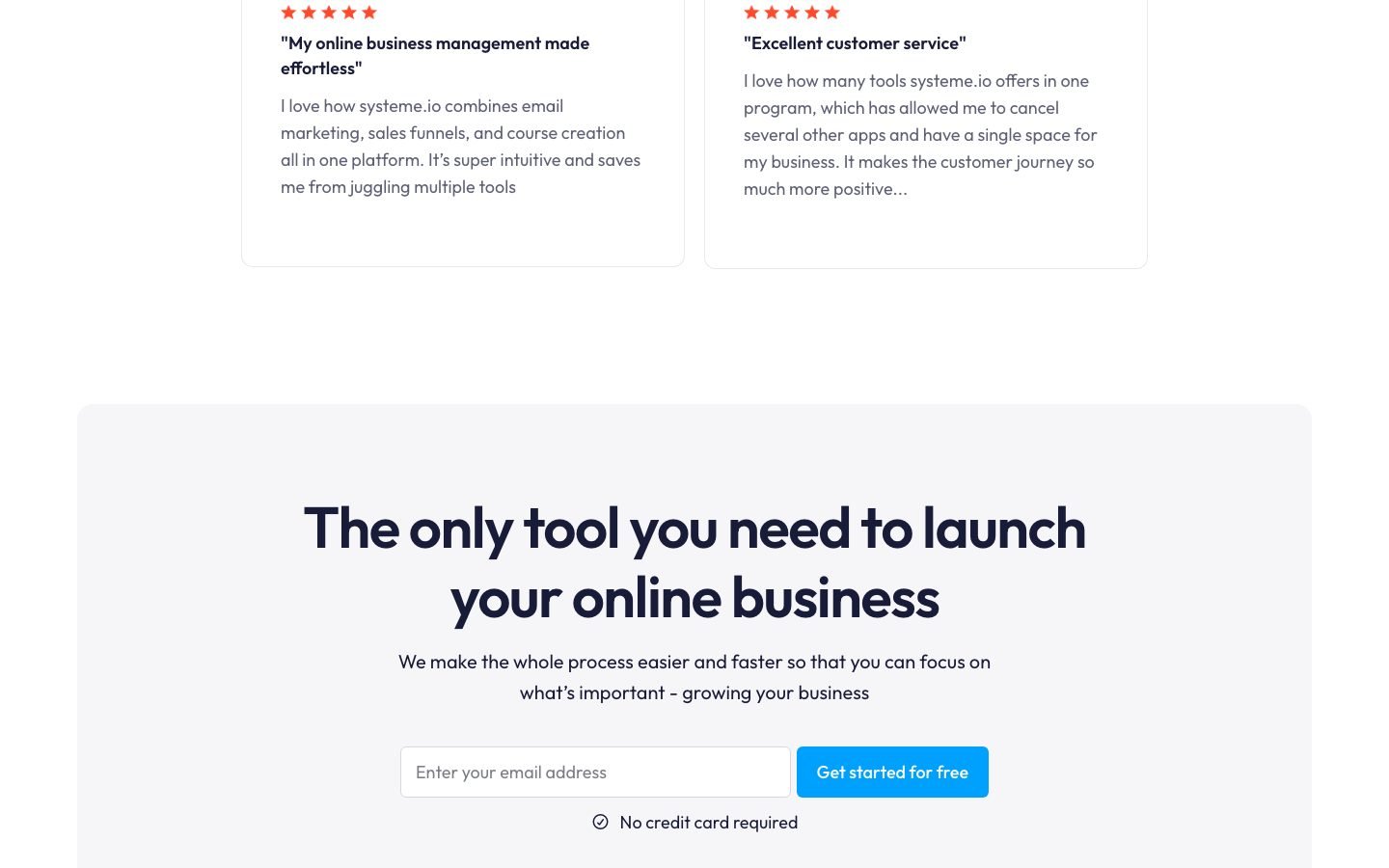
Built-in conversion tools include:
- Order bumps and 1-click upsells on every plan
- A/B split testing (1 test on free, 10 on Startup, 50 on Webinar)
- Deadline funnels with per-visitor countdown timers
- Custom domain connection on all plans
Where the Systeme.io editor falls short: custom CSS animations, advanced layout control, and the kind of pixel-precise design agencies expect all hit a ceiling fast. The editor is a Toyota Camry. It gets you from A to B reliably, but nobody calls it exciting.
Page load speeds on unoptimized templates also lag on mobile. Compress images and strip unnecessary scripts before going live if conversion rates matter.
The Systeme.io template library is limited. Trustpilot reviewers repeatedly mention duplicating and heavily editing the same few templates rather than picking new ones. ClickFunnels 2.0’s global sections and richer template set are a real step up for design-heavy brands; I broke that down in my ClickFunnels 2.0 review.
Is Systeme.io Good for Email Marketing?
Systeme.io includes unlimited email sends on every plan, including free, a feature most dedicated email tools lock behind paid tiers.
The Systeme.io email system uses tag-based segmentation rather than rigid lists. One contact can carry multiple behavioral tags and trigger different automation sequences based on what they click, buy, or complete. That’s ActiveCampaign-level logic at a fraction of the price. (Systeme.io Email Marketing, 2026)
What’s included on every plan:
- Unlimited newsletters
- Tag-based segmentation
- Behavior-triggered automations
- Domain authentication (SPF, DKIM)
- Automated IP warm-up for new accounts
Deliverability sits between 96-98% inbox placement when you authenticate your sending domain properly. The platform throttles new accounts during warm-up to protect IP reputation and caps opt-ins at 10 per IP per day to block bot submissions.
One requirement: you need a professional domain email address. Sending from Gmail or Hotmail is blocked. In practice that protects your inbox placement, so I count it as a plus.
The automation rule limit is the one Systeme.io email friction point. Free plan gets 1 rule. Startup gets 10, Webinar gets 100. If you’re building multi-step sequences triggered by multiple behaviors, the free tier caps out quickly.
Does Systeme.io Have AI Features in 2026?
No. Systeme.io ships no built-in AI as of September 2026. Its official features page lists no AI copywriter, no AI funnel generator, and no AI assistant. You build every page and email by hand (Systeme.io Features, 2026).
- The product markets funnels, email, courses, and affiliates. AI copy generation is not among them.
- Some third-party directories tag “AI text generation” against Systeme.io, but I could not confirm any such tool inside the live product. Treat those tags as unverified.
- If AI drafting matters to your workflow, write copy in an external tool and paste it in.
For a platform where AI is native to the workflow, see my GoHighLevel review 2026.
Is Systeme.io Good for Selling Online Courses?
The Systeme.io course builder handles straightforward content delivery reliably. Modules, lectures, video uploads, drip scheduling, and basic quizzes are all included.
Paid Systeme.io plans get unlimited video storage, which alone saves the $20-$100/month you’d spend on Wistia or Vimeo for hosted video. The free plan caps student accounts at 500, enough to validate a course before paying anything. (Systeme.io Online Courses, 2026)
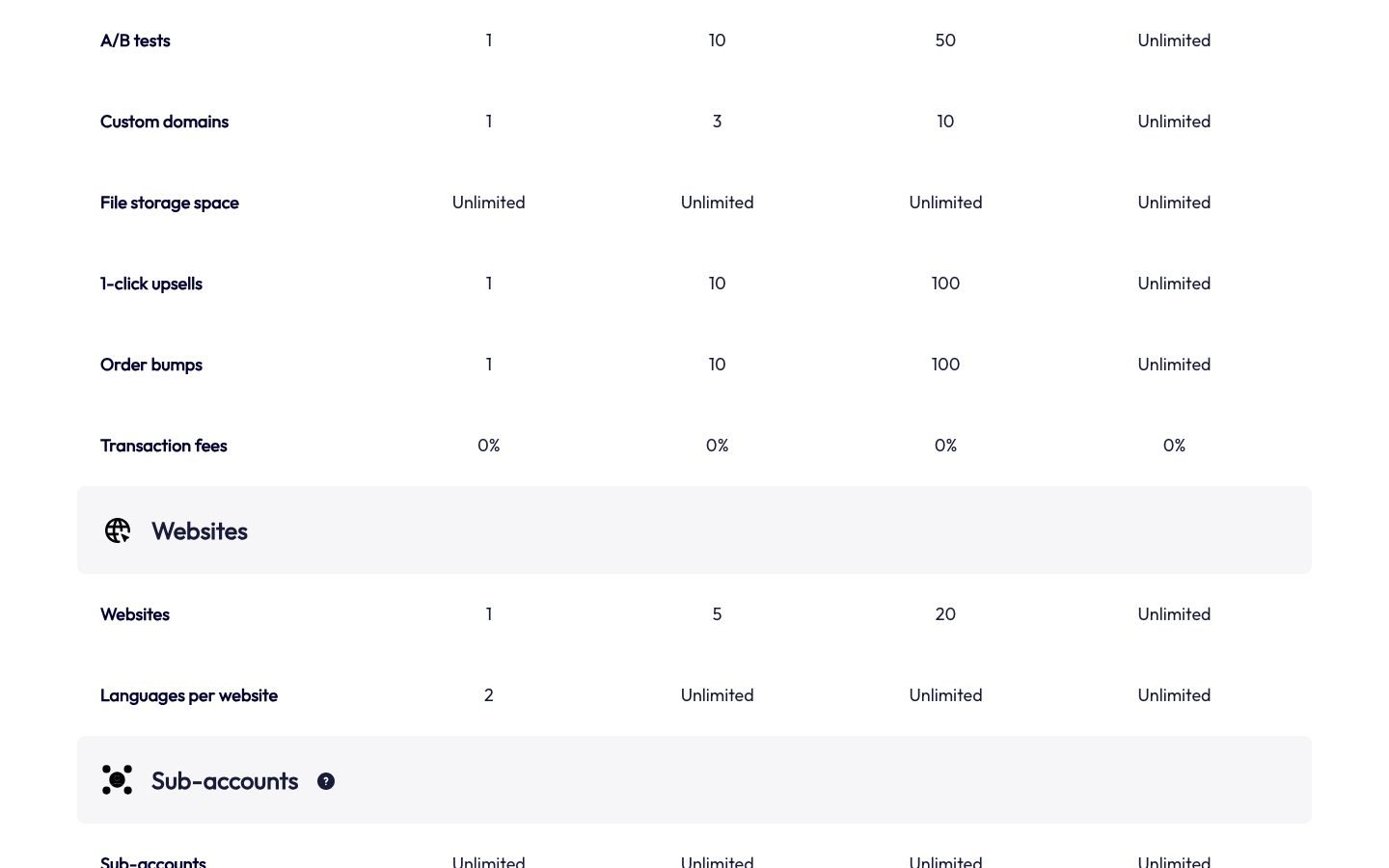
Course features by plan:
| Feature | Free | Startup | Webinar | Unlimited |
|---|---|---|---|---|
| Courses | 1 | 5 | 20 | Unlimited |
| Students | 500 | Unlimited | Unlimited | Unlimited |
| Video storage | Unlimited | Unlimited | Unlimited | Unlimited |
| Drip scheduling | Yes | Yes | Yes | Yes |
| Quizzes | Basic | Basic | Basic | Basic |
| Student activity history | No | No | No | No |
The automation integration is where the Systeme.io course builder earns its value. When someone buys through your funnel, their course account is created automatically, login credentials go out via the built-in email, and they land in the right module. No Zapier. No broken webhooks. It just works.
What the Systeme.io course builder doesn’t do: advanced student analytics, branching logic, certificates, or deep gamification. Kajabi handles those (I compared the two ecosystems in Kajabi vs ClickFunnels). If your students expect a premium learning experience with progress tracking and certificates, the course builder will feel limited.
Systeme.io also has a community feature: forum-style spaces alongside courses. It works, but the polish lags well behind Skool or Circle.
Systeme.io vs ClickFunnels: Which Is Better?
Systeme.io wins on price. ClickFunnels wins on design. ClickFunnels 2.0’s Launch plan starts at $97/month, five to six times the Systeme.io Startup plan, and offers better funnel design, global sections, more templates, and a stronger visual editor.
Systeme.io covers 90% of standard marketing workflows at a fraction of that cost. (ClickFunnels Pricing, 2026; Systeme.io Pricing, 2026)
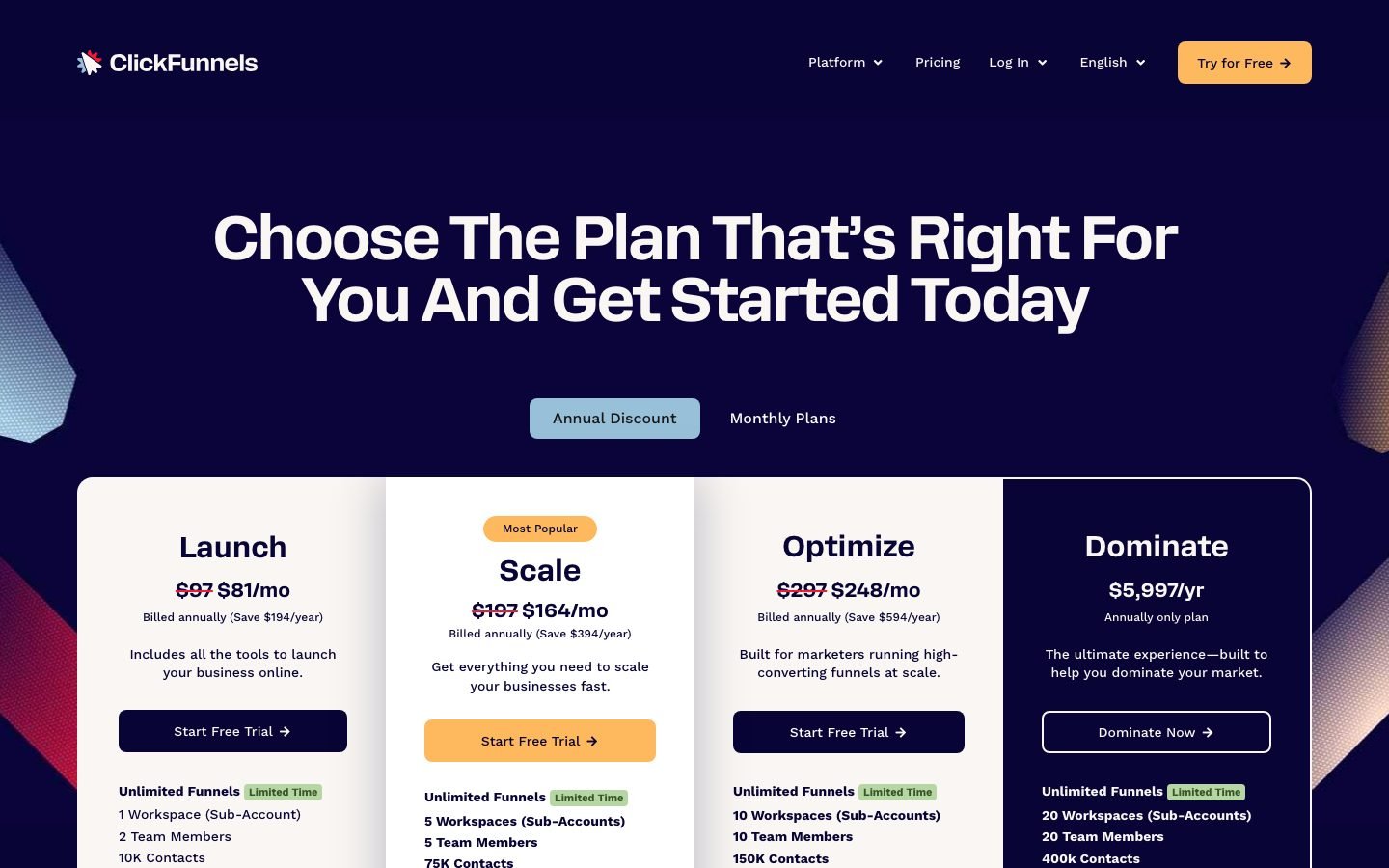
Side-by-side comparison:
| Feature | Systeme.io Startup | ClickFunnels Launch |
|---|---|---|
| Monthly price | $17 | $97 |
| Funnels | 10 | Unlimited (limited time) |
| Contacts | 5,000 | 10,000 |
| Email sends | Unlimited | 50,000/month |
| Courses | 5 | 3 |
| Transaction fees | 0% | 0% |
| Affiliate management | Included | Optimize plan ($297/mo) and up |
| A/B testing | Yes | Yes |
| Template quality | Basic | Strong |
The ClickFunnels email limit of 50,000 sends per month on the Launch plan is a real constraint that Systeme.io’s unlimited sends eliminates. For high-volume email marketers, that one difference can justify the platform switch.
Systeme.io’s page editor gets a basic lead capture funnel live faster than ClickFunnels 2.0, but ClickFunnels produces a better-looking result. The full eight-round breakdown is in my ClickFunnels vs Systeme.io comparison. If ClickFunnels’ price is the blocker, my best ClickFunnels alternatives roundup ranks Systeme.io against seven other options.
What Are Systeme.io’s Limits and Weaknesses?
Systeme.io’s limits cluster into four areas: design polish, SEO tools, native integrations, and automation depth on lower tiers.
Design limitations: Templates look budget. The builder lacks the visual polish of dedicated page builders like Leadpages or Unbounce. Custom CSS is available on paid plans but requires manual work. Not a fit for brand-conscious businesses where aesthetics drive trust.
SEO and blog tools: The built-in blog has no schema markup support, limited redirect management, and no canonical tag control. If organic search is your primary traffic channel, run your blog on WordPress and use Systeme.io as a funnel layer on a subdomain. Don’t try to do both in one place.
Integration depth: Stripe, PayPal, Razorpay, Flutterwave, Xendit, and Apple Pay are all included. Zapier handles third-party connections. But the native integration list is thin. If your fulfillment relies on specific tools outside this list, you’ll be relying on Zapier webhooks rather than direct connections.
Automation rule caps: The free plan allows just 1 automation rule. Startup gets 10. This is the number one complaint from users who try to build multi-sequence funnels on entry-level plans.
Support: Email-only with an average response time under 2 hours, available 7 days a week. (Systeme.io Pricing, 2026). There is no live chat. For urgent issues mid-launch, a two-hour wait can feel long.
Is Systeme.io Legit? Who Built It?
Systeme.io was founded by Aurelien Amacker, a French entrepreneur, and launched publicly in 2018. The company is headquartered in France and has been profitable since launch.
Systeme.io has processed transactions for hundreds of thousands of users across funnels, courses, and affiliate programs. The free plan is a genuine working product with no trial clock attached. (Systeme.io, 2026)
Systeme.io runs its own 60% lifetime recurring affiliate program, which has created a large ecosystem of promoters and community content. That affiliate ecosystem means there’s plenty of tutorial content, but also a lot of promotional reviews that gloss over the real limitations.
Systeme.io operates transparently: published pricing, a public roadmap at roadmap.systeme.io, and a 30-day refund policy on paid plans.
Trustpilot signal: The platform maintains positive user sentiment with consistent praise for the free plan value and native automation reliability. Common complaints center on design limitations and template quality, which align with the platform’s documented feature set. (Trustpilot: Systeme.io, 2026)
What Are the Pros and Cons of Systeme.io?
The biggest Systeme.io pros are a permanent free plan and a $17/month Startup plan with unlimited email and 0% fees. The biggest cons are budget-looking templates, a weak blog for SEO, and 1 automation rule on the free plan.
Pros:
- Genuinely free plan: 2,000 contacts, 3 funnels, 1 course, unlimited email, 0% fees, no card required
- $17/month Startup plan is the lowest-cost all-in-one funnel stack available
- Unlimited email sends on every tier, including free
- Native integration between funnels, email, courses, and affiliate management
- Affiliate management included on all plans, even free
- Zero transaction fees across all plans
- Unlimited sub-accounts on all plans at no extra cost
- 30-day refund policy on paid plans
- Average support response under 2 hours, 7 days/week
Cons:
- Templates lack the visual polish agencies expect
- Free plan limited to 1 automation rule, tight for complex workflows
- Blog engine unsuitable for SEO-first strategies (no schema, no canonical tag control)
- No live chat support, email only
- Native integration list is thin beyond payment processors
- Mobile page load speeds can lag with unoptimized templates
- Course quizzes are basic right/wrong only, with no branching logic or certificates
- Student activity history not available on any plan
Who Should Use Systeme.io in 2026?
Systeme.io fits solopreneurs, course creators and affiliate marketers who want funnels, email and courses in one dashboard for $0 to $17/month. Systeme.io does not fit brand-conscious businesses, SEO-first content sites or advanced LMS needs.
Best fit:
- Solopreneurs validating a first digital product at zero cost
- Course creators who want funnel + email + course delivery without Zapier
- Affiliate marketers building funnel-first businesses under $17/month
- Small creators who need affiliate management without paying $89/month for Tapfiliate
- Anyone moving off three separate tool subscriptions to consolidate under one dashboard
Not a fit:
- Brand-conscious businesses where design quality affects trust
- SEO-first content businesses (the blog tool is too limited)
- Agencies needing white-label at scale (contact Systeme.io for white-label pricing)
- Advanced LMS requirements: certificates, branching logic, deep student analytics
- Teams needing extensive third-party integrations beyond Zapier
How Do You Get Started With Systeme.io?
Sign up for Systeme.io, verify your email, and you land in the dashboard. No onboarding wizard, no forced sales call. Week one: connect your domain and build your first funnel. The template library gets you a working page in under ten minutes.
Week two matters most for deliverability. Authenticate your sending domain through DNS (SPF and DKIM records). Set your default sender to a professional domain email. This takes 20 minutes and dramatically improves inbox placement from day one. Don’t skip it.
Week three: get your first automation running. Lead magnet funnel into welcome sequence, or product purchase into course access and a follow-up series. That native chain between funnel, email, and course delivery is the biggest Systeme.io advantage at this price.
Week four: review analytics. Page views, funnel step conversion rates, and email open rates give you enough data to optimize before spending anything. Most users know within 30 days whether the platform fits their workflow.
The most common beginner mistake: Importing a large list without a warm-up period. Any platform needs gradual volume increases when starting fresh. Start with 200-500 contacts per day and ramp up over two weeks.
Frequently Asked Questions
Is Systeme.io really free?
Yes. The free plan is permanent: no credit card, no trial timer, no expiry. It covers 2,000 contacts, 3 funnels, 1 course, 1 community, unlimited email sends, and 0% transaction fees. The limits that matter are 1 automation rule and 500 students. For validating a digital product idea, the free plan is sufficient. (Systeme.io Pricing, 2026)
What does Systeme.io cost in 2026?
Four plans: Free ($0), Startup ($17/month), Webinar ($47/month), and Unlimited ($97/month). Annual billing saves the equivalent of two months. The Startup plan dropped from $27 to $17 in late 2025, a 37% reduction. The Unlimited plan at $97/month replaces a comparable four-tool stack that Systeme.io’s FAQ prices at $245/month separately. (Systeme.io Pricing, 2026)
How does Systeme.io compare to ClickFunnels?
Systeme.io Startup costs $17/month vs. ClickFunnels Launch at $97/month. Systeme.io wins on price and offers unlimited email sends vs. ClickFunnels’ 50,000/month cap on its entry plan. ClickFunnels wins on funnel design, template quality, and visual editor depth. For most solopreneurs running standard marketing funnels, Systeme.io covers the job at a fraction of the cost. (ClickFunnels Pricing, 2026)
Is Systeme.io legit and safe to use?
Yes. Systeme.io has operated since 2018, founded by Aurelien Amacker in France. The platform is profitable, has processed transactions for hundreds of thousands of users, and maintains a 30-day refund policy on paid plans. The free plan requires no payment information. It’s a legitimate operating business with a public roadmap and transparent pricing. (Systeme.io, 2026)
What are Systeme.io’s main limits?
Free plan: 2,000 contacts, 3 funnels, 1 course, 1 automation rule. Startup: 5,000 contacts, 10 funnels, 5 courses, 10 automation rules. The most constraining limit for growth is the automation rule cap. One rule on free is tight for anything beyond a basic sequence. The blog tool also lacks SEO capabilities (no schema markup, no canonical tags). (Systeme.io Pricing, 2026)
Does Systeme.io have transaction fees?
No. Zero transaction fees on all four plans, including free. Compare that to Teachable, which charges a 7.5% transaction fee on its Starter plan. Systeme.io takes nothing on any sale processed through the platform, on any plan. (Systeme.io Pricing, 2026)
Does Systeme.io have a free trial?
No, because Systeme.io does not need one. Instead of a trial, Systeme.io offers a permanent free plan with no credit card and no expiry: 2,000 contacts, 3 funnels, 1 course and unlimited email sends. Paid plans carry a 30-day refund policy (Systeme.io Pricing, 2026).
Does Systeme.io have AI features in 2026?
No. As of September 2026, Systeme.io ships no built-in AI. Its official features page lists no AI copywriter, no AI funnel generator and no AI assistant, so you build pages and emails by hand. Some third-party directories tag AI text generation against Systeme.io, but I could not confirm it in the live product (Systeme.io Features, 2026).
The 2026 Verdict
For solopreneurs and bootstrapped creators, Systeme.io is the most cost-efficient starting point available. The free plan is genuinely functional. The $17/month Startup plan is the best value-per-dollar all-in-one funnel tool in the market right now.
The late 2025 price drop on the Startup plan, from $27 to $17, removed the last real objection for budget-conscious creators. That’s a 37% cut on the tier most beginners actually need.
Skip it if brand aesthetics matter to your customers, if organic SEO drives most of your traffic, or if you need advanced LMS capabilities. Those gaps show up in real use.
My advice: Start on the free plan, validate your funnel concept, upgrade to Startup at $17/month when you need more automation rules. If you would otherwise be paying for three separate subscriptions, the Unlimited plan at $97/month earns its cost back immediately.
Related Reading
- Best ClickFunnels Alternatives 2026
- ClickFunnels Review 2026
- Kajabi vs ClickFunnels 2026
- Skool vs Kajabi 2026
- GoHighLevel Review 2026
- Ultimate Branding Course Review 2026
- Flodesk vs ConvertKit 2026
Full pros & cons
- Genuinely free plan with 2,000 contacts, 3 funnels, 1 course. No credit card, no expiry
- Zero transaction fees on every tier including free
- Unlimited email sends on all plans, which competitors gate behind paywalls
- Tag-based segmentation with behavior-triggered automations on every plan
- Consolidates funnels, email, courses, and affiliates starting at $17/month
- Funnel builder and course tools feel budget. Templates lack polish
- Advanced design control hits a ceiling fast, well short of agency-grade
- Page load speeds lag on mobile with unoptimized templates
- Blog and SEO tools are weak, the wrong fit for content-first strategies
- Free plan limits automation rules to 1, a real constraint for complex sequences
Reader feedback
Was this review helpful?
Your feedback helps us write better reviews.
Thanks for your feedback.

AI Funnel Insider is an independent review site covering AI tools, Skool communities, and online courses. Every review states what was paid for, what was accessed and what was verified before a verdict goes live. Reviews are independent and may contain affiliate links, at no extra cost to you.
Related Posts

8 Best ClickFunnels Alternatives 2026 (1 Is Free)
ClickFunnels costs $97 to $297/mo. These 8 alternatives match it for less, and one is permanently free. Full 2026 pricing, pros, and cons inside.

Kajabi vs ClickFunnels 2026: Pick by Business Type
Kajabi vs ClickFunnels in 2026: pricing, courses, funnels, and email compared side by side. Which one wins depends on what you sell.

Kartra vs Kajabi 2026: Pick by Use Case
Kartra looks cheaper than Kajabi, but price alone does not pick the winner. The full 2026 breakdown by use case so you choose right the first time.

Skool Free Trial 2026: 14 Days Free (One Catch)
Skool's 14-day free trial works on both plans, but there is a credit card catch most guides skip. How to start it and exactly what is included.

ClickFunnels 2.0 Review 2026: Still Worth $97/mo?
I've built funnels in ClickFunnels 2.0 myself. What 2.0 actually includes vs the original, the real price, and my honest 2026 verdict.

GoHighLevel Review 2026: Worth the Learning Curve?
GoHighLevel replaces your CRM, email, SMS, and funnels in one tool. Is it worth the price and the steep learning curve in 2026? Honest verdict.
Price watch
Get told if Systeme.io changes price.
It is Free-$97/month today. We re-check prices on everything we review and email you once when this one moves, plus the Sunday review.