Overskill Pricing 2026: $99 Studio, $25 Bootcamp Plan, Free Tier
Evidence Review Built from public, vendor and customer evidence. We did not buy or use it.Overskill now starts at $99/mo, but the Side Hustle Bootcamp checkout still sells $25 Starter. Real credit costs, the free tier and the certification price.

The $25 Starter plan still sells through the Side Hustle Bootcamp checkout, a quarter of the public $99 entry price
Still invite-only. Our own account sits at waitlist position 4,841
- Review type
- Evidence Review. Built from public, vendor and customer evidence. We did not buy or use it.
- Tested since
- Free-plan account opened September 2026
- Last verified
- 2026-10-07
- Evidence reviewed
- /images/posts/overskill-review/overskill-dashboard.jpg · /images/posts/overskill-review/overskill-credits.jpg · /images/posts/overskill-review/overskill-checkout-promo.jpg
- Affiliate relationship
- Yes, disclosed above
| Closest alternatives | Price | Score |
|---|---|---|
| Databox | Free-$399+/mo | 4.1/5 |
| Taskade | Free to $250/mo | 4.1/5 |
| Marquiz | Free-$39+/mo | 4/5 |
Overskill’s public pricing now starts at $99 a month. The $25 Starter plan has disappeared from the pricing page since our 10 September check, but it did not disappear from the checkout. The Side Hustle Bootcamp link that Russell Brunson gave attendees in October still sells Starter at $25 for 2,500 credits.
We loaded that checkout, re-read the pricing page and checked our own account before rewriting this. We also watched Days 1 and 2 of the bootcamp in full, so the two free templates and the certification are covered below from the source rather than from the sales page.
Pricing verified 6 October 2026 against the live pricing page, the bootcamp checkout, and our own account. Bootcamp and certification details updated 7 October 2026 after Day 2.
TL;DR: The public plans are Studio at $99 a month for 12,000 credits and Max at $199 for 25,000 plus 35,000 bonus credits in month one. Starter at $25 for 2,500 credits still sells through the bootcamp checkout at overskill.com/sidehustle. A free plan with 550 credits appears once you have an account. Overskill is still invite-only. The bootcamp gave away two templates, Instant Influencer and the Sales App. Its certification has dropped from $18,000 to a waitlist guarantee of under $9,997. Most people do not need it.
Quick Verdict Before the Detail
Overskill is a capable AI app builder with a pricing page that keeps moving. If you can reach the $25 Starter checkout, it is the cheapest way in. If you cannot, $99 Studio is a serious commitment for a tool you cannot trial past 550 credits.
What we rate: the $25 bootcamp entry, frontier models on every public plan, and the volume discount that now exists at the top of the Studio ladder.
What we do not: the invite-only wall, a pricing page that hides its cheapest plan, and credits that vanish at the end of every month.
Bottom line: worth $25 if you already know the app you want to ship. Not worth $9,997 to learn how to build it.
What Overskill Costs in October 2026
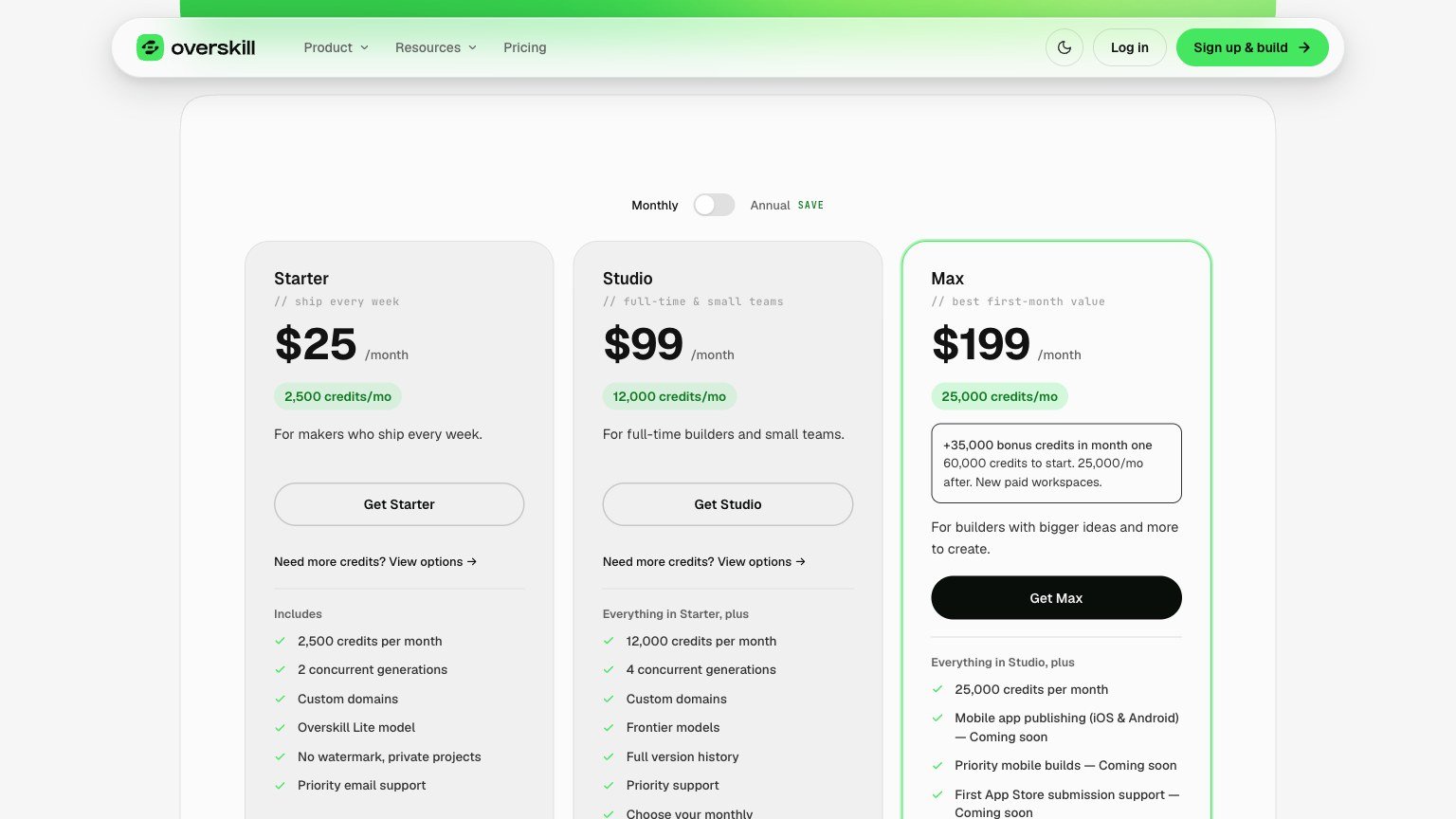
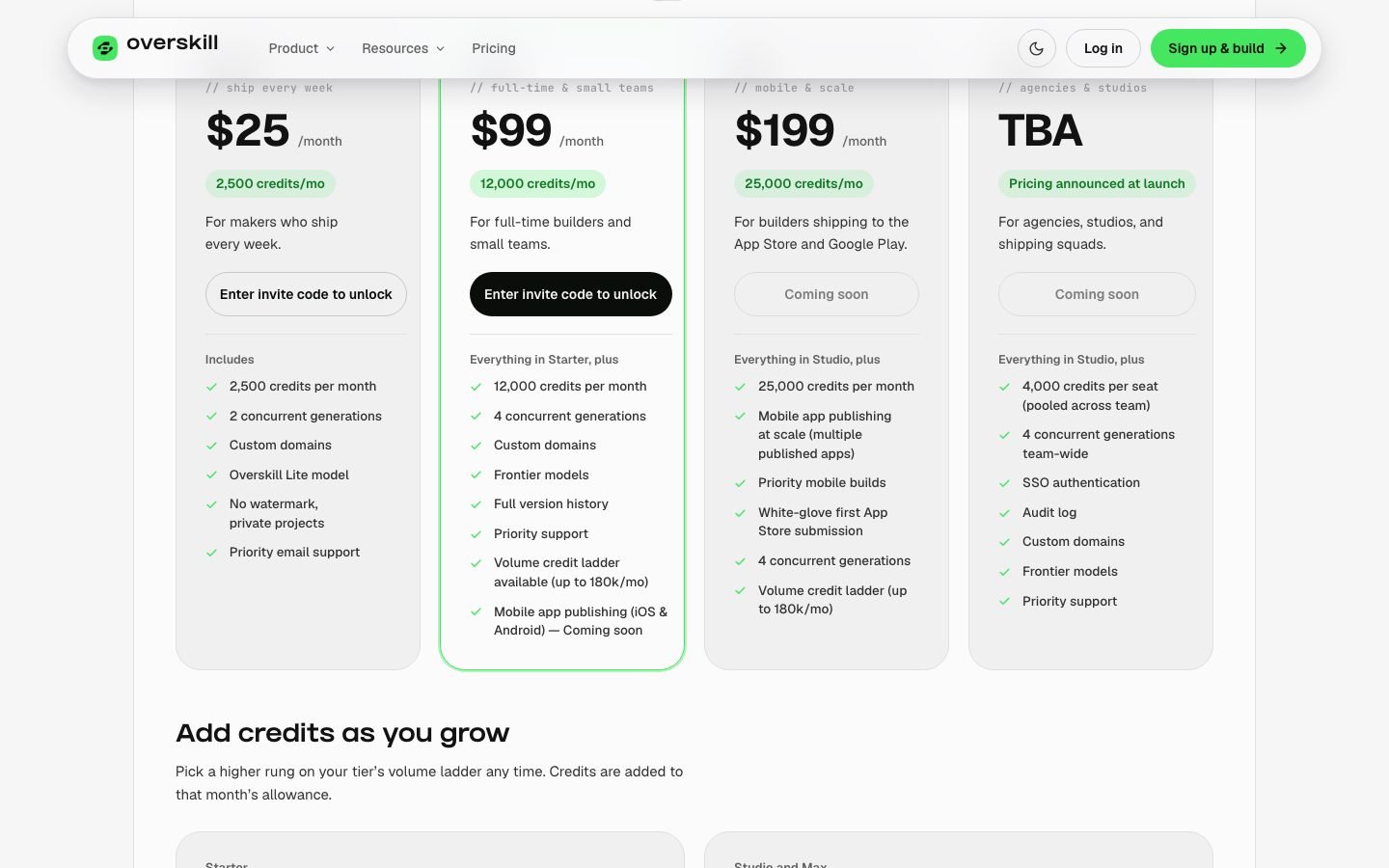
The public pricing page lists two plans. Studio is $99 a month for 12,000 credits and Max is $199 for 25,000, with 35,000 bonus credits in a new paid workspace’s first month. Annual billing on Studio saves 17%. Enterprise is priced on request.
| Plan | Monthly | Credits/month | Where you can buy it |
|---|---|---|---|
| Starter | $25 | 2,500 | Bootcamp checkout and affiliate invite codes only |
| Studio | $99 | 12,000 | Public pricing page |
| Max | $199 | 25,000 plus 35,000 first month | Public pricing page |
| Enterprise | Custom | Custom | Sales team |
Two things have changed since our September check. Starter vanished from the public page, and the page now says every plan includes frontier models. In September, Starter ran a cut-down model called Overskill Lite. The bootcamp checkout does not say which model Starter gets now, and the model picker in our free account still defaults to Lite.
Payments changed too. Overskill’s FAQ now says customer payments inside your app run on Whop, at Whop’s published rates. Check those before you price anything you plan to sell.
Storage is unchanged and rarely the constraint: 50GB of database, 100GB of files, up to 10GB per app, and unlimited bandwidth. Past those limits, database storage costs $1 per GB per month and file storage $0.05, charged out of your credits.
The $25 Starter Plan From the Side Hustle Bootcamp
The Side Hustle Bootcamp was a four-day live event run by Russell Brunson in early October 2026 for buyers of his Monetize program with Iman Gadzhi. On Day 1 he called Overskill a “magic box” and sent attendees to a private checkout. That link still works.
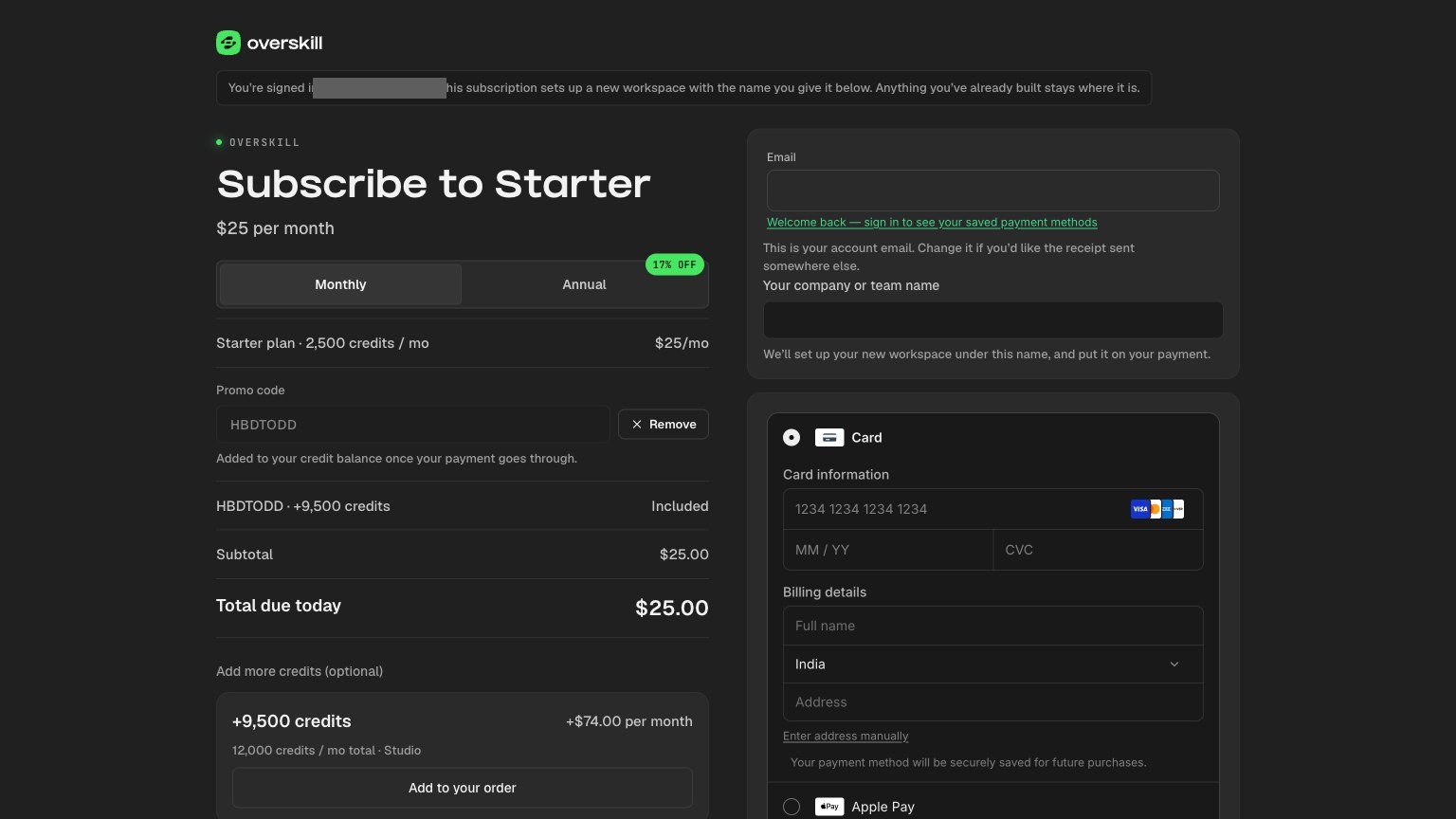
The address is overskill.com/sidehustle, with no hyphen. The hyphenated version returns a 404. The link redirects to a checkout page that reads “Subscribe to Starter, $25 per month, 2,500 credits”. On stream, Russell also mentioned a $97 tier. The checkout we loaded offered only Starter.
Russell’s reason for charging at all was cost. He said the AI providers bill Overskill for every generation, so attendees were paying close to the raw credit cost. He also told attendees to buy discounted credit packs while the event ran. We could not see pack prices on the logged-out checkout, so we cannot confirm the discount.
On Day 2, Russell said the beta prices sit close to cost and that Overskill will raise them later. He also said the first prompt in a new app is the most expensive, because it builds the database and infrastructure. Copying one of his templates into your account costs no credits. Only your edits do.
If you already have an Overskill account, the bootcamp link drops you on your dashboard instead of the checkout. The pricing FAQ says public checkout creates a separate workspace. Existing users should change plans from the billing page.
The Real Cost of an Overskill Credit
Credits decide what a plan is worth. Dividing price by allowance gives the number the pricing page never prints. The Studio ladder has been rebuilt since 10 September, and it now hides one bad deal.
| What you buy | Cost | Credits | Cost per 1,000 credits |
|---|---|---|---|
| Starter, bootcamp checkout | $25 | 2,500 | $10.00 |
| Studio | $99 | 12,000 | $8.25 |
| Studio, 25,000 rung | $249 | 25,000 | $9.96 |
| Studio, 50,000 rung | $449 | 50,000 | $8.98 |
| Studio, 100,000 rung | $749 | 100,000 | $7.49 |
| Studio, 250,000 rung | $1,499 | 250,000 | $6.00 |
| Max | $199 | 25,000 | $7.96 |
| Max, first month | $199 | 60,000 | $3.32 |
Never buy the 25,000 Studio rung. Max gives you the same 25,000 credits a month for $199, which is $50 cheaper, plus the 35,000 first-month bonus. The Studio rung is the most expensive credit on the platform after Starter.
The top of the ladder finally rewards volume. In September every rung sat near $8.30 per 1,000. Now the 250,000 rung reaches $6.00. That only matters if you are building for several clients at once.
In practice, a small change burns about 100 credits and a full new feature costs 300 to 800. Starter’s 2,500 credits buy three to eight features a month. Nothing rolls over on any tier.
Does Overskill Have a Free Trial?
Overskill advertises no free trial and no free tier. Create an account and a Free plan appears anyway, carrying 500 monthly credits plus a 50-credit waitlist bonus. We re-checked our account on 6 October and the 550 credits are still there.
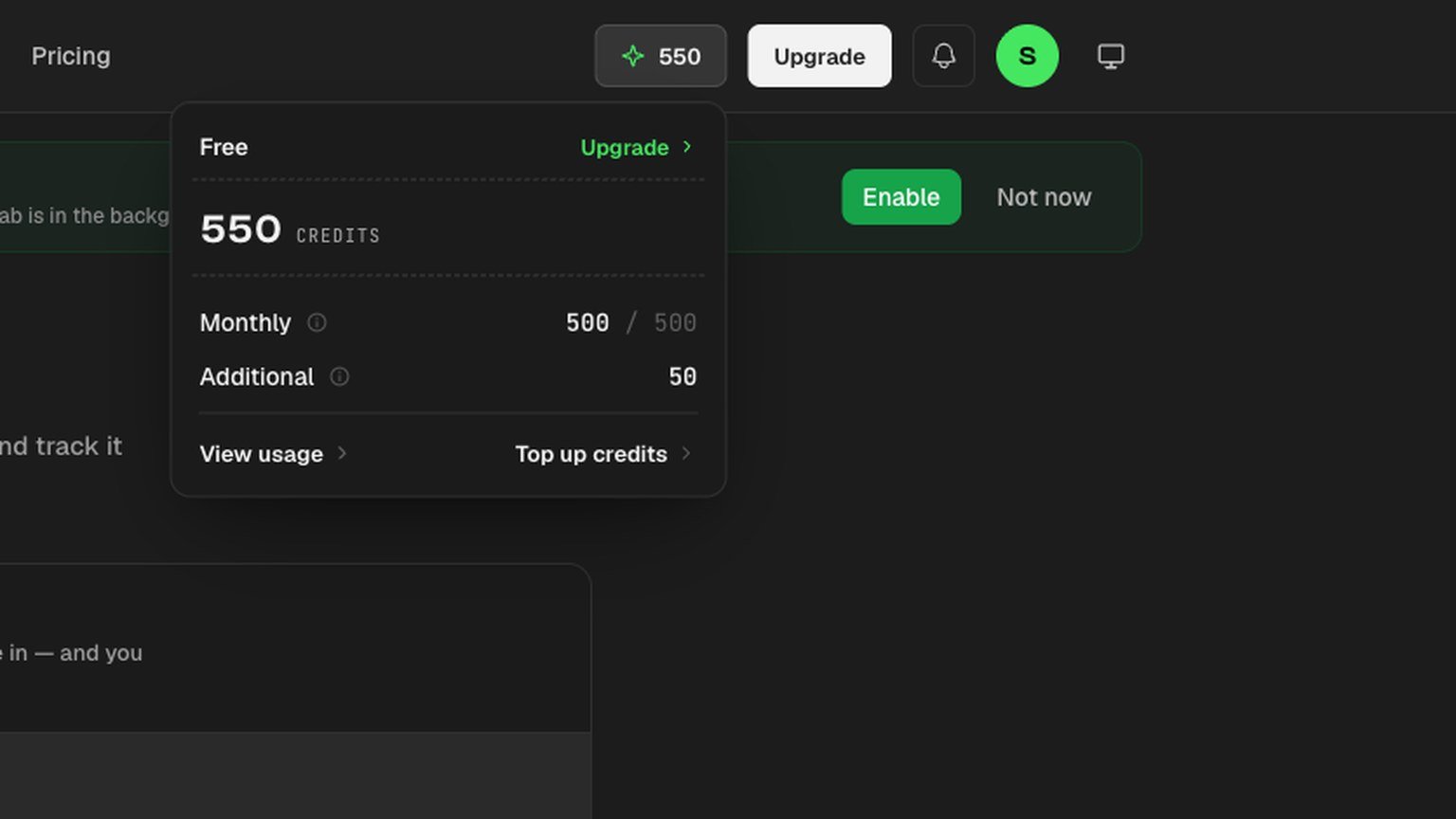
That covers roughly one feature or five small edits. It is enough to see whether the builder suits you, but not enough to build anything you would sell.
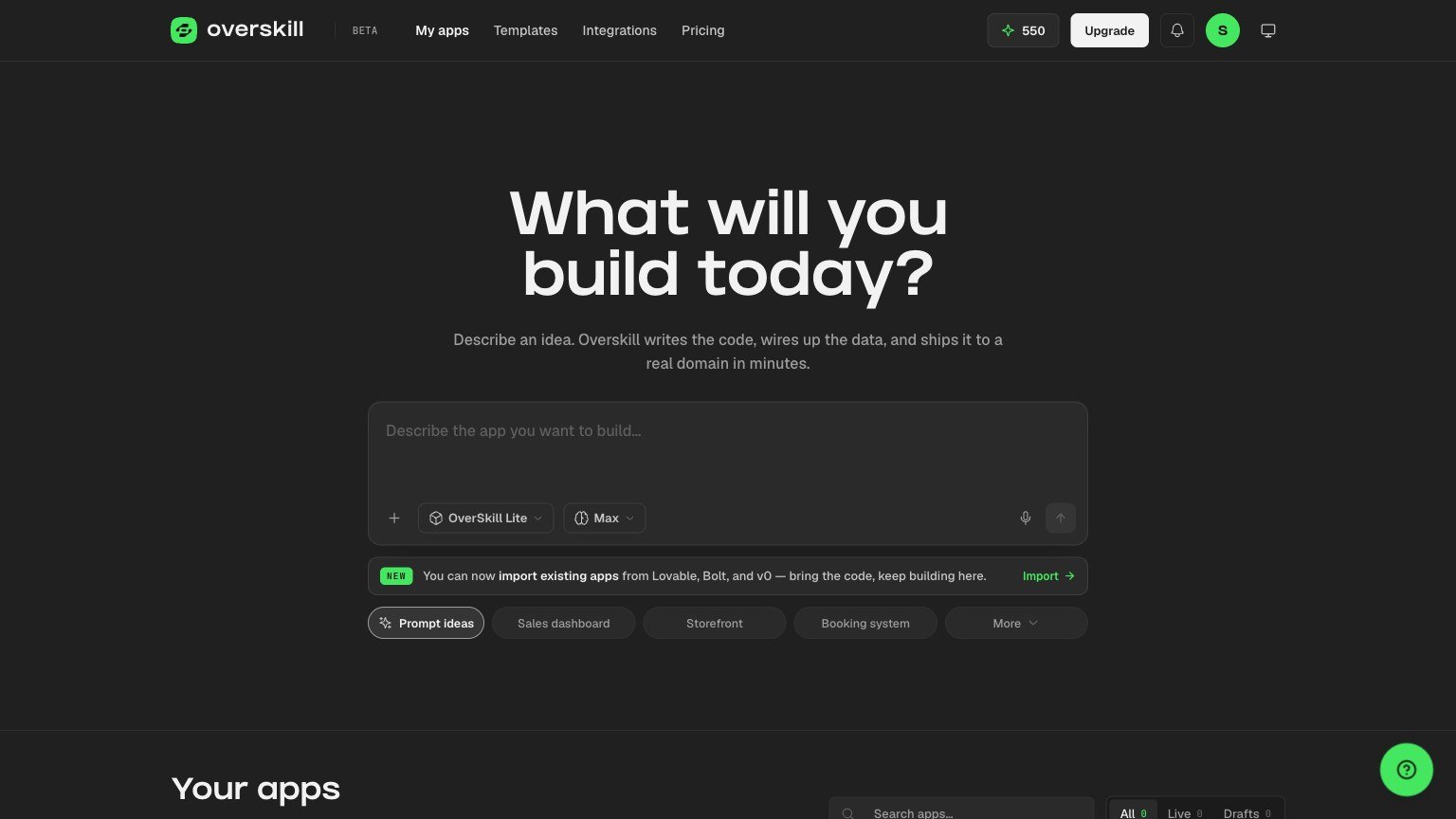
We have not shipped an app on this account, so treat the speed and quality claims in this piece as Overskill’s and Russell’s, not ours.
The Instant Influencer Template
Instant Influencer is a ready-made Overskill app that Russell built and gave to bootcamp attendees. You install a copy into your own account and rebrand it. He said building it cost about $10,000 in credits. Attendees get the rights to resell it and keep the revenue.
According to Russell’s Day 1 demo, the template has five parts:
- A membership site that hosts a creator’s courses and digital products.
- A “success path” that walks members through the creator’s videos in order.
- A converter that turns the creator’s books or courses into small software tools.
- An AI coach trained on the creator’s YouTube videos and podcasts, which answers questions in their voice.
- A built-in community, so members stay inside the app.
Russell priced it against the tools it replaces. He named Delphi for AI coaching at $349 a month, Circle for communities at about $300, and Skool at $97 a month. Skool’s own pricing has since moved to $99. The pitch is that a creator gets all of it in one app, and the person who set it up splits the monthly revenue with them.
Our take: the template is a sensible starting point if you already work with creators. Three cautions before you rely on it:
- Every edit costs credits. Rebranding and customising a large app for each creator eats a 2,500-credit Starter allowance fast.
- Get written permission. The AI coach is trained on the creator’s videos and podcasts, so it needs their consent, in writing, before you use their content.
- A built-in community is not Skool. It has no discovery network, so the creator has to bring every member.
We have not installed the template ourselves. Everything above comes from the live demo.
The Sales App Template
The Sales App is the second free template, handed out on Day 2. It is built for local businesses that close customers by phone, Zoom or text. When a lead fills in a form, the owner gets an instant alert, a grade for the lead and a custom call script. Leads can attach photos, a website link or a voice note, and the app grades those too.
Russell estimated it took $5,000 to $10,000 in credits to build. You copy it into your Overskill account through a remix link, overskill.com/remix/JnoPxe, then customise it for each client. The link loads on the live site. We have not remixed it ourselves.
The bootcamp pairs the template with a four-page Sales App Guide. It covers three things:
- Replying to comments: a public reply, then a DM asking for a 15-minute call within the hour.
- The “Hit by a Bus” closing script: the business owner’s current numbers, the speed-to-lead target, a four-step plan, and the question “Do you want help implementing this plan?”
- The close: waive a $2,000 setup fee and charge $250 a month to keep the app running.
On stream, Catherine Jones Lish advised scaling that monthly fee to the client’s deal size. Her examples were about $100 a month for a hairstylist and $500 for a roofer.
Three cautions apply:
- The stats need checking. The guide’s speed-to-lead figures appear in different forms across the slides and the script. One version says “100% more likely” and another says “100 times”. Check the sources before you repeat them to a client.
- You become the support desk. A $250 monthly fee makes you responsible for the client’s app, its hosting and every change they request.
- Customising costs credits. A 2,500-credit Starter plan covers only a few changes per client per month.
The App Builder Certification: Price Drops and an Honest Take
Russell is selling a certification for app builders, and its price has moved every day of the bootcamp:
| When | Stated price |
|---|---|
| Day 1, announced | From $18,000 |
| After Day 1 | $15,000 |
| Overnight before Day 2 | $13,000 |
| Day 2, waitlist guarantee | Under $9,997, “maybe even lower” |
The doors open later in the week, most likely on Day 4. We will add the final price and terms when we have seen them.
The waitlist is at appbuildercertification.com/waitlist, with “builder” in the singular. The “appbuilderscertification” spelling heard on stream does not resolve. Joining is free. The page promises three bonuses:
- notice 15 minutes before the public launch
- the Sales App, which the page values at $10,000
- the Sales Script, valued at $997
On Day 2, Russell described the certification as the place to learn custom apps, pricing complex builds and selling to $100,000 and $1,000,000 clients.
The bootcamp’s own evidence is still the best argument for waiting. Russell’s team ran a test challenge the week before. Of 180 people who attended every day, 62 made money, which is 34.4%. The event never defined how much. Most of those sales were free sales-app builds for local businesses, converted into monthly maintenance fees.
Catherine Jones Lish, who ran that test, said on stream that none of the 62 had used Overskill before their first sale. The money came from posting an offer and talking to business owners. Day 2 then handed out the full closing script for free. The method that produced those first sales is already in the free material.
Who should skip it: anyone who has not yet closed a paying app client. The building part is what a $25 Starter plan teaches in an afternoon. The selling part is in the free Sales App Guide.
Who might consider it: someone already closing app clients who wants help pricing and selling larger custom builds. Even then, ask four questions in writing before paying:
- What does “certified” get you: a directory listing, referred leads, or a badge?
- What is the refund policy?
- What is the full curriculum?
- What did past certified members earn?
This page carries no affiliate link for the certification.
Getting In Is Still the Real Constraint
Overskill remains invite-only. Its affiliate dashboard still describes the product as prelaunch, with single-use invite codes that expire 48 hours after issue. Our free account sits at waitlist position 4,841. In September, Overskill quoted a waitlist of about 11,000 people.
The pricing page FAQ now says you can buy a plan as soon as you sign up. In our experience, an account gets you onto the waitlist, and an invite code or an event link like the bootcamp checkout gets you to a paid plan.
The HBDTODD promo code from our September update expired on 17 September 2026, when Todd Dickerson’s ClickFunnels workshop began. It no longer adds credits.
What Ships on the First Prompt
Overskill’s pitch is that sign-in, a database, payments, email and push notifications arrive with the first prompt. On Day 1 of the bootcamp, Russell positioned it against Base44, Lovable and Claude Code on exactly that point. He said non-coders never have to connect a database.
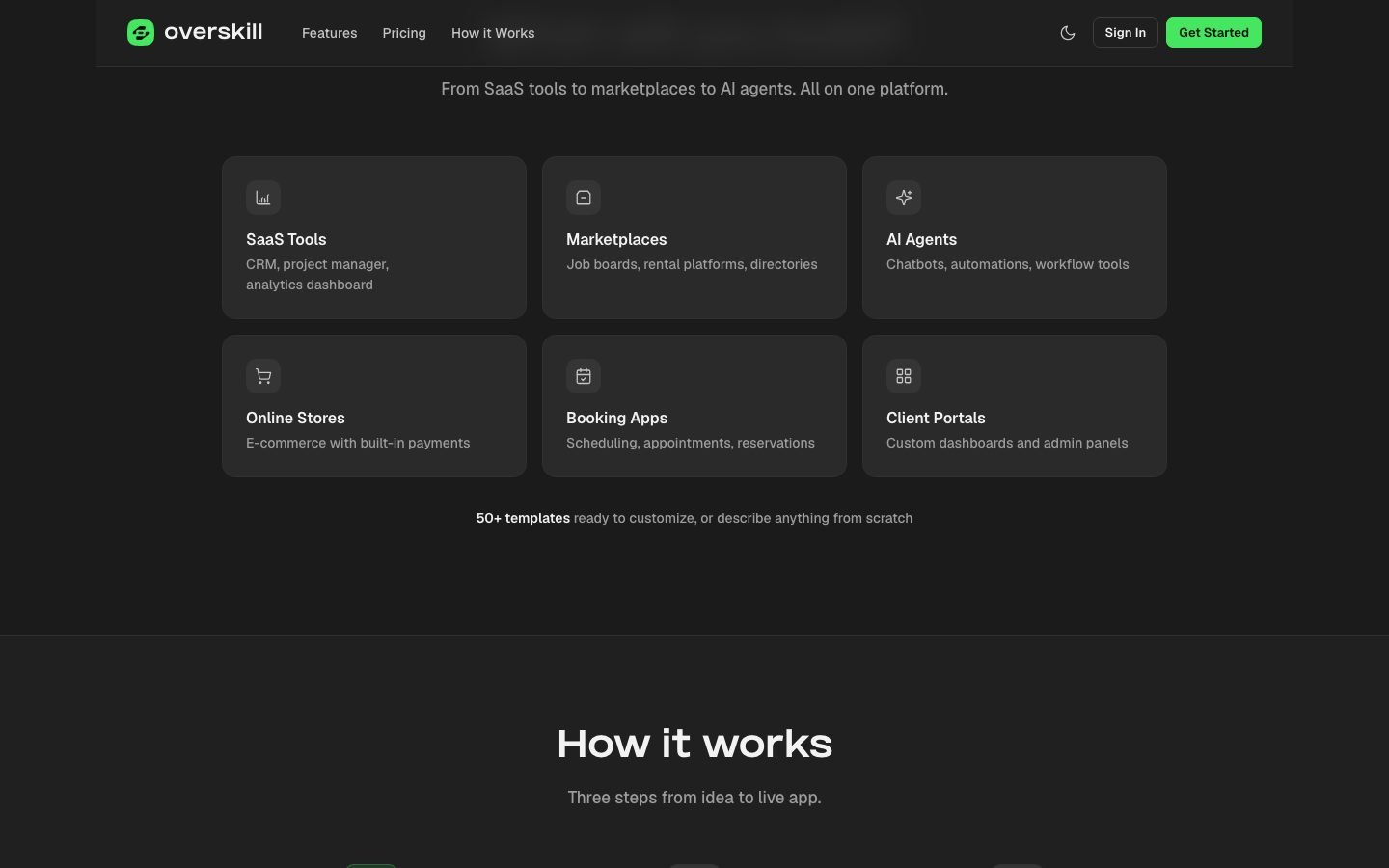
Overskill’s own FAQ is more careful than the pitch. It says sign-in, payments and email “need the right permissions, configuration and testing” for each app. Budget for that setup time even if the code arrives prewired.
- Authentication, so the app has real users from the start.
- A provisioned database, so data saves without you configuring a backend.
- Payments through Whop, which is the line between a demo and a business.
- Email and push, handled in the platform.
- Buyer credits, which let you charge your own customers for the AI inside your app at a markup you set.
Mobile app publishing to iOS and Android is still marked coming soon on both public plans.
Overskill vs Lovable vs Bolt vs Replit
Overskill is the only one of the four with no public free tier and no public entry plan under $99. Lovable, Bolt and Replit all start free and all expect you to assemble more of the backend yourself.
| Tool | Free tier | Entry paid plan | Backend |
|---|---|---|---|
| Overskill | None advertised, 550 credits once you have an account | $99/mo Studio publicly, $25 Starter through event links | Auth, database, payments via Whop, email and push |
| Lovable | Yes, 5 build credits a day up to 30 a month | $25/mo Pro, 100 credits, credits roll over | You connect Supabase, Stripe and email yourself |
| Bolt | Yes, 1M tokens a month, 300K daily | $25/mo Pro, from 10M tokens, tokens roll over | Partly bundled, more assembly than Overskill |
| Replit | Yes, Free Mode usage | $20/mo Core, $18 billed annually | Full control and full responsibility |
Overskill prices checked 6 October 2026. Rival prices checked on each vendor’s own pricing page on 10 September 2026.
At $25, Overskill is competitive with Lovable once you count the services Lovable makes you connect. At $99 it is four to five times the entry price of every rival. Lovable and Bolt also roll unused credits into the next month, and Overskill does not.
Where Overskill Still Falls Short
You cannot simply buy it. Invite codes last 48 hours and the waitlist is still thousands deep. Every rival is one signup away.
The pricing page hides its best deal. Starter at $25 exists, but only behind event links and invite codes. A buyer who reads only the public page sees $99.
One volume rung is a trap. Studio’s 25,000-credit rung costs $50 more than Max for the same credits.
Credits expire every month. Lovable and Bolt both roll them forward. A slow month on Overskill is simply gone.
Upgrading costs you the remainder. Change plans mid-cycle and you pay the new plan in full that day, with no refund for the days left on the old one. Your credit balance does carry over.
Independent testing is still thin. Most of what circulates traces back to the company, Todd Dickerson and Russell Brunson. That includes the claim that Russell’s son built 12 apps in one afternoon.
Who Should Buy It, and Who Should Not
Buy Overskill if you already know the app you want and you can reach the $25 Starter checkout. Studio at $99 earns its price once you are building for clients or running more than one project.
Best for:
- Bootcamp attendees who want the $25 plan while the event link still works.
- Non-technical operators with a specific app in mind, usually a client portal, booking tool or quiz funnel.
- Anyone working with creators who wants the Instant Influencer template as a starting point.
Skip if:
- You are still working out whether AI app building suits you. Lovable and Bolt answer that for free.
- You would be paying $99 to experiment.
- You build in bursts and would lose credits in the quiet months.
- You need App Store publishing or SSO today.
If you want maximum control and you are comfortable near real code, Replit or Claude Code will take you further than any of these.
Key Takeaways
- Overskill’s public plans are Studio at $99 and Max at $199 a month. Starter at $25 survives only through the bootcamp checkout and invite codes.
- The bootcamp link is overskill.com/sidehustle, with no hyphen.
- Never buy Studio’s 25,000-credit rung. Max gives the same credits for $50 less.
- A free plan with 550 credits still exists inside the product.
- Instant Influencer and the Sales App are free, rebrandable templates for bootcamp attendees. Copying them costs no credits, but customising them does.
- The certification fell from $18,000 to a waitlist guarantee of under $9,997. The bootcamp’s own test group made its first sales without Overskill at all.
Affiliate disclosure: we earn a commission if you subscribe to Overskill through our links. It costs you nothing extra and the pricing above is what the checkout charges. This page has no affiliate link for the certification. See our affiliate disclosure.
Related Reading
- Buildy AI Review 2026, another plain-English app builder in the same price bracket.
- ClickFunnels Pricing 2026, what Todd Dickerson’s first platform costs now.
- ClickFunnels Review, the funnel platform Overskill plugs into.
- MarketingSecrets.ai Review, the wider Brunson and Dickerson AI stack.
- Best AI Tools for Online Business 2026, where app builders sit against the rest.
FAQ
What is Overskill pricing in 2026?
Overskill’s public pricing is $99 a month for Studio with 12,000 credits and $199 a month for Max with 25,000 credits plus a 35,000 credit bonus in the first month. The $25 Starter plan with 2,500 credits is no longer on the pricing page but still sells through the Side Hustle Bootcamp checkout.
Is the $25 Overskill plan still available?
Yes, through the bootcamp checkout at overskill.com/sidehustle, which offered Starter at $25 a month for 2,500 credits on 6 October 2026. The hyphenated address returns a 404. Affiliate invite codes also lead to plans starting at $25.
Does Overskill have a free trial?
Overskill advertises no free trial. Once you have an account, a Free plan appears with 500 monthly credits plus a 50-credit waitlist bonus, which is 550 in total. That covers roughly one feature or five small edits.
What is the Overskill Instant Influencer app?
Instant Influencer is a rebrandable Overskill template that Russell Brunson gave Side Hustle Bootcamp attendees. It bundles a membership site, a success path, a product-to-software converter, an AI coach trained on a creator’s content, and a community. Attendees can resell it and keep the revenue.
How much is the App Builder Certification?
Russell Brunson announced it at $18,000, then cut it to $15,000 and $13,000 during the Side Hustle Bootcamp. On Day 2 he guaranteed waitlist members a price under $9,997. The waitlist is free at appbuildercertification.com/waitlist and includes the Sales App template and sales script.
Is the Overskill certification worth it?
For most people, no. The bootcamp’s own test group of 62 earners made their first sales without using Overskill at all, by posting an offer and talking to business owners. The closing script they used is free with the waitlist. Consider the certification only if you already close paying app clients and have seen its curriculum and refund terms in writing.
How much does an Overskill credit cost?
Credits cost $10.00 per 1,000 on Starter, $8.25 on Studio and $7.96 on Max. Max’s first month falls to $3.32 because of the bonus. Studio’s volume rungs run from $9.96 per 1,000 at 25,000 credits down to $6.00 at 250,000.
Is Overskill worth it?
Overskill is worth $25 a month if you already know the app you want and can reach the Starter checkout. At the public $99 entry price it is four times the cost of Lovable or Bolt, so test the 550 free credits first.
Full pros & cons
- The $25 Starter plan still sells through the Side Hustle Bootcamp checkout, a quarter of the public $99 entry price
- Studio's top volume rung cuts credits to $6.00 per 1,000, the cheapest recurring rate on the platform
- A free plan with 550 credits exists inside the product, though the pricing page never mentions it
- Buyer credits let you resell the AI inside your app at a markup you set
- Every public plan now runs frontier models
- Still invite-only. Our own account sits at waitlist position 4,841
- The public pricing page dropped Starter, so $25 is only reachable through event links and invite codes
- Studio's 25,000-credit rung costs $50 more than Max for the same 25,000 credits
- Unused credits never roll over, so a quiet month is money burned
- The bootcamp upsell is a certification guaranteed under $9,997 for its waitlist, down from $18,000
Try it yourself
Ready to put it to the test?
We may earn a commission at no extra cost to you. Affiliate disclosure.
Reader feedback
Was this review helpful?
Your feedback helps us write better reviews.
Thanks for your feedback.

AI Funnel Insider is an independent review site covering AI tools, Skool communities, and online courses. Every review states what was paid for, what was accessed and what was verified before a verdict goes live. Reviews are independent and may contain affiliate links, at no extra cost to you.
Related Posts

Funnel Builder Certification Review: $5,500, Earned by Revenue
ClickFunnels' Funnel Builder Certification costs $5,500. You don't pass a test to get certified: Bronze needs $10,000 in verified sales.

One Comma Club Challenge Review: Free, 5 Days, One $5,500 Pitch
The One Comma Club Challenge is free and runs Oct 26-30, 2026. Expect about 20 hours of content, not 90 minutes a day, and a $5,500 pitch.

AI Builders Skool Review 2026 (Marcin Teodoru's NoCode AI Stack)
AI Builders is Marcin Teodoru's Skool: a 21-day OpenClaw vibe coding program for 545 members. Is the $67/mo worth it? Honest pros, cons, and verdict.

AI Secrets Challenge Review: I Attended and Paid $2,997
I attended all five live days in April, then paid $2,997 for MarketingSecrets.AI Platinum. Four months of daily use later, here is what was actually worth it.

MarketingSecrets.ai Review 2026: Worth the Price?
After 120 days on Marketing Secrets AI, here is what the $97/mo AI router does well, where a $20 ChatGPT plan beats it, and who should skip it.

Russell Brunson Scam Allegations: What's Actually True
Is Russell Brunson a scam? The real allegations against him and ClickFunnels, what is true, what is hype, and an honest verdict for 2026.
Price watch
Get told if Overskill Pricing 2026 changes price.
It is $25/month today. We re-check prices on everything we review and email you once when this one moves, plus the Sunday review.
