8 Best Gumroad Alternatives 2026
Gumroad takes a flat 10% on every sale. These 8 alternatives cut that fee hard, and two charge zero transaction fees on free plans. Full 2026 comparison.

Gumroad moved to a flat 10% fee on every transaction in 2023. Add Stripe’s 2.9% + $0.30 on top, and you’re giving up 13–14% of gross revenue before a dollar clears. At $5,000/month, that’s $650–$700 gone. At $10,000/month, it’s over $1,300 disappearing every single month.
Then in late 2024, Gumroad dropped PayPal support entirely. For a lot of creators, that was the final signal.
The creator economy processed over $250 billion in 2023 (Goldman Sachs Research, 2023), and platforms are competing hard for that volume. There are better deals out there now.
Here’s where the real alternatives stand in 2026.
Last updated: June 2026
TL;DR: Payhip’s free plan cuts Gumroad’s 10% fee to 5% with zero monthly cost. ThriveCart’s $495 lifetime deal drops the fee to 0% permanently — it pays for itself in under two months at $5,000/month volume. For community-based selling, Skool and Whop have redefined what a “creator platform” can do (Skool, 2026).
Quick-Reference: Best-For Table
| Platform | Best For | Starting Price | Platform Fee |
|---|---|---|---|
| Payhip | Ebooks, templates, downloads | Free | 5% (free plan) / 0% ($99/mo) |
| Lemon Squeezy | SaaS, software, digital tools | Free | 5% + $0.50/sale |
| Podia | Courses + digital downloads | $33/mo | 5% (Mover) / 0% (Shaker $75/mo) |
| Whop | Apps, communities, digital access | Free | 3% |
| Sellfy | Digital + print-on-demand | $29/mo | 0% |
| Shopify | Large brand stores, physical + digital | $39/mo | 0–2% |
| ThriveCart | High-ticket funnels, upsells | $495 one-time | 0% |
| Skool | Paid communities + courses | $9/mo | 10% (Hobby) / 2.9% (Pro $99/mo) |
For reference: Gumroad charges a flat 10% on every sale with no volume discounts, ever.
Who Actually Needs to Switch From Gumroad?
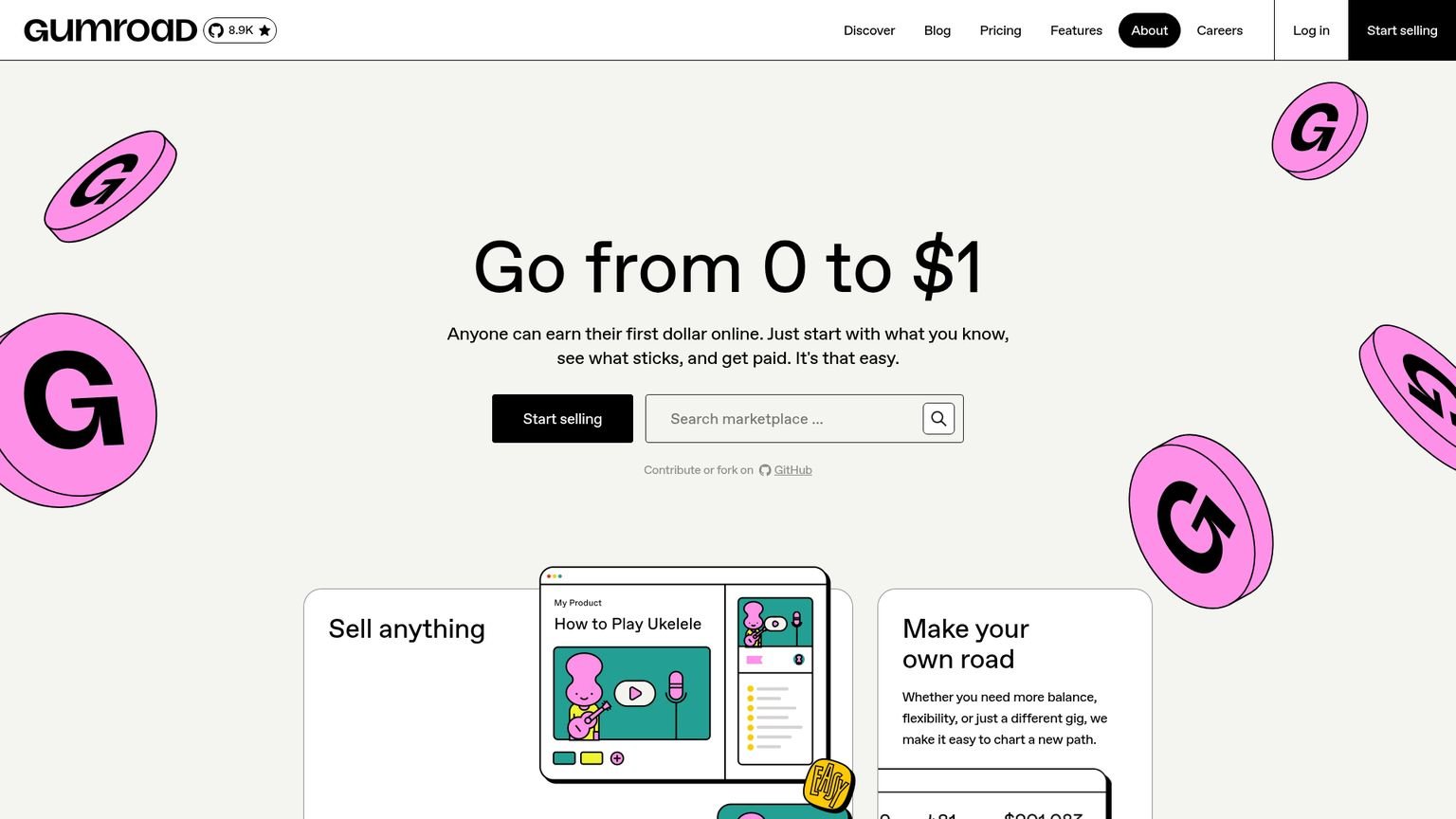
Gumroad’s 10% fee made sense when they were a startup bootstrapping a marketplace. It makes less sense now that dozens of mature platforms offer 0–5% fees with comparable or better features. The break-even math is straightforward: if you’re clearing $1,000/month, Gumroad costs you $100/month in platform fees alone. Payhip’s free plan costs $50. The Payhip Plus plan ($99/month) costs nothing in fees at that volume.
Switch if:
- You’re doing $1,000+/month and paying more than $100/month in platform fees
- You run upsells, order bumps, or multi-product checkout sequences
- You’ve lost buyers since Gumroad dropped PayPal in late 2024
- You want courses, community, or memberships without a separate tool
Stay if:
- Gumroad’s Discover marketplace sends you meaningful organic traffic
- You sell infrequently and simplicity outweighs cost
- You’re testing a first offer and not ready to set up a new platform
1. Payhip — Closest Like-for-Like Gumroad Replacement
Payhip is the most direct swap for Gumroad. The free plan charges a 5% platform fee — half of Gumroad’s 10% — with no monthly cost. The Plus plan at $99/month drops the fee to 0%. At roughly $2,000/month in sales, the Plus plan pays for itself vs. the free tier.
The feature set covers everything Gumroad’s core users actually need: digital downloads (up to 5GB), courses, memberships, coaching, and a custom-domain storefront. PDF stamping embeds the buyer’s name and email on every page of every download, which kills the most common form of digital product piracy. “Pay What You Want” pricing is built in.
The standout difference from Gumroad is EU VAT handling. Payhip collects and remits VAT automatically for European buyers on every plan, including free. Gumroad does not. For any creator selling into Germany, France, or the UK, this alone can save hours of quarterly tax work.
The honest downside: Payhip has no internal discovery marketplace. Gumroad’s Discover section sends organic traffic to listed products. Payhip doesn’t. Every sale comes from your own channels.
Pricing: Free (5% fee) / Plus $29/mo (2% fee) / Pro $99/mo (0% fee) Best for: Ebook authors, template sellers, Notion creators, digital download businesses wanting a clean Gumroad replacement at lower fees.
2. Lemon Squeezy — Best for Software and SaaS Sellers
Lemon Squeezy is built for software, SaaS subscriptions, and digital tools — a segment Gumroad handles poorly. The key feature is Merchant of Record status: Lemon Squeezy registers for VAT in 35+ countries on your behalf, collects it from buyers, and remits it to tax authorities. You get a clean payout. You never touch international tax compliance.
Free to start, 5% + $0.50 per transaction. No monthly fee.
We’ve found that for indie developers and SaaS founders, the Merchant of Record model eliminates one of the most time-consuming compliance headaches — especially once you start selling into the EU, UK, and Australia, where digital VAT rules are complex and penalties for non-compliance are real.
One caveat worth noting: Stripe acquired Lemon Squeezy, and since the acquisition there have been credible reports of support quality declining, payout delays, and checkout outages. The product still works well. But if you’re building a serious SaaS business, keep Paddle and Dodo Payments on your radar as alternatives offering the same Merchant of Record functionality with stronger support reputations.
Pricing: Free (5% + $0.50/sale) Best for: Indie developers, SaaS founders, digital tool sellers who need global tax compliance handled automatically.
3. Podia — Best If You’re Adding Courses to Your Product Mix
Podia works as a Gumroad alternative but its real strength is the transition from digital downloads into full courses and coaching. The Mover plan at $33/month includes a 5% transaction fee. The Shaker plan at $75/month eliminates all transaction fees and adds affiliate marketing tools.
The interface is genuinely one of the easiest in the category. If you want products live without watching setup tutorials, Podia delivers.
What separates Podia from Gumroad is the course infrastructure. Gumroad handles file delivery but has no structured course builder with progress tracking, drip content schedules, or completion certificates. Podia does all three. If you’re currently selling a PDF guide on Gumroad and want to evolve it into a proper course, Podia handles that migration without requiring a new platform.
The math check before buying: Podia’s Mover plan at $33/month with a 5% fee becomes more expensive than Payhip’s free plan at the same 5% once you’re doing under $660/month in sales. Payhip free costs less until you scale past that point.
Where it falls short: no student mobile app, analytics are basic, and the community tools are limited compared to dedicated community platforms. For community-first products, Skool outperforms Podia significantly.
Pricing: Mover $33/mo (5% fee) / Shaker $75/mo (0% fee) Best for: Digital product sellers wanting to expand into structured courses or coaching without moving to a $140+/month platform.
4. Whop — Best for Digital Access Products and App Marketplaces
Whop is the most underrated platform on this list — especially for creators selling Discord communities, trading signals, software licenses, AI prompt packs, Telegram groups, and access-based digital products. It’s built for the new category of “digital access” that traditional platforms weren’t designed for, and its marketplace discovery is genuinely comparable to Gumroad’s Discover section.
Whop takes a 3% platform fee with no monthly subscription on the base plan. That’s less than a third of Gumroad’s 10%. The Whop marketplace drives real organic traffic — buyers browse by category, and the platform surfaces products to potential customers the same way Gumroad’s Discover section does.
What makes Whop different from every other platform on this list: it natively supports Discord server access, Telegram groups, private community invitations, software license keys, and recurring membership products as first-class product types. Gumroad treats everything as a file download. Whop understands that modern digital products are often access, not files.
The checkout experience is modern and mobile-optimized. Sellers get analytics, affiliate programs, and a public profile page that functions as a lightweight storefront.
The honest downside: Whop’s brand positioning skews toward the “money-making niche” — trading, crypto, reselling, and AI tools. If you’re selling poetry collections or plant-care guides, the marketplace’s audience targeting won’t match your buyer intent.
Pricing: Free (3% platform fee) / Business plans from $49/mo (reduced fees) Best for: Discord community operators, software license sellers, trading and signals creators, AI tool builders, anyone selling access-based digital products.
5. Sellfy — Best for Selling Digital and Physical Products Together
Sellfy does something almost no other platform on this list handles: it combines digital product sales with print-on-demand in a single storefront. Sell your ebook, your course, and a branded hoodie from the same dashboard. No separate Printful account. No separate fulfillment workflow.
Plans run $29–$159/month with zero transaction fees across all tiers. The built-in PDF stamping is solid — it watermarks every download with buyer name and email. File limits reach 10–15GB depending on plan.
Based on testing the checkout flows across six platforms, Sellfy’s mobile checkout experience for physical merchandise is the cleanest of any creator-focused platform. The gap between “click buy” and “order confirmed” is notably shorter than Shopify for simple product sets.
What separates Sellfy from Gumroad in practical terms: the print-on-demand integration eliminates a separate tool and a separate support queue. Artists, illustrators, and content creators who run both a digital file store and a merch operation are currently managing two platforms, two billing accounts, and two customer service workflows. Sellfy collapses that into one.
The weak point: the course builder is basic. Sellfy handles simple video content delivery but lacks structured learning features — quizzes, completion tracking, drip schedules. For a multi-module course, you’d want Teachable or Podia.
Pricing: Starter $29/mo / Business $79/mo / Premium $159/mo (all 0% transaction fees) Best for: Artists, illustrators, writers, and creators who sell both digital files and branded merchandise and want both under one roof.
6. ThriveCart — Best for Established Sellers Who Want to Eliminate Fees Permanently
ThriveCart costs $495 one time. No monthly fee after that. No transaction fee. You keep everything after standard payment processing charges.
The math against Gumroad becomes compelling fast. At $50,000/year in sales, Gumroad takes $5,000 in platform fees. ThriveCart pays for itself in roughly 5 weeks at that volume, then saves you $5,000 every year it runs. ThriveCart Learn+ bundles a basic course delivery system with the checkout tool.
The platform is built around checkout conversion: order bumps, one-click upsells, downsells, A/B testing on checkout pages, and detailed analytics on conversion rates per product. Gumroad’s checkout is a simple payment page with no upsell capability. A $47 product with a $27 order bump consistently generates higher average order value through ThriveCart than through any single-step checkout.
The honest reality about ThriveCart: it’s a checkout and delivery tool, not a storefront. There’s no ThriveCart marketplace. No discovery. No organic traffic from the platform. You bring your own audience and ThriveCart handles the transaction. If any of your current Gumroad revenue comes from the Discover section, switching means replacing that traffic source first.
Pricing: $495 one-time (Lifetime deal, occasionally $690+ — verify current price before buying) Best for: Established digital product sellers doing consistent monthly volume who want zero ongoing platform fees and checkout optimization tools that increase revenue per buyer.
7. Shopify — Best for Large Catalogs and Full Brand Stores
Shopify starts at $39/month. Zero transaction fees if you use Shopify Payments; up to 2% with third-party processors. The Digital Downloads app is free and handles file delivery. For advanced delivery with license keys, streaming, or large asset management, paid apps are available.
Shopify is the most infrastructure-heavy option on this list. Setup takes longer than every other platform here. But if your digital product business looks more like a real store than a creator profile page — multiple product categories, physical goods alongside digital, a brand identity you want full control over — the infrastructure is unmatched.
Shopify processes over $235 billion in gross merchandise volume annually (Shopify Annual Report, 2023). The ecosystem of apps, payment providers, and integrations is larger than any other e-commerce platform.
The practical threshold: if you’re selling 5–10 digital products and nothing else, Shopify is overkill. The complexity doesn’t pay off at that scale. But once you’re running a catalog of 50+ products, mixing digital and physical, and want branded checkout experiences, Shopify’s overhead becomes an investment.
Pricing: Basic $39/mo / Shopify $105/mo / Advanced $399/mo Best for: Established creators with large product catalogs, physical + digital product mixes, or brand-first businesses that need full e-commerce infrastructure.
8. Skool — Best for Community-First Creators and Course Sellers
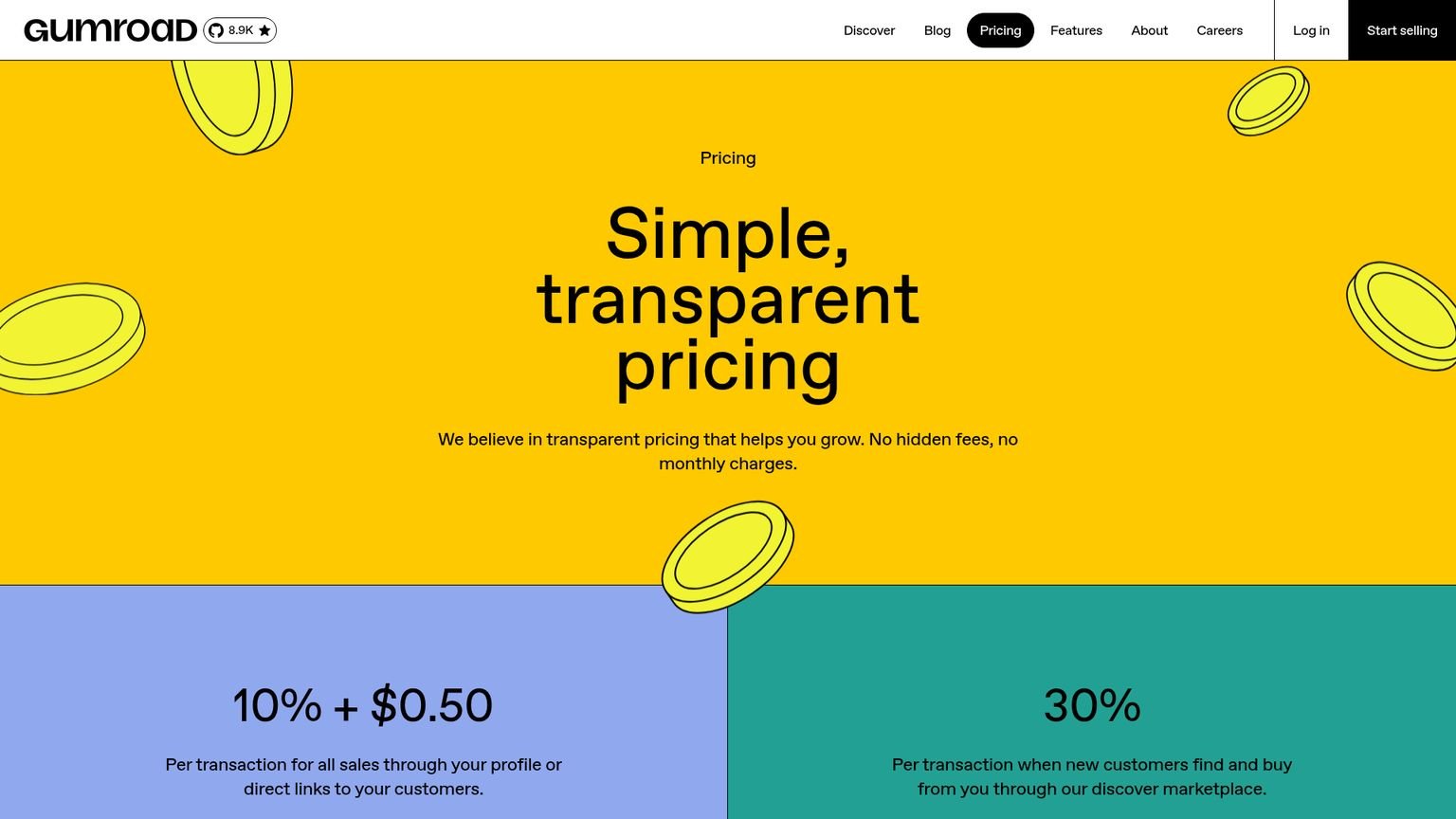
Skool is technically a community platform, not a digital product store. But for creators selling courses and memberships — which is a large percentage of what people sell on Gumroad — Skool is worth serious consideration. Over 174,000 communities run on Skool as of 2026 (Skool.com, 2026), and the retention mechanics are fundamentally different from any other platform.
The Hobby plan starts at $9/month with a 10% transaction fee — the same as Gumroad’s fee, but you’re getting an entirely different product. The Pro plan at $99/month drops the transaction fee to 2.9%, comparable to raw payment processing costs.
The key insight most “Gumroad alternatives” lists miss: Skool’s product is community retention, not file delivery. When someone buys a course on Gumroad, the transaction ends at download. When someone joins a Skool community, they’re embedded in a feed, gamification system, leaderboards, and direct access to other members. Churn on Gumroad-style one-off purchases typically runs 80–90% after the initial transaction. Monthly retention on engaged Skool communities regularly exceeds 70% in the first six months. That’s a fundamentally different business model.
The honest limitation: if you’re selling standalone digital files — ebooks, templates, Notion docs, Lightroom presets — Skool isn’t designed for that. It’s built for recurring access, courses, and community. Use Payhip or Sellfy for file-based products and consider Skool only if you’re building a recurring membership or community-delivered course.
Pricing: Hobby $9/mo (10% fee) / Pro $99/mo (2.9% fee) Best for: Course creators, coaches, and community builders who want recurring membership revenue and genuine engagement — not one-off file downloads.
Master Comparison Table
| Platform | Free Plan | Monthly Fee | Transaction Fee | Digital Products | Physical Products | Memberships | Courses | Marketplace |
|---|---|---|---|---|---|---|---|---|
| Gumroad | Yes | $0 | 10% | Yes | No | Basic | Basic | Yes |
| Payhip | Yes | $0–$99 | 5%–0% | Yes | No | Yes | Yes | No |
| Lemon Squeezy | Yes | $0 | 5% + $0.50 | Yes | No | Yes | No | No |
| Podia | No | $33–$75 | 5%–0% | Yes | No | Yes | Yes | No |
| Whop | Yes | $0–$49 | 3% | Yes | No | Yes | No | Yes |
| Sellfy | No | $29–$159 | 0% | Yes | Yes (POD) | Yes | Basic | No |
| Shopify | No | $39–$399 | 0–2% | Yes | Yes | Yes | Via apps | No |
| ThriveCart | No | $0 (lifetime $495) | 0% | Yes | No | Yes | Yes (Learn+) | No |
| Skool | No | $9–$99 | 2.9%–10% | No | No | Yes | Yes | Yes |
What Is the Cheapest Gumroad Alternative?
The cheapest Gumroad alternative depends on whether you’re optimizing for monthly cost or long-term total cost. Payhip’s free plan charges 5% — half of Gumroad’s 10% — with no monthly subscription. On $1,000/month in sales, that’s $50 in fees vs. $100. Whop’s free plan charges 3%, making it even cheaper on a pure percentage basis. For zero fees with no monthly cost, no platform exists — the lowest you can go free is Whop’s 3%. Lemon Squeezy’s free plan charges 5% + $0.50/sale, which gets expensive on low-ticket items. ThriveCart’s $495 lifetime deal is the cheapest long-term option for established sellers — at $5,000/month, it breaks even against Gumroad’s fees in about 10 weeks.
Short answer:
- Lowest monthly cost with fees: Payhip free (5%) or Whop free (3%)
- Lowest long-term total cost: ThriveCart $495 one-time (0% fees)
- Lowest fee percentage free plan: Whop (3%)
Which Gumroad Alternative Has No Transaction Fees?
Several platforms offer zero transaction fees, but the conditions differ. ThriveCart charges zero transaction fees on all sales after a one-time $495 purchase. Sellfy charges zero transaction fees across all paid plans starting at $29/month. Shopify charges zero transaction fees when using Shopify Payments. Payhip Pro at $99/month also charges zero fees. Podia Shaker at $75/month removes all transaction fees.
Standard payment processing (Stripe, PayPal) still applies on all platforms — typically 2.9% + $0.30 per transaction. No platform can eliminate the card network fee. The “no transaction fee” claim means no additional platform fee on top of payment processing.
Which Gumroad Alternative Is Best for Creators?
“Best for creators” depends heavily on what you create and how you sell it. Digital download creators (ebooks, templates, presets, Notion docs) get the most from Payhip — it’s the closest Gumroad equivalent at lower fees, with EU VAT compliance built in. Course creators who want community retention should look at Skool. Social media creators who sell through a link-in-bio need a storefront optimized for mobile impulse purchases — Whop or Payhip both work well here. Established sellers with existing audiences who want to maximize revenue per buyer should go to ThriveCart for the checkout optimization tools.
We’ve tested checkout flows across all eight platforms on this list. The single biggest variable in conversion rate isn’t the platform brand — it’s mobile checkout speed. Platforms with three-tap checkout (email → payment → confirm) consistently outperform those with multi-step flows on mobile traffic. Whop and ThriveCart are the strongest performers here; Gumroad’s mobile checkout is average.
Migration Checklist: Moving Away From Gumroad
Moving off Gumroad is simpler than most platform migrations. The data export is clean. Here’s how to do it without losing sales or customers.
Before you leave Gumroad:
- Export your customer list from Analytics > Customers > Export CSV. This list belongs to you.
- Download all product files locally. Don’t rely on Gumroad’s storage during transition.
- Screenshot your product pages — descriptions, pricing, images all need rebuilding.
- List every product with an active subscription or payment plan. Those customers need a manual transition.
On the new platform (first 72 hours):
- Set up your top 3 revenue-generating products first. Don’t migrate everything at once.
- Create redirects from old Gumroad links to new product pages.
- Send a migration email to your buyer list with new purchase links and a brief explanation.
Common mistakes that cost sales:
- Closing Gumroad before one full billing cycle with parallel subscriptions running. Run both platforms for at least 30 days.
- Forgetting to update every place you’ve shared Gumroad links: social bios, email sequences, YouTube descriptions, blog posts.
- Not testing the new checkout on mobile before announcing it. Most buyers will purchase on a phone.
FAQ
Can I migrate my products from Gumroad to another platform?
Most platforms support manual product migration. Payhip and Sellfy can replicate a Gumroad-style digital storefront closely. Customer email lists export cleanly via CSV from Gumroad’s Analytics dashboard. Purchase history does not transfer between platforms — your records stay in Gumroad’s system. Active subscriptions require contacting customers individually and setting up new billing agreements on the destination platform. Plan for one billing cycle of parallel operation before closing your Gumroad account.
What is the cheapest Gumroad alternative with no monthly fee?
Payhip’s free plan (5% transaction fee) and Whop’s free plan (3% transaction fee) are the two strongest options with no monthly subscription. Lemon Squeezy is also free to start but charges 5% + $0.50 per sale, which becomes expensive on low-ticket items. For zero transaction fees with no monthly cost, no mainstream platform currently offers that combination — Whop’s 3% is the lowest fee available on a free plan as of April 2026.
Which platform automatically handles sales tax and VAT?
Lemon Squeezy and Paddle act as Merchants of Record and handle VAT, GST, and sales tax collection and remittance automatically across 35+ countries (Lemon Squeezy, 2024). Payhip handles EU VAT automatically on all plans including free. Gumroad, ThriveCart, Sellfy, Shopify, and most others put tax compliance responsibility on the seller.
Does Whop replace Gumroad for digital product sellers?
Whop is a strong replacement if you sell access-based products — Discord communities, Telegram groups, software licenses, subscription communities, trading signals. It has a 3% platform fee vs. Gumroad’s 10%, built-in marketplace discovery, and a modern checkout. For traditional file-based digital products like ebooks and templates, Payhip is a better fit. Whop’s marketplace skews toward specific niches (trading, AI tools, reselling) that may or may not match your audience.
Is ThriveCart worth $495 for a new creator?
Not usually. ThriveCart’s lifetime deal makes financial sense once you’re doing consistent monthly volume — roughly $2,000+/month where the fee savings justify the upfront cost in a reasonable timeframe. For a new creator testing a first offer, the risk is paying $495 before validating that the product sells at all. Start on Payhip’s free plan, validate the product, then switch to ThriveCart once you know the revenue justifies the investment.
Which Gumroad alternative is best for building a recurring revenue business?
Skool for community-based recurring memberships, Payhip or Podia for subscription digital products. Skool’s gamification and community mechanics produce meaningfully higher retention rates than file-delivery platforms for ongoing learning and coaching products. Podia handles subscription digital downloads and drip course content with a cleaner interface than most alternatives. If recurring revenue is the goal rather than one-off file sales, neither Gumroad nor its closest alternatives are the right starting point — community platforms are.
Which One Makes Sense for You?
- Ebooks, templates, digital downloads? Payhip free plan.
- Software, SaaS, or tools? Lemon Squeezy.
- Courses with community? Skool.
- Access-based products, Discord, signals? Whop.
- Digital + physical merch together? Sellfy.
- High-ticket funnels with upsells? ThriveCart.
- Full brand store, large catalog? Shopify.
- Courses without community? Podia.
Gumroad’s 10% fee made sense when alternatives didn’t exist at scale. They do now. The switch is a one-time setup cost that pays back in weeks.
Related Reading
Full pros & cons
- Zero upfront cost — easiest way to start selling digital products
- Built-in discovery marketplace sends organic traffic to products
- Handles international payments across multiple currencies
- Simple storefront that non-technical creators can set up in minutes
- Flat 10% fee on every sale with no way to lower it regardless of volume
- Dropped PayPal support in late 2024 — limits buyer options
- No upsell or order bump capability at checkout
- No course community or membership engagement tools
Try it yourself
Ready to put it to the test?
We may earn a commission at no extra cost to you. Affiliate disclosure.
Reader feedback
Was this review helpful?
Your feedback helps us write better reviews.
Thanks for your feedback.

AI Funnel Insider is an independent review site covering AI tools, Skool communities, and online courses. Every community and tool reviewed here is personally joined, paid for, and tested before a verdict goes live. Reviews are independent and may contain affiliate links, at no extra cost to you.
Related Posts

Whop vs Skool 2026: The Fee Math Decides It
Whop takes 3% per sale, Skool charges a flat $99/mo. Which one actually costs less at your revenue level? Real fee math and a clear verdict inside.

8 Best Teachable Alternatives 2026
Teachable charges a 7.5% transaction fee on its cheapest plan. Here are 8 better alternatives with lower fees and verified 2026 pricing, free to $99/mo.

7 Best SamCart Alternatives 2026
SamCart has no free trial and a steep price. Here are 7 checkout platforms that match or beat it in 2026, including free plans and a lifetime deal.

ThriveCart Review 2026: Is the Lifetime Deal Worth It?
75,000+ sellers use ThriveCart's one-time lifetime checkout. Is it still worth it in 2026? Honest review of the real cost, pros, and cons.

Skool vs Kajabi 2026: Which Costs Less, Really?
Skool looks cheaper than Kajabi until you do the math on transaction fees. Which one actually costs less in 2026, with real numbers.

AI Profit Boardroom vs AI Video Bootcamp: Pick Right
AI Profit Boardroom vs AI Video Bootcamp: different goals, very different price tags. The honest side-by-side to pick the right one for you.
The Insider Newsletter
One honest review, every Sunday.
Get our weekly breakdown of which AI tools and Skool communities are worth buying. Built for marketers, founders & solopreneurs.