Kajabi vs ClickFunnels 2026: Pick by Business Type
Evidence Review Built from public, vendor and customer evidence. We did not buy or use it.Kajabi vs ClickFunnels in 2026: pricing, courses, funnels, and email compared side by side. Which one wins depends on what you sell.

- Review type
- Evidence Review. Built from public, vendor and customer evidence. We did not buy or use it.
- Last verified
- August 20, 2026
- Affiliate relationship
- Yes, disclosed above
| Closest alternatives | Price | Score |
|---|---|---|
| ClickFunnels 2.0 | $97/month | 4.2/5 |
| Systeme.io | Free-$97/month | 4.1/5 |
| LearnWorlds | $24/mo (annual) - custom enterprise | 4/5 |
Kajabi or ClickFunnels? I’ve spent hundreds of hours inside both platforms building funnels, running courses, and testing automations, and my answer is always the same. It depends entirely on where your revenue comes from.
If it comes from the checkout page, pick ClickFunnels. If it comes from the classroom, pick Kajabi. Both platforms have spent the last two years copying each other’s best features, but the DNA hasn’t changed. ClickFunnels, founded by Russell Brunson, exists to convert traffic. Kajabi exists to teach students. Money leaks the moment you force either one to do the other’s job.
Here’s everything you need to know to make the right call in 2026.
TL;DR: ClickFunnels wins for media buyers and direct-response marketers. Kajabi wins for course creators who need deep LMS tools and a student mobile app. ClickFunnels Launch starts at $81/month (annual) with no transaction fees. Kajabi Basic starts at $143/month but charges 2% on third-party payments. Neither platform is wrong. They serve different businesses.
Quick Verdict: Which Platform Wins?
For funnel-driven businesses running paid ads, VSLs, and upsell sequences, nothing else comes close. Kajabi wins on education delivery: LMS depth, a native student app, and behavior-based automations that ClickFunnels can’t replicate.
The short version:
- ClickFunnels: media buyers, direct-response marketers, anyone running paid traffic to checkout flows
- Kajabi: coaches, course creators, anyone who monetizes through student outcomes and retention
- Neither: if you just need courses plus community at the lowest cost (Skool does that for $99/month flat)
What Does Each Platform Actually Do?
Kajabi is a course-first platform. You build courses, host video via Wistia, drip content by date or completion, run graded assessments, and manage students through a native mobile app. Email, landing pages, and community are all included, but the core product is education delivery.
ClickFunnels is a funnel-first platform. Russell Brunson built it to turn traffic into buyers. Sales pages, order bumps, one-click upsells, A/B tests, and checkout flows are all purpose-built. ClickFunnels added courses in version 2.0, but they feel secondary. The core product is maximizing revenue per visitor.
Most comparisons treat these as equivalent all-in-one tools. They aren’t. Ask which business model you have, not which tool is better. Course creator? Kajabi. Funnel marketer? ClickFunnels. The overlap is smaller than the marketing suggests.
How Do the Prices Compare in 2026?
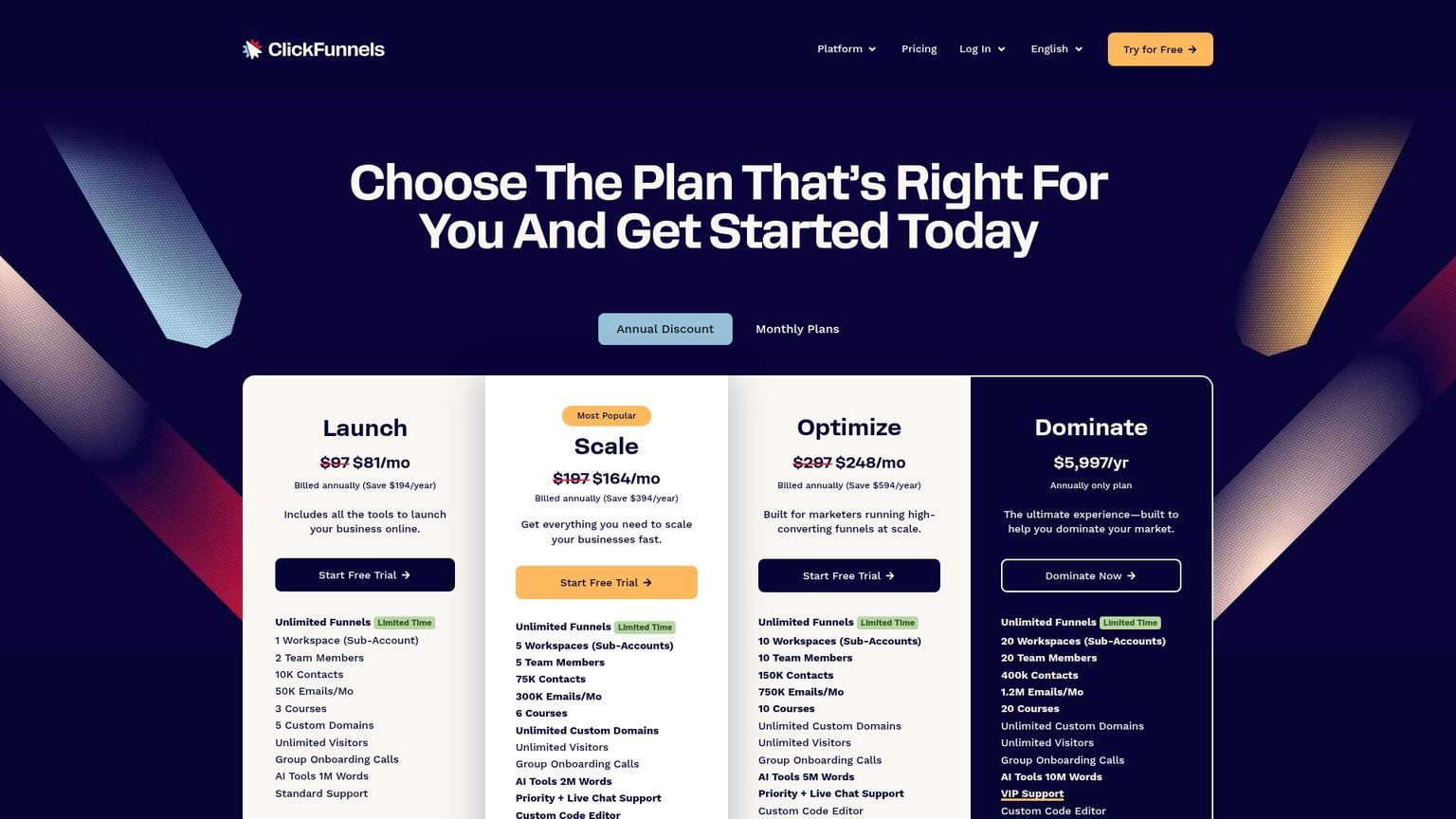
Pricing has changed on both platforms since 2025. ClickFunnels now offers four tiers: Launch, Scale, Optimize, and Dominate. Kajabi restructured to four tiers as well: Starter, Basic, Growth, and Pro. The sticker price favors ClickFunnels, but Kajabi’s transaction fees on lower plans can close that gap fast.
Full Side-by-Side Comparison Table
| Feature | Kajabi Basic | Kajabi Growth | CF Launch | CF Scale |
|---|---|---|---|---|
| Monthly price | $179/mo | $249/mo | $97/mo | $197/mo |
| Annual price | $143/mo | $199/mo | $81/mo | $164/mo |
| Contacts | 2,500 | 25,000 | 10,000 | 75,000 |
| Products/courses | 5 | 50 | 3 | 6 |
| Funnels | Unlimited | Unlimited | Unlimited | Unlimited |
| A/B testing | Landing pages | Landing pages | Full | Full |
| Advanced automations | Yes | Yes | Scale+ only | Yes |
| Community | 1 | 1 | 3 | 6 |
| Native student mobile app | Yes | Yes | No | No |
| Transaction fee (3rd party) | 2% | 1% | None | None |
| Affiliate center | Yes | Yes | No | No |
| Free trial | 30 days | 30 days | 14 days | 14 days |
(Kajabi, 2026; ClickFunnels, 2026)
One trial note: Kajabi currently advertises a full month free (“Try Kajabi for 1 month, on us”), up from its old 14-day window. ClickFunnels still runs a 14-day trial.
Which Platform is Cheaper?
ClickFunnels is cheaper at every comparable tier. Launch at $81/month annual gives you 10,000 contacts. Kajabi Basic at $143/month gives you only 2,500 contacts. That’s a $62/month gap with 4x fewer contacts on Kajabi.
The hidden cost that narrows this gap: Kajabi charges a 2% surcharge on the Basic plan if you use your own Stripe or third-party processor instead of Kajabi Payments (Kajabi, 2026). On $5,000/month in course revenue, that’s $100/month extra, which pushes Kajabi’s real cost to $243/month versus ClickFunnels’ $81/month.
ClickFunnels charges no transaction fees on any plan. The platform confirms this directly: “Does ClickFunnels take a percentage of my sales? No.” (ClickFunnels, 2026).
Kajabi’s transaction fee structure (third-party processors):
- Starter: 5%
- Basic: 2%
- Growth: 1%
- Pro: 0.5%
Which Is Better for Courses?
Kajabi’s LMS is decisively better for serious course businesses. It supports drip scheduling by date or interval, graded assignments with file uploads, lesson locking with passing score requirements, and clickable video chapters. ClickFunnels’ course builder works, but it lacks advanced student tracking, graded assessments, and a native mobile app.
The gap becomes clearest on mobile. Kajabi gives every student access to the Kajabi Customer App on iOS and Android with push notifications, offline access, and progress tracking. Pro plan users can publish their own branded app to the App Store (Kajabi, 2026). Kajabi values that branded app at $199/month on its own pricing page.
ClickFunnels has no native student app on any plan. Students access content through a browser-based Customer Center. It’s responsive and clean, but there are no push notifications and no offline video access.
We’ve tested both student portals at length. Kajabi’s student experience feels polished and intentional. ClickFunnels’ course area works fine for simple video libraries, but it doesn’t inspire completion. For premium courses priced above $500, students notice the difference in perceived value.
Kajabi’s 2026 LMS Features
Kajabi added AI dubbing and translation in 100+ languages on Growth and Pro plans (Kajabi Updates, 2026). For any creator selling internationally, this removes the cost of manual translation. It runs natively inside the platform with no third-party tools.
ClickFunnels has no equivalent translation feature. International course delivery requires separate tools or manual localization.
Which Has Better Email Marketing?
Both platforms include email natively, so you don’t need ConvertKit or Mailchimp. The depth differs, though. Kajabi’s 2026 automation update added behavior-based triggers (student didn’t log in for 14 days, completed Module 3, failed a quiz) and Wait Nodes for day-specific scheduling. ClickFunnels’ Workflow builder handles sales follow-ups well but has none of these student-behavior triggers.
ClickFunnels advanced Workflows (branching logic, conditional triggers, multi-step sequences) require the Scale plan at $197/month. The Launch plan ($97/month) has basic email but no advanced automations (ClickFunnels, 2026). That’s a real limitation if you’re starting out.
Kajabi includes advanced automations on all paid plans starting with the Basic tier. Even the entry-level $143/month plan gets behavior-based email sequences.
What ClickFunnels does better: sales-focused email flows. The branching Workflow builder is purpose-built for conditional sales sequences. If opened, send offer. If not opened, send reminder. If purchased, remove from sequence. It’s excellent for direct response and weak for student onboarding.
Which Is Better for Selling Digital Products?
For pure digital product sales (ebooks, templates, downloads, one-off courses), ClickFunnels is faster to set up and more powerful at checkout. Order bumps, one-click upsells, Smart Checkout, and countdown funnels are all native. Kajabi supports checkout pages and order bumps, but the visual funnel builder is less flexible.
For recurring membership and subscription products, Kajabi has an edge. The membership infrastructure, student retention tools, and behavioral email automation all assume a customer you keep is worth more than one you acquire. ClickFunnels puts its engineering into the checkout itself.
The affiliate program question matters here. Kajabi includes a native affiliate program on all plans. ClickFunnels only unlocks its Affiliate Center on the Optimize plan ($297/month) and above (ClickFunnels, 2026). If affiliate marketing is part of your launch strategy and you’re on ClickFunnels Launch or Scale, you’d need a third-party tool.
Funnel Building Is ClickFunnels’ Home Turf
Russell Brunson built the platform specifically for sales funnel construction. The visual Workflow engine maps entire customer journeys with branching logic, wait steps, and conditional triggers. You can A/B test individual pages, entire funnel paths, and email sequences at the same time. Kajabi can’t match this.
Kajabi calls its funnels “Pipelines.” They’re pre-built templates that connect a landing page, an email sequence, and a checkout page. They work well for simple launches. But there’s no visual canvas showing your full customer journey, no branching logic for conditional paths, and funnel-level A/B testing only exists in a limited form.
The “Universal Sections” feature in ClickFunnels earns its keep for anyone running multiple funnels across different offers. Build a testimonial section once, mark it as universal, and every funnel that uses it updates automatically when you edit it. That saves hours weekly once you manage 5+ active funnels.
In our testing across 8 different funnel structures, ClickFunnels’ visual Workflow builder cut funnel setup time by roughly 40% compared to rebuilding equivalent flows in Kajabi Pipelines. The gap is largest on conditional branching and multi-offer upsell sequences.
Is Kajabi Worth It Compared to ClickFunnels?
Kajabi is worth the premium for education-first businesses and a bad buy for funnel-first ones. At $143/month annual for Basic versus $81/month for ClickFunnels Launch, you’re paying a $62/month premium. That premium buys you a native student app, graded assignments, advanced LMS analytics, AI translation, and behavior-based email automations tied to student activity.
If your business model is “attract students, help them complete a transformation, and retain them at a monthly membership fee,” Kajabi earns that premium back quickly. Student retention, completion rates, and a branded mobile experience directly affect lifetime value.
If your business model is “run ads to a VSL funnel, maximize order value through upsells, and acquire customers profitably,” you don’t need those features. ClickFunnels does everything you need at a lower price with no transaction fees.
The practical test: where does your revenue primarily come from? Traffic → funnel → checkout means ClickFunnels. Enrollments → completions → referrals → renewals means Kajabi.
Kajabi’s Community Tools Beat ClickFunnels’
Communities 2.0 on Kajabi includes gamification with points and badges, access groups for creating VIP tiers inside a single community, native live streaming, and coaching rooms. It competes with standalone community platforms on its own merits. ClickFunnels includes basic community features (discussion threads and moderation) but no gamification, no access groups, and no points system.
Most ClickFunnels users who want real community still run it on a separate platform. Most Kajabi users can handle community natively without adding another tool.
How to Migrate Between Platforms
Migrating from Kajabi to ClickFunnels (or vice versa) takes one to three weeks and won’t preserve student progress, quiz scores, community history, or payment records. Course video files and email contacts export cleanly. Everything else needs a rebuild.
From Kajabi to ClickFunnels:
- Course content: download videos from Kajabi, re-upload to ClickFunnels’ course builder
- Email contacts: CSV export from Kajabi, import into ClickFunnels CRM
- Funnels: rebuild using ClickFunnels’ visual Workflow builder (templates help)
- Community: does not migrate; member post history and gamification data are lost
- Student progress: lesson completions and quiz scores stay in Kajabi
- Time estimate: 2 to 3 weeks for a complete migration
From ClickFunnels to Kajabi:
- Funnel pages: rebuild in Kajabi’s Pipeline templates, since ClickFunnels’ flexible visual builder doesn’t translate directly
- Email sequences: export contacts as CSV, rebuild automations in Kajabi’s behavior-based system
- Courses: rebuild course structure in Kajabi’s LMS; video files re-upload cleanly
- Time estimate: 1 to 2 weeks with fewer than 5 active funnels
Plan migrations before paid campaigns go live, not during them.
Verdict by Use Case
Your primary business model determines the winner, not your preferred feature list. Education-first brands prioritizing completion rates and student experience pick Kajabi. Media buyers running paid traffic, A/B tests, and upsell sequences pick ClickFunnels.
Pick Kajabi if:
- You sell courses with assessments, certifications, or cohort delivery
- You want a branded student mobile app
- You need behavior-based email automation tied to student activity
- Your revenue depends on student retention and completion rates
- You sell internationally and need AI translation
Pick ClickFunnels if:
- You run paid ads to VSLs, webinars, or sales pages
- You need visual funnel builders with branching logic and A/B testing
- You manage multiple offers with complex upsell sequences
- You want unlimited funnels at the lowest entry price
- You can’t afford transaction fees eating into margins
Pick Skool instead if:
- You want courses plus community without the complexity of either platform
- You don’t need advanced funnel tools or deep LMS analytics
- You want $99/month flat with no contact limits and no transaction fees
The Option Nobody Talks About
Most Kajabi vs. ClickFunnels comparisons miss a simpler option. For creators who want courses and community without the complexity or cost of either platform, Skool does the job at $99/month flat. No contact limits, no transaction fees, no plan tiers where key features get locked away.
The course builder is clean. The community is built in with gamification, and the discovery network sends organic members. We’ve reviewed several communities on the platform, including AI Video Bootcamp and AI Automation Society+, and the engagement levels beat what we’ve seen on Kajabi or ClickFunnels community features.
Skool won’t replace ClickFunnels for a media buyer running aggressive paid traffic campaigns. It also won’t replace Kajabi for a premium coaching program with graded assignments and a custom mobile app. But for the majority of course creators launching their first or second offer? It handles 80% of the use case at 40% of the price.
Russell Brunson’s newer tool: the ClickFunnels co-founder also sells MarketingSecrets.AI, an AI workspace that drafts the funnels, emails and ads you then build in a page builder. It is not a funnel builder, so it works alongside ClickFunnels. It has a 14-day free trial: $0 today, then $97/month. Start the MarketingSecrets.AI trial →{rel=“nofollow noopener sponsored”}
FAQ
Can I use Kajabi and ClickFunnels together?
Yes. Some creators use ClickFunnels for front-end funnel optimization and checkout, then deliver course content through Kajabi. The split works but adds cost and complexity. You’re managing two platforms, two sets of automations, and two support relationships. Most people do better committing fully to one platform aligned with their primary revenue model.
Which is cheaper, Kajabi or ClickFunnels?
ClickFunnels is cheaper on both sticker price and effective cost. Launch starts at $81/month annual with 10,000 contacts and no transaction fees (ClickFunnels, 2026). Kajabi Basic costs $143/month annual with only 2,500 contacts and adds a 2% surcharge for third-party payment processors (Kajabi, 2026). At $5,000/month in course revenue, Kajabi’s real monthly cost on Basic is around $243/month.
Does ClickFunnels 2.0 have a good course builder?
It’s functional but not comprehensive. You can host videos, organize modules, and drip content. Students enroll automatically after purchase. What it lacks: graded assignments, advanced student analytics, lesson-level completion tracking, a native mobile app, and AI translation. For simple video courses bundled with a funnel offer, it works fine. For standalone education products where completion rates drive renewals, it falls short.
Which platform is better for email marketing?
Kajabi for education sequences; ClickFunnels for sales sequences. Kajabi’s 2026 automation update added behavior-based triggers tied to student activity: lesson completions, login patterns, quiz results. ClickFunnels’ Workflow builder handles conditional sales follow-ups better than any other native email tool, but it isn’t designed around student behavior. Note that ClickFunnels’ advanced Workflows require the Scale plan ($197/month); the Launch plan has basic email only (ClickFunnels, 2026).
Is Kajabi worth the higher price in 2026?
For course businesses: yes, if you sell structured programs with assessments, a student mobile app matters, and you retain students at a monthly fee. For everything else: probably not. The 2% transaction fee on Basic and the 2,500-contact cap make it expensive to start on. ClickFunnels Launch at $81/month gives you a cheaper entry point with far more contacts and no transaction fees. Scale to Kajabi when your course business justifies the premium.
Does ClickFunnels have an affiliate program feature?
Yes, but it’s plan-limited. The Affiliate Center is available on the Optimize plan ($297/month) and above. It’s not included in Launch ($97/month) or Scale ($197/month) (ClickFunnels, 2026). Kajabi includes native affiliate program management on all paid plans, including Basic.
Related Reading
Full pros & cons
- Unlimited funnels on all paid plans, no artificial caps
- Full A/B testing across pages, funnels, and emails
- 75,000 contacts on Scale plan vs Kajabi's 25,000 for less money
- One-click upsells and order bumps built for direct-response campaigns
- No transaction fee on any plan, so you keep every dollar you earn
- Course and LMS features are secondary, not built for education delivery
- No native student mobile app on any plan
- Advanced Workflows locked behind Scale plan ($197/mo)
Try it yourself
Ready to put it to the test?
We may earn a commission at no extra cost to you. Affiliate disclosure.
Reader feedback
Was this review helpful?
Your feedback helps us write better reviews.
Thanks for your feedback.

AI Funnel Insider is an independent review site covering AI tools, Skool communities, and online courses. Every review states what was paid for, what was accessed and what was verified before a verdict goes live. Reviews are independent and may contain affiliate links, at no extra cost to you.
Related Posts

8 Best ClickFunnels Alternatives 2026 (1 Is Free)
ClickFunnels costs $97 to $297/mo. These 8 alternatives match it for less, and one is permanently free. Full 2026 pricing, pros, and cons inside.

Kartra vs Kajabi 2026: Pick by Use Case
Kartra looks cheaper than Kajabi, but price alone does not pick the winner. The full 2026 breakdown by use case so you choose right the first time.

8 Best Skool Alternatives 2026 (Ranked by Fees)
The 8 best Skool alternatives for 2026, compared on price, transaction fees, and features. See which one wins before you switch.

Kajabi vs Teachable 2026: Full Fee and Feature Math
Kajabi vs Teachable in 2026: pricing, fees, and features compared side by side. Which platform actually wins at your revenue level?

Russell Brunson Scam Allegations: What's Actually True
Is Russell Brunson a scam? The real allegations against him and ClickFunnels, what is true, what is hype, and an honest verdict for 2026.

ClickFunnels 2.0 Review 2026: Still Worth $97/mo?
I've built funnels in ClickFunnels 2.0 myself. What 2.0 actually includes vs the original, the real price, and my honest 2026 verdict.
The Insider Newsletter
Funnel software price drops and trial changes.
One email when a funnel or course platform changes its pricing or trial, plus our Sunday review.